Pages

Showing posts with label theory. Show all posts

Thursday, July 24, 2025

Conspicuous Secret Doors

Recently, I’ve been thinking about tutorials. The post/OSR milieu places great emphasis on player skill, but has not been good at creating skilled players except by a potent combination of attrition and player stubbornness. My conclusion: we need more tutorial dungeons. Lair of the Lamb and Tomb of the Serpent Kings are excellent, but Lair presumes a level-0 funnel and everyone in the scene has read Tomb. Skerples' 2017 point remains relevant eight years later: "It's like all the adventures we have are Bach concertos. People keep writing amazing works of staggering genius, but someone needs to write a book on how to play the piano."

This list of conspicuous secret doors is a teaching tool. Put these in the dungeon to tell players two things:

  1. Secret doors exist.
  2. Secret doors can be identified and opened through environmental interaction.

If you want to conceal them further, place extra clutter in the room. Searching a room for 10 minutes identifies presence of secret doors but expends resources and risks random encounter.

  • Wooden doors can be destroyed with 10 minutes of hard labor, or burned.
  • Stone doors can be destroyed with 10 minutes of hard labor, but require a pickaxe.
  • Metal mechanisms can be destroyed with a single attack or manipulated by characters who possess some facility with devices.

Conspicuous Secret Doors

Conspicuous components are bolded.

  1. Tapestry/rug conceals door/trapdoor.
  2. Bookshelf slides away when false book “The Secret Way” pulled.
  3. Brick sticks out of the wall. Pushing it back in opens a hidden door.
  4. Wind blows through room from an illusionary wall.
  5. Furniture piled against wall, concealing regular door.
  6. Discolored plaster on wall seals up former doorway.
  7. Grimy statue with polished bits often moved to open a secret door behind it.
  8. Obvious lever opens a secret door elsewhere. Gears, ropes, and pulleys connect the two through buried channel in floor; rat-sized creatures can traverse it with ease.
  9. Lighting an unlit torch causes nearby wall to swing open. 
  10. Keyhole on wall, but door is well concealed and key is kept elsewhere.
  11. Secret door left open by inhabitants who recently passed through.
  12. Ivy has grown over the walls and doors, concealing any difference between the two.
  13. A fireplace burns, but the room doesn’t fill with smoke. Where does the chimney go?
  14. Water leaks into the room from beneath a secret door.
  15. Brick pattern changes to allow a secret door to hinge.
  16. Carved relief with socketed gems is a secret door. Pushing gems opens door, removing gems triggers trap.
  17. Raised pressure plate opens secret door, but only while plate is held down.
  18. Obvious door opens to brick wall. That wall is a secret door.
  19. Pool of water conceals underwater entrance to another room.
  20. Dark rafters conceal door high up in room.

Friday, July 11, 2025

Facility: Clearance, Redaction, and You

Clearance

Every employee, from the lowest test subjects and janitors to the most dangerous Kappa operatives and Esoteric Assets, are issued identification with a Clearance Level (or just Level) between 0 and 9.

Oversight does not have or need Clearance Level 10. — A.O.

Admin is often forced to issue day passes to Rival Agency liaisons or to Security and Maintenance teams resolving specific issues. These badges are large and clearly marked with a red expiry time stamp 24 hours from issuance.

Many doors, vaults, cabinets, and machines require a passcode that (1d6):

  1. Changes daily.
  2. Is incredibly difficult to type (roll Admin to input correctly).
  3. Pokes fun at a specific employee.
  4. Is written somewhere nearby.
  5. Hasn’t changed from factory settings.
  6. You already know.

L5+ IDs are linked to biometrics in the Facility database. L5+ locks require a number of the following biometric samples equal to their level minus 4.

  1. Speech sample
  2. Palm print
  3. Facial scan
  4. Retinal scan
  5. DNA sample (saliva)
  6. DNA sample (blood)

If you suspect that your biometrics have been compromised due to artefact exposure, please report to Inhuman Resources for a full scan and/or autopsy. — A.O.

L0 — A dog tag, blinking subdermal chip, or visitor sticker.
L1 —  An employee ID and a keyfob, typically worn together on a lanyard. Includes location tracker, can be loaded with vending machine bucks.
L2 — An ID badge, typically carried in a wallet. Easily mistaken for local government agency.
L3 — An employee ID issued to team leaders. Still tracked, but has unlimited vending machine bucks.
    
A privilege, not a right. — A.O.

L4 — A nonreactive metal ID card. Etched to maximize legibility in case of severe mangling. Tracked for your safety.
L5 — Biometric ID card issued to Division Chiefs. Isn’t tracked.
L6 — Biometric ID card. Role and department are redacted.

Admin just doesn’t want to admit that some secretaries need to have the same clearance level as moonshot researchers and Kappa team grunts. — A.O.

L7 — Biometric ID card issued to Departmental Directors. Awarded alongside a small congratulatory plaque.

Bugged by Internal Affairs, naturally. — A.O.

L8 — Matte black ID card. Probably legible under UV or something.

If someone flashes this at you, run. They need the exercise. — A.O.

L9 — Biometric ID card issued to the Facility Director.

Redaction

Lots of media in the anomalous containment space leans on redaction as a tool to build horror. This doesn’t work in the tabletop RPG space, or at least, it has to work differently.

If you redact out any amount of information, players will want to know what’s behind it. In a story, video game, or an SCP-style database entry, the best a reader can do is infer the scariest thing they can think of given the space constraints established by the redaction. In tabletop games outside of the storygame milieu, a GM needs better answers than “you tell me”.

Most tabletop RPGs already presume an amount of redaction due to the vast information asymmetry between players and the GM. Therefore, redaction is useful as a visual signifier of information that can be discovered with further effort. The only difference between a monster’s stat block and an anomaly’s case file is the amount visible to the players; the latter is far more transparent.

If the party knows about an object’s perilous aura, but its effective range is redacted, they can take actions to identify that range and act accordingly. If a player approaches an entity without yet having untangled a large redaction in its file, they will be more understanding when it paralyzes them, emits a roomful poison gas, or fades from their memories. Partial documents become valuable loot. Black boxes become a quest log. A feel-bad moment becomes a successful scouting mission.

At the table, use redaction as a puzzle that generates gameplay. Hand your players your prep, liberally marked up. Let them play smart, metagame, and sneak peeks behind the screen. If any place is appropriate to gain extradimensional insights through creative malfeasance, it’s the Facility.

For examples of productive use of redaction, highlight this page.

Janitor

Qualifications
None.

Saves
Weapons +0, Trauma +0, Explosions +0, Contaminants +2, Anomalies +2

Expertise
Cleaning (Normal), Sneak (Physique)

Uniform
L1 ID, blue coveralls, janitor’s cart (buckets, mundane cleaning supplies, push-broom, mop, vacuum, toiletry refills).

Sanitize
With appropriate cleaning agents and ten minutes of vigorous scrubbing, you may roll Normal to remove all hazardous materials from a room. If you fail, you may Salvage the attempt at the risk of becoming exposed to one of those hazards. Whether you succeed or fail on the Salvage attempt, you must save vs. a hazard you cleaned.

You may spend a Break (1 hour) cleaning to automatically succeed at cleaning 1d6 rooms.

This cleaning process produces a bucket of hazardous sludge that inflicts 1d3 wounds to everyone in the splash zone and may cause additional effects based on the originating hazards. You will also have to clean the resulting mess up again.

Nondescript
You are always the lowest priority target for hostile action. 

Sunday, October 18, 2020

Radical Catgirl Anarchist

 Sorry to anyone (Dan) who I may or may not have cribbed this idea wholesale off of in a fit of hyperfocus in the OSR discord. Anyway, it's a slow month for posts on my end (when isn't it these days), so have something small and quick and memey to tide you over until I get off my ass and post another giant chunk of a system.

RADICAL CATGIRL ANARCHIST

by avvart

Radical Catgirl Anarchist 1: Catgirl Can Do Little a Arson (As a Treat), Like Nyaa.... 
Radical Catgirl Anarchist 2: Banned, Kitty Got Claws 
Radical Catgirl Anarchist 3: Polycule, The Discourse, +1 use of Banned 
Radical Catgirl Anarchist 4: One (Cat)Woman Army, Virulent Discourse, +2 uses of Banned

Hit Die: d9 (this is the next best thing to having nine lives, make it count)
Starting Equipment: Anarchist flag, trans flag, flag of a defunct soviet republic, burner phone, cat ear headphones, overflowing gas can, lighter, pamphlets
Starting Skills: 1. Computer Science (or nearest setting equivalent), 2. History, 3. Lockpicking, 4. Seduction, 5. Thievery, 6. Oratory

Catgirl Can Do Little a Arson (As a Treat): You always have the supplies on you to do arson, and it doesn't count towards your inventory slots. This makes you extra-flammable (any magic effect or max-damage attack will light the accelerant you're carrying), and anyone looking for a reason to arrest you will find "carrying a lighter and a gas can" a very compelling reason to do so. You can't not have arson supplies on you.

Like, Nyaa...: By acting cutesy, you can hold someone's attention and distract them from literally anything they're doing, even fighting you. The distraction ends and they realize it's actually really annoying as soon as you do anything else, like paying attention to another person, or scratching them bad enough to deal damage. Affects templates^2 people at once.

Banned: Once, at any point, you can declare that you've been banned from a particular political party, establishment, polycule, cult, university, etc. When you do, learn a skill or ability related to that group. They've blacklisted you, hate your guts, and will mess you up if you ever show your face around there again (and might send people to do so anyway). 

Kitty Got Claws: Turns out the catgirl thing is more than just an aesthetic! Your unarmed attacks deal d6 slashing damage, and you have the proportionate hearing (real cat ears! what a world) and mobility of a cat (jumping, climbing, kneading, having a tail, sunning yourself in the most inconvenient locations, etc.)

Polycule: At any point, you can declare that someone in your polycule has the very specific skill your party needs and reach out to them for help. The GM makes a reaction roll to see if that person is actually still in your polycule or if it's all collapsed since you've last checked in, and how they take you reaching out for aid. They don't tell you what result you got until the person arrives.

Polycule Reactions
12: Surprise party! Not only do they show up, but d4 of their metamours show up too - with d4 total class levels (yes, possibly in Radical Catgirl Anarchist), and d4 eighths of good weed.
10-11: They were just on their way to see you! The partner or metamour in question shows up and joins the party until you don't need their skills anymore (or until they realize they aren't gonna get lucky this time).
7-9: It's a date! They arrive in d6 (exploding)*10 minutes, because public transit is just Like That sometimes.
5-6: They're on their way (as It's a Date), but they have some drama to share. They'll do you this favor this once, but then they're breaking up with you and/or whoever you're both dating.
3-4: Explain yourself! They show up in d6*10 minutes, and are immediately hostile. Hurting them (physically, and probably emotionally too) will get you on bad terms with your other partners if you don't have a chance to spin the story first*.
2: Your polycule has completely imploded. Not only does the person you're reaching out to hate your guts and want revenge for slights both real and imagined, but you can't use this ability again until you return to town and queer dance nights at the local tavern.

The Discourse: Your truly dizzying knowledge of radical theory lets you whip up any political group into a frenzy with a quick speech. Roll a d6 when you try; on a 5 or 6, they'll follow one order you give them (to the letter and their own interpretation of your arguments). On a 3 or 4, they fall into a frenzy against each other, quickly forgetting that you're even there to stir the pot. On a 1 or 2, they realize your ethos is diametrically opposed to theirs and attack you! Damn anarchists! They ruined anarchy!

Virulent Discourse: Discourse now gets the group to follow you on a 4, 5, or 6, causes them to attack each other over minor doctrinal differences on a 2 or 3, and makes you their next target on a 1. You can initiate discourse with a single sentence, rather than multiple paragraphs; or you can do it by getting them all to read your ((cat)wo)manifesto.

One (Cat)Woman Army: You're always prepared and spectacularly lethal. Gain an AK-47 with practically limitless ammunition. Of course, it never breaks, but it's also subject to the same stipulation as CCDLaA(AaT) - you can't leave it behind or hide it; it's always slung over your shoulder, practically begging to be used.

AK-47 Stats: 2d4 damage, 4s explode (roll another d4 and add that damage, explosions can cascade). You may split the dice between up to 2 different targets. Needs to be reloaded after any of its dice roll a 1 or explode. Reloading takes an attack action. Never jams.

*Needless to say, the RCA is in an incredibly dysfunctional polycule. There's honest, open, and healthy ways to do polyamory - and very few of them involve being an adventurer who's incommunicado for weeks at a time fighting monsters while everyone else is chilling back in town.

Tuesday, April 30, 2019

Speedrunning #AprilTTRPGmaker pt. 2

First post here! This one's much shorter, because it's less than half the month, and a good chunk of the questions are outside my area of expertise. Still, hope this gives some insight into who I am as a person and a creator!
19. Favorite themes to explore? Hope and resilience in the face of abject despair, the consequences of necessary evil, how we understand the vast impersonality of the cosmos, fighting against all odds because that is what must be done, are my high-minded answers that are probably never actually going to show up in my games. At the table, the themes that usually show up are being big damn heroes, cancelling the apocalypse, and heroic sacrifice.

20. A game you want to make that you think no one would play? Stellaris but as a tabletop game. A long-running, dozen+ player, emergent nation-building and diplomacy space opera game where you build vast spacefaring societies and explore the possibilities of galactic societies and cultures. I've tried to do stuff like this before, in play-by-post games and various video game design docs, and it always seems rad until I realize that there's no way I'd get enough people together for a long enough time to be satisfying. I'm pretty burned out on that kind of hard sci-fi anyway, though Mothership has gotten me to dip my toes back into it, and someday I'd like to play around in that space again.

21. What external factors do you struggle with to create? Ironically, feeling an obligation to create is maybe the largest. I feel an internal pressure to constantly be posting, and while I enjoy it, it does make me feel like I'm torn between posting mediocre content that I don't fully enjoy, and spending far too long perfecting and tweaking every last word. Also, most of my content skews towards mechanically-dense posts rather than theory or setting content or opinions, and that's because I'm not confident in my ability to deliver quality content in those areas. I'm trying to break through that barrier, but it's slow going - watch this space for more stuff besides homebrew classes.

22. How are you working to improve the ttrpg community? I make content that I want to see, and hope other people like what I make and get inspired by it. There's so much good in the community already - interact with and support it!

23. Mentoring/being mentored by? Nope, is that a thing that happens here?

24. Favorite RPG thing to create? I really enjoyed writing up the Goblinplagued Barracks! Expect more short dungeon content like that in the future.

25. A rad diversity consultant? Wish I knew one, sorry. I don't exactly have the money to hire one right now, either...

26. Favorite online community? I'm a big fan of (and frequent participant in) the OSR Discord. It features the #glog-ghetto channel, the glogosphere's own little pocket of a pocket of a pocket of the internet.

27. How do you market your work? The OSR discord, r/osr, and mastodon. I'm not a brand, I'm not an influencer, I just post stuff in places that I think people would like to see it, and I like it that way. I do get most of my views from other bloggers' blogrolls, so I figure I must be doing something right?

28. What tools help you create? Notepad++. I've used it for text editing since forever because it's free, quick to run and load, and has minimal distractions besides the dozen other tabs I have open. It also helps that my posts look much shorter with its super long lines, so I'm pleasantly surprised when I paste it into Blogger for formatting and it's waaaay longer than I expected.

29. Exciting 2019 rpg trends? I'm not up on recent RPG trends outside the OSRverse, but it seems to me like the OSR is in a time of upheaval. With the exodus from the still-cooling corpse of Google+, I hope we can form new social circles and hubs of activity where creativity can flourish. I'm excited to see where that takes us!

30. If you were in charge of the TTRPG industry, what would you change? Lots of the conventions established by D&D still shackle large swathes of the TTRPG market. Gigantic impenetrable book-sets that cost an arm and a leg; a focus on pushing out new content that's just refurbished same-old-same-old, a devotion to Balance that borders on the pathological (and usually creates even more imbalanced games in the process), and an obsession with hiding the fun parts of games behind towers of busywork.

If I ran the industry (and it's a good thing I don't, though give me their number and I'll give them a nice talk), I'd make the fundamental essence of the hobby a collaborative and creative one, where homebrew is a key part of major games, and you aren't expected to drop $150 to just sit down with some friends and play the one game you've heard of (or one of the neat obscure-ish ones you've seen online). Release rules for free, update them often, create transparent systems to understand, modify, and bolt on extras to, so players can create the content that they want to play at their tables instead of feeling constrained by overwrought systems with one original idea per hundred pages.

So that's April over and done with, and as usual I'm winging the content I'm releasing for May. Expect more grunginess, random tables, weird magic, people-eating, and crabs!

Thursday, April 18, 2019

Speedrunning #AprilTTRPGmaker

Ok, I've been keeping up with a few people who've been doing this challenge, and I keep meaning to write it as sorta an intro (because in three months of blogging I've pumped out almost exclusively content), but hell if I'm going to keep to a daily schedule. So here's prompts 1-18. 19-30 will presumably end up posted separately at the end of the month.
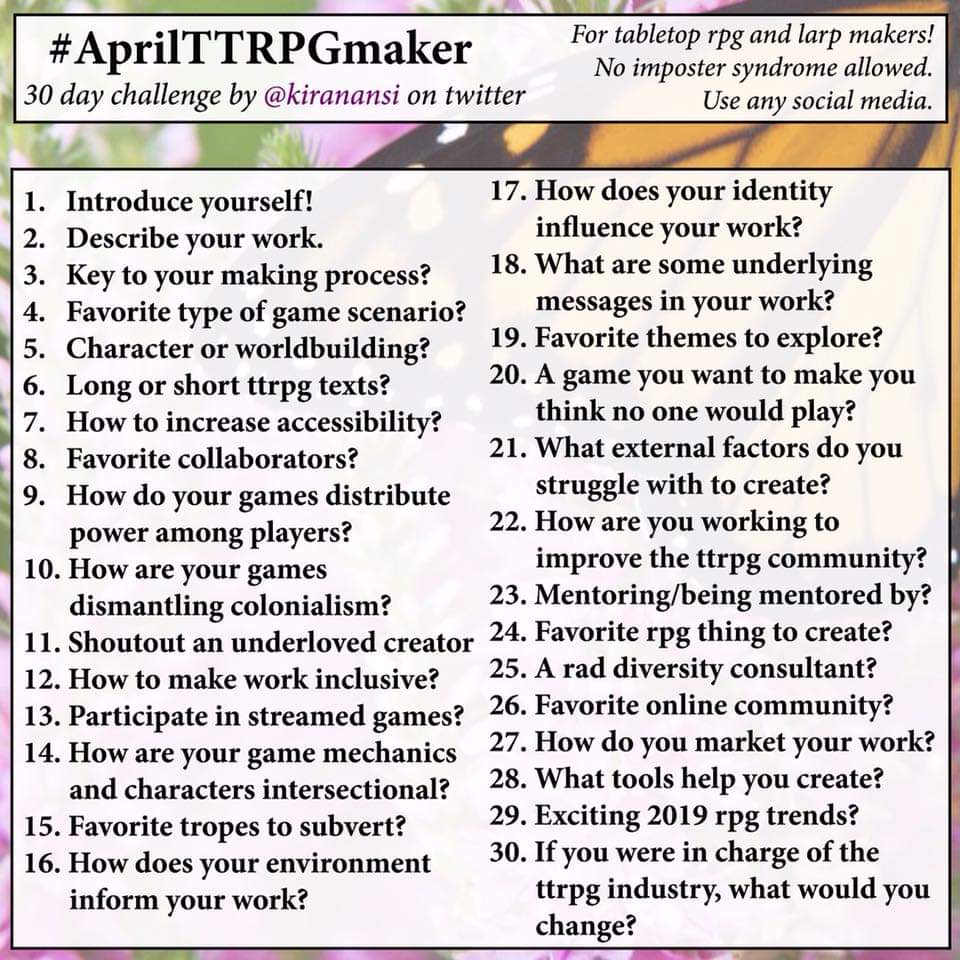
1. Introduce yourself. Hi! I'm Lexi (she/her pronouns). I write tabletop games, and have ever since I was introduced to the hobby. I enjoy hard-ish science fiction, body horror, Pratchetty fantasy, and watching my players come up with off-the-wall plans to tackle problems I never prepped for in the first place. I'm still in my undergrad, which I think makes me one of the young'uns in the OSRscape; my first D&D was 4th edition rather than any AD&D/1e/Red Box variant or derivative, so I come from a very different place than much  of the community. Still, it's a rad community with so much raw creativity and conceptual density (check out Joseph Manola's article on the subject for a very good read), and I intend to stick around for a good long while.

2. Describe your work. Almost all of my work is based on Arnold K's Goblin Laws of Gaming, which I have a handy intro to up in the top bar. My own personal hack (because the GLOGosphere is just a network of content and hacks for home games and personal tastes) is Mimics & Miscreants, which takes a chisel to all the bits of RPGs I enjoy, saws them off, and cements them together into 30-odd pages of dungeoncrawling rules with two pages (ish) of random character generation. Lots of my work is riffs on other people's stuff or conversions of existing content or ideas, but there's nothing new under the sun anyway - especially not in a hobby where the most popular systems are literally reformats of the granddaddies of all RPGs.

3. Key to your making process? I joke about it being coffee, but really it's other people. I'm a classic extrovert, and being able to brainstorm, bounce ideas around, hear what other people think works and sounds cool - this all stirs the pot of creativity that sits precipitously atop the hearth of caffeine within my head.

4. Favorite type of game scenario? To run, I love a good old-fashioned dungeon crawl. Go in, solve the problems, interact with the things, meet strange creatures and talk with them, stab them in the back, roast them over a campfire, and take their stuff. To play in? I'd love a giant hexcrawl where I go through a character every other week and get to explore a vast world full of curiosities and wonders, all the while finding amusing solutions to difficult problems.

5. Character or worldbuilding? I can't build characters to save my life, especially not in advance. I can improvise NPCs okay, and there's a few archetypes I enjoy, but for this question I have to give it to worldbuilding by default.

6. Long or short ttrpg texts? If I have to run it or play it, it had better be well-organized and I shouldn't have to flip through 20 pages of spells or equipment (or god-help-me lore) to find the one option my character has. Large tomes do make excellent coffee table books, and I do want a giant library of interesting core books to flip through on occasion, but ultimately they just don't fit with my game style. Nice heft, though.

7. How to increase accessibility? Figure out how to write your books in a way that players actually use them. I have a laundry list of complaints that I'd love to send to the President of RPGs, if anyone could give me their number and/or address. First and foremost is making character generation something that can be done without reading the whole book back to front, or, (once again god-help-me), something you need an ENTIRELY SEPARATE FAN-MADE PROGRAM to do properly. Also, mainstream TTRPG industry, it'd be really nice if you could release like $5-$10 reference PDFs instead of $40 three-book sets with art and so much extraneous padded text, I'd probably actually recommend buying your books instead of pirating them.

8. Favorite collaborators? I haven't really collaborated with anyone, though from time to time I've helped other people on the OSR discord hash out mechanics and classes. That's probably my favorite group of people to collaborate with - though they're also the only ones I do, so...

9. How do your games distribute power among players? Mechanically, I really dislike dictating power relations among players beyond "you're all equal, chill". Up front, I tell people that there's no PvP, you've got to hammer out disputes between each other out of character if necessary, and you're working as a collaborative team. In play, I try to keep everyone engaged, asking people if they want to contribute to plans, trying to manage who gets the spotlight, etc - it doesn't always work, but I try to foster a cooperative atmosphere, rather than one with winners and losers. Even character death can mean victory, and with quick chargen it's not as daunting as other games make it seem.

10. How are your games dismantling colonialism? Colonialism is a Really Big Thing and I'd be really, really overselling myself if I said that my games were contributing to its dismantling even in the slightest. Still, I try to keep the more problematic concepts that fantasy has unfortunately reified out of my work - no noble savages or other caricatures of racialized communities, no arbitrary restrictions on character gender/ethnicity/etc, no racism/sexism/homophobia/ableism/transphobia "to make it more realistic"... sometimes it amazes me how much there is to be done, but also how easy the first few steps are. From a position of privilege, there are so many simple things you can question and think critically about to start making the world a better place.

11. Shoutout to an underloved creator! My friend T at Dreams and Fevers got me into the OSR, and they've got fantastic takes on history in RPGs. 

12. How to make work inclusive? There's so much that can be said here, and needs to be said, by lots of people who aren't all me, but here's an easy one: stop using "he or she" and "his or her" in your rulesets and just adopt the singular they. It's shorter, flows better, and actually gender-neutral instead of presuming that your readers fit into the gender binary. Perhaps more importantly, put content warnings up front if you intend for your game to cover triggering concepts (like bigotry, and graphic violence, and sex, and sexual assault, and slavery, and drug use, etc...), and talk with your players beforehand to make sure that your game and their expectations are on the same page. Don't force players to participate in something that makes them viscerally uncomfortable; we're all here to have a good time, and sometimes that means that your gritty realistic dirt farmers setting might need to accommodate female knights and treat people with different skin colors equally, or lose your players.

13. Participate in streamed games? Naah. I've started watching LoadingReadyRun's Bylaw and Order campaign, but that's an exception for some content creators that I absolutely love. Generally speaking, I can't get into watching a dozen 3-hour-long videos of a game system I don't enjoy playing in, of a bunch of people that I can't differentiate the voices of. I enjoy building games, and I enjoy playing them in person - watching others do so doesn't have the same appeal.

14. How are your game mechanics and characters intersectional? Off the top of my head, I'm not sure how you'd make game mechanics intersectional (and as someone who's been studying this stuff for a bit, this question feels like it's just throwing intersectionality in as a buzzword, which I really don't appreciate). Systematizing the interactions between multiple marginalized identities feels like something that A: I'm not the right person to do, and B: is something that would go incredibly wrong incredibly quickly, because mechanical reification of real-life oppression isn't something many people who face those struggles on the daily want in their escapism? Character-wise, you'd be hard-pressed to find a straight NPC in my worlds, but that's just because I have no idea how to RP one believably.

15. Favorite tropes to subvert? I really enjoy making gods with moralities that don't mesh with humanity's very well. They care about things, but you can't get the God of Inexorable Progress to help with your tiny little war when there's some really cool evolutionary conditions in deep sea thaumic vents that are going to yield fascinating creatures in a few dozen million years. Also, picking five fantasy races and four classes that aren't humans/elves/dwarves/orcs/hobbits and fighter/thief/wizard/cleric and making a new world assuming that those are the default.

16. How does your environment inform your work? I'm an undergrad double-majoring in cognitive science and queer studies, so questions of how people think and how systems we create work are constantly on my mind. Combine that with having a whole bunch of close friends IRL who are just as weirdly geeky as I am, and I have a lot of off-the-wall setting concepts and content that end up never seeing the light of blogs. Someday they might, if they ever get more fleshed-out, or if I decide to do a big dump of stuff for other people to pick at.

17. How does your identity influence your work? Looking back to #10 and #12, I wouldn't be putting as much thought into inclusivity and diversity if that wasn't something I had to deal with in my personal life. Experiencing institutional shit and growing up in the wild world of boys-club D&D gave me very clear perspectives on what I don't want anywhere near my tables, and the sort of stories that I want to tell. Sorry if this is vague, but I don't like crossing the streams of venting and content creation - I save the word-vomit about my personal life for my Mastodon account and my group chats.

18. What are some underlying messages in your work? Cooperation is more powerful than competition, more things are edible than you'd expect, people come in all varieties whether or not they're immediately recognizable to you, making bad decisions isn't the end of the world, and with great power comes both great responsibility and great potential for misuse at the expense of both yourself and others.

19-30 coming someday! probably April 30th!

Sunday, April 14, 2019

Lexi's Big Bag of GM Tips

Behold: my first theory post! Including lessons I've learned over a decade of GMing everything from D&D 4e to Eclipse Phase to Dungeons the Dragoning 40,000 7th Edition to a half-dozen of my own homebrews. This isn't necessarily all going to be relevant to your games - indeed, very little GMing advice is ever universally applicable (though I certainly have opinions about games that don't do some of these things) - but if you read through this and think even one is kinda neat and worth doing, this post has done its job.
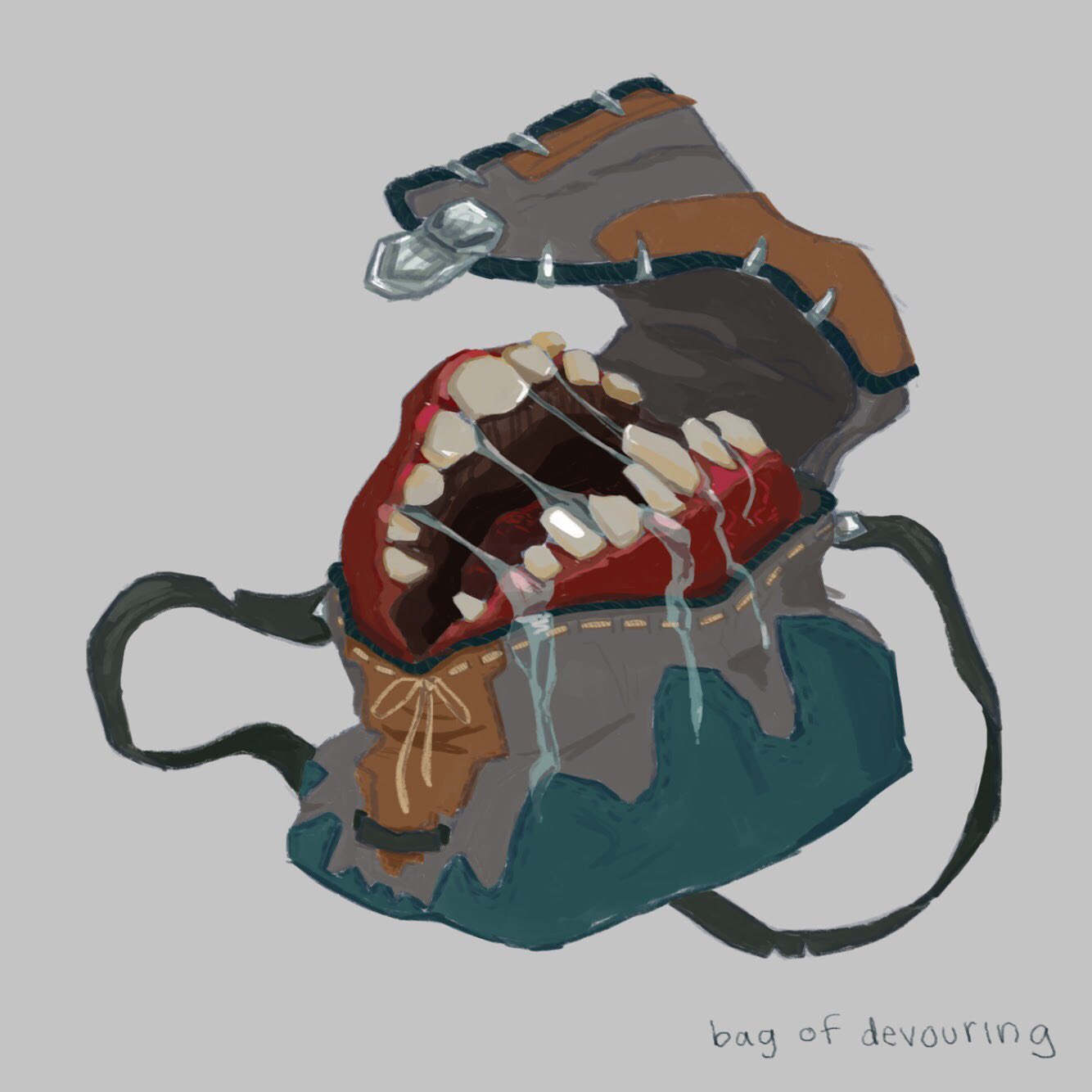
Image result for bag of devouring art
reach in and pull out a tip! i promise it won't bite, i've trained it well
art by Miranda Sider
1. Build your settings to be destroyed. Players tend to wreck things, so create structures that your players will have fun obliterating, or at least trying to obliterate. Make the setting such that you will root for them when they do so. Give them oppressive regimes to topple, or enemy armies to incinerate, or ancient wonders to reduce to rubble. If you can't get them to feel wonder and pathos, at least get them to feel triumphant.

2. Or better yet, let your players do the building. Some players love reading expansive loredocs, making/reading wikis, looking upon your face adoringly as you expound on the minutia of your setting. Most don't care and won't read the 2-page setting doc you send out or hand them at the table. Giving some creative control to the players lets them have some buy-in, gives them a little customization for their characters' cultures and personalities (especially in systems where they'd be rolling mostly-random characters), and gives them something to care about. I like making my players' characters foreigners and letting the players make up where they're from; it saves me tons of setting work and means that I can reveal the setting of the game proper through play rather than giving a big exposition talk beforehand.

3. Talk with your players before the game starts, whether that's for five to ten minutes before the con game starts, or in the group chat where you've assembled your players to schedule games. Get everyone on the same page regarding table expectations, game themes, character death, system options, PvP combat, railroads, etc - and especially content warnings and topics that are unwelcome at the table. So many RPG horror stories have come from players not knowing what's okay to talk about at the table - and while a lot of it should seem like common sense, common sense isn't common, and it's way easier to shut problem players down when you've established guidelines for behaviour beforehand.

4. Rule of Cool. The answer to "is this cool thing in the scene so I can do something cool" is almost always yes. "Is the duke having a meal so I can try to slip poison into his food?" "Does the castle wall have arrow slits I can peek and shoot through?" "Is there a chandelier in the hall that I can detonate and cause mayhem at the ball?" Unless it's patently ridiculous or you've already established something to the contrary, imho, you should let them go for it. When you make rulings (because you're making rulings, not looking up rules - one of my favorite OSR paradigms), err on the side of making players feel good. That doesn't have to mean that they succeed, but it does mean that interesting things happen. Sometimes the coolest thing that can happen is character death. This does mean you have to be on the same page as your players, and understand what they want out of the game, but you should have talked about that already (see prior tip).

5. Chekov's guns are a sometimes food. If it's not going to be mechanically or interaction-relevant, don't put much emphasis on it - and when you do emphasize something, let the players use it. This is mostly regarding setting and plot info - if there's twelve noble houses and only two are relevant in the next few sessions, leave the other ten out of your description to the players, even if you've built them ahead of time. If the players want to ask, then give them the loredump - but too much information just causes decision paralysis and drags them away from whatever you've prepped. On the other hand, if you describe a granary tower in the bandit camp, let the players blow it up to cause a distraction; don't force them through fighting twenty bandits.

6. Handwave things. You do not, cannot, and should not, try to explain everything away in lore-friendly ways, because that does not work. I have spent literal days of my life arguing with other GMs about where to put teleportation circles in settings so that characters can move between parties if their players want to try a different GM for a week. I have seen dozens of stories online about how a GM took control of an absent player's character, or gave the character to another player, and killed the character while the player was absent. If a player is absent, just let the character not exist for a bit, don't explain it, don't justify it. Verisimilitude is valuable, but when you try to explain real-world phenomena with in-game logic, you're just making it harder on yourself.

7. Don't try to fix out-of-game problems with in-game solutions. Talk to your players. Make your expectations for their behavior clear. If two players have beef with each other, or someone has issues with you, speak with them about it outside of the construct of the fiction. You're all there to have fun, so if someone isn't having fun - or if someone's idea of fun is making the game unfun for others - something is going wrong. Ask the players who are having problems what's up, and mutually figure out a solution that works for all parties involved, without the pretense of verisimilitude or the rules of the game getting in the way. Also, consider if you might be the problem; not all players are up for all games, and if they're not having fun because of the game you want to run, you either need to run a different game or find players who're up for what you're running.

8. Put your characters somewhere they're going to be doing interesting things. Too many settings I've seen (currently my big pet peeve is Lancer) have so many cool ideas, and all of them are secrets to virtually any PC that'd be created, and wouldn't be revealed until well into a campaign. If there's fun stuff you want players to interact with, give them a chance to do so when the game starts, even if they don't grasp the full scope of the conspiracy, or explore the depths of all the multifarious demiplanes, or whathaveyou. Put cool stuff everywhere, and don't worry about "balance" or "level-appropriate rewards/enemies/phenomena". If you want your players to explore the City of Brass and make enemies with the djinn, don't save that for level 7 when you're starting the game at level 1 - put them in the City at the start, because at worst, even if the campaign collapses early, you've gotten a chance to play with the cool stuff too.

9. Encourage bad decisions. It's in the tagline of Mimics & Miscreants for a reason, and I wholeheartedly believe that making bold, risky, bad decisions is the heart of how I enjoy RPGs. Payoffs are all the sweeter when you've risked everything to get there, and surviving a dungeon has meaning when some characters didn't make it out. Note that that doesn't mean make every test a one-in-a-hundred miracle to pull off - that discourages bad decisions; too much risk will only make players want to do everything the safe and boring way. Instead, let players get themselves into hot water by taking actions that'll definitely work, and definitely have bad consequences, but might (might!) work out in the end if they're smart and play their metaphorical cards right.

10. Accept that your game will probably end prematurely. There's few things more disheartening than a campaign petering out because of scheduling conflicts, players getting bored, or the GM getting bored - but I've been in very few campaigns that've ended with a bang rather than a whimper. This doesn't mean the game is a failure! It just means that you need to plan shorter-term, and ensure that there's good content from start to finish, so that everyone comes away feeling like they've accomplished something even if the campaign never makes it past session 3 or 4.

Most Recent Post

Mothership: Alternative Trauma Responses

My current weekly drop-in game of Mothership: Gradient Descent is now twelve sessions and thirteen characters deep. The extant four (or six,...