Pages

Showing posts with label worldbuilding. Show all posts

Tuesday, July 8, 2025

Facility: Departments & Factions

On a good day, everyone in the Facility is in the same org chart and on the same payroll. Today is not a good day.

When all hell breaks loose, the Facility splinters along departmental and sectoral lines. Off-shift Research personnel in Residences band together with Facility Services to barricade the doors and wait for outside rescue; Kappa teams raid Archives to identify priority targets and start cleaning house, Lambda Containment Research abandons their rampaging experiments and rushes to the eyewash stations, then the bunkers, with covering fire from Security. Under the Facility’s full-scale lockdown protocols, paranoia sets in immediately, resource scarcity soon after, and mad science competes with occult ritual for third place.

Roll at least twice on the Departments list to populate a faction, then again on the Common Cause list to determine their highest priority.

When populating factions with characters, include at minimum an overall leader, and one key NPC from each constituent department. If the same Department appears on multiple factions, you have a good old-fashioned intradepartmental schism.

Departments (d66)

  1. Administration
    1. Executive
    2. Accounting
    3. Human Resources
    4. Procurement
    5. Archives
    6. Legal
  2. Operations
    1. Dispatch
    2. Public Relations (REMINDER: circulate memo re. “cover-up” vs. “conspiracy”. while we perform the former, we are NOT the latter)
    3. Internal Affairs
    4. External Affairs
    5. Field Operations “Delta Teams”
    6. Kinetic Field Operations “Kill Kappa Teams”
  3. Research
    1. λ Containment Research
    2. Theoretical Research
    3. ΧΨ Off-Site Monitoring
    4. Facility Architecture
    5. Entity Research
    6. τ Artefact Exploitation (I’ve scheduled a brainstorming meeting in D-04 at 9:15 EST. The extension is -0451 for anyone who wants to call in and pitch a less ominous department name.)
  4. Facility Services
    1. Canteen
    2. Medical
    3. Custodial Services
    4. Warehousing
    5. Maintenance
    6. Information Technology
  5. Containment
    1. μ Facility Security (Just let the mundane guards have a letter like the real artefact security teams. I know it’s not in ACID, but we have enough turnover in the security department already.)
    2. π Artefact Security
    3. ρ Dedicated Containment (ATTN Research: Medical won’t give their sign-off on team-wide blinding, even if you call it a team-building exercise. Procurement has sent over a crate of blindfolds instead. Optical hazards are a solved problem. Please stop asking.)
    4. Entity Handling
    5. Subject Management
    6. Inhuman Resources
  6. Other
    1. Joint task force between Facility and a rival agency
    2. Test subjects, human
    3. Intern pool (Not to be confused with the contents of Lρ3211.001, the “Intern Pool”, until IHR clears it for Tau reclassification)
    4. Rival agency task force, organized incursion
    5. PΧ organized Entity incursion
    6. Oversight (I finally got permission to include them on the org chart. Please clap.)

Common Cause (1d20)

  1. Allocating scarce resources.
  2. Contacting outside world for aid.
  3. Contacting another Facility for rescue.
  4. Contacting another Agency for cleanup.
  5. Contacting an Entity for inadvisable reasons.
  6. Containing a dangerous artefact.
  7. Protecting the outside world from further breaches.
  8. Returning the Facility to working order.
  9. Re-establishing pre-Incident chain of command.
  10. Performing forbidden research.
  11. Under the effects of an artefact.
  12. Started a cult dedicated to an artefact.
  13. Infiltrators from (1. a rival agency, 2. the local government, 3. conspiracy message boards, 4. an artefact liberation front, 5. an artefact cult, 6. another world)
  14. Escaping the Facility at all costs.
  15. Escaping the Facility with as many survivors as possible.
  16. Escaping the Facility once everything has been contained.
  17. Leader maintains control over fractious group with pre-Incident credentials.
  18. Leader maintains control over fractious group with access to scarce resource.
  19. Leader maintains control over fractious group with artefact.
  20. Silencing all attempted escapees, both mundane and anomalous.

Sample Factions

Foodbank
In order to generate enough food for the population of the Facility while under indefinite lockdown, a special project team (36) has teamed up with the canteen staff (41) to identify, mass-produce, and distribute (1) the byproducts of nutrient-dense artefacts. So far, they’ve converted a laboratory into a hydroponic garden for anomalous flora and produced ludicrous quantities of a nutritious anomaly they call The Stew, which they trade for the ammunition they need to prune their garden.

Rho Containment Team WDH “We’re Done Here”
A dedicated containment team for an escaped Rho artefact (53), having suffered horrific losses during the breach, has defected to Rival Agency forces that are storming the upper levels of the Facility (64). The Rho team is providing the Rival Agency with insider knowledge on artefacts and layouts in exchange for the tools to avenge their fallen team members during the cleanup effort.

Director Forthright
Immediately in response to the breach, Director Annabel Forthright of External Affairs (24) assumed control of the Monitoring team (33) to use their satellite surveillance tools to assess the scope of the incident. She now leverages her credentials (17), the loyalty of the remaining External Affairs personnel, and the Monitoring team’s fears of reprisal to monopolize all data going in or out of the Facility to make herself the logical choice for Facility Director once the breach is resolved.

E4 (Emergency Executive Entity Enterprise)
Members of the Facility’s Executive branch (11) have identified specific entities under the purview of the Entity Handling department (54) as critical to enforcing their authority (9) against rival agencies, dissident elements within the Facility, and the most dangerous artefacts in the Facility’s depths. They’re now engaged in a high-stakes game of Pokémon; attempting to recapture and weaponize every anomalous entity they can find in their files.

UTILITY
In response to incursions from within and without the Facility, Accounting (12) has decided that an ongoing partnership between a Delta Team and a rival agency’s counterpart (61) is the model for a new era in artefact containment. By demonstrating the efficacy of inter-Agency intelligence sharing, reasonable bipartisan consensus, prudent spending, and common-sense containment regulations, the UTILITY framework sets out principles for an agile, small-Facility era of global security (7). Now they just have to build it.

The Party
The few survivors of the epicentre of the breach (the Lambda laboratory sector) have formed a motley gang of liberated test subjects, Esoteric Assets, and disgruntled maintenance workers. Despite their average Clearance level of 0.5 out of 10, lack of scientific or administrative expertise, and minimal weaponry, their broad variety of expertise across mundane and anomalous fields may just be enough for them to reach the outside (2) and contact their grieving loved ones — if there’s any outside left to reach. 

Monday, July 7, 2025

Facility: Artefact Classification

 The Facility is a megadungeon that contains a wide variety of anomalous artefacts and player characters. At approximately the start of the campaign, an incident occurs and reliable containment can no longer be guaranteed. Once lowly assistants, security guards, maintenance workers, and test subjects, the player characters must explore, salvage, improvise, negotiate, and kill to survive until rescue arrives.

Artefact Classification Identifier (ACID)

The Organization likes to think it takes paperwork seriously. Within the Facility, artefacts are assigned an identifier based on their Mode, Status, and a unique two-part numerical designation (for example: Oρ0255.018, LΔ0023.001, Eτ0994.999). This identifier is listed on all associated paperwork, both the outside and inside of the artefact's containment cell, as well as label stickers on all samples, byproducts, and research team files regarding the artefact in question.

Mode

The Mode is a Latin letter that describes the artefact’s scope and mobility. The Organization currently recognizes five Modes
O: Object
The most common classification. Some objects can be left in a properly secured box (consider: radioactive waste); some objects are world-ending threats (consider: a dinosaur-killer asteroid). Most are somewhere in between.

E: Entity
Anomalous creatures, swarms, people, ghosts, etc. When there’s debate between what’s considered an Entity or an Object, Research considers its nutritional requirements, mobility, and stimulus responses. For the GM: if you’d stat it up as a monster, it’s an Entity. If not, it’s an Object.

L: Location
A physical space with anomalous properties. Some are very small and can be cordoned off without much trouble; larger locations require extensive Public Relations disinformation campaigns and/or the construction of specialized Facilities. While alternate dimensions are Locations; their entry points are sometimes classified as Objects, Phenomena, or even Entities.

P: Phenomenon
Anomalous events occur that are not related to specific Objects, Entities, or Locations. A spontaneous anomalous gathering, a UFO sighting, a memory hole, a disease with no known vector but anomalous symptoms, an unnatural weather pattern — these are all different Phenomenon artefacts. Correctly identified and unfairly lambasted as a wastebasket taxon.

C: CLARAA (CLAssification Requires Additional Analysis)

Correctly identified and fairly skewered as a wastebasket taxon, but one that fulfills an essential function: a placeholder in the Mode field on forms while no one knows what they’re dealing with.

Optimistic researchers regularly submit proposals to reclassify the Organization’s entire artefact catalogue into a novel series of ostensibly-more-rational Modes. These proposals are regularly rejected by tired administrative staff.

Status

The Status is a Greek letter that corresponds to the artefact’s current containment requirements. I have listed ten, which leaves 13 more for enterprising GMs to fill out. Status does not directly correlate to danger. The combination of uppercase and lowercase is intended to maximize the difference between Greek and Latin shapes given the choice of letters.

π Pi
Reliably contained with passive countermeasures. It’s in a box — maybe a big one, but not one that anyone has to check on unless something goes wrong.

ρ Rho
Reliably contained with active countermeasures. Active guard rotations watching a portal, entities that need to be regularly fed and watered.

λ Lambda
Temporarily contained; research into reliable containment underway. Lambda labs are the throbbing heart of most Facilities.

τ Tau
In active use by the Organization. Locations converted into Facilities, artefacts critical to the containment of other artefacts, entities on payroll.

Δ Delta
Containment efforts are ongoing; situation subject to rapid change. Field agents handle Delta artefacts until they’re handed off to a Lambda team. During a containment breach, all artefacts on site are subject to Delta procedures until a Research Lead signs off on paperwork confirming successful recontainment.

Κ Kappa
Cannot be safely contained, monitored, or left alone. Disposal is necessary. Heavy weapons are authorized.

β Beta
Contained by another Organization. Secondary classifications are occasionally awarded to Beta artefacts, but due to significant political and ideological conflicts between Organizations, data is usually insufficient.

Ψ Psi
Externally monitored, uncontained, further containment efforts unnecessary. UFOs are Psi until they crash or start abducting people.

χ Chi
Not contained, but containment is not a priority. Cryptids are Chi until they start eating more people than Public Relations can explain away.

Ω Omega
Disposed of, dead, finished, gone. Records are stored in Archives in case it shows up again.

Class

When combined, Mode and Status are referred to as a Class. For example:

  • Eτ Esoteric Assets are under the purview of Inhuman Resources; this is where anomalous individuals on payroll are siloed — alongside various other useful entities, like the Anti-Radioactive Barnacles and Digit the Numbers Station Dog.
  • The Organization’s largest containment sectors are warehouses for Oπ artefacts, which require minimal personnel after setup. Some O-Pi artefacts don’t even need bespoke containment cells; they just need to be isolated until they arrive at their temporal origin point, their legitimate owners come to claim them, they finish dissolving into inert mundane chemicals, the Organization figures out how to weaponize them, or the heat death of the universe.
  • PΩ refers to events and phenomena that have ended and are not expected to recur. After the mandatory 18-month monitoring period (subject to change based on established periodicity), everyone involved is more than happy to shove another case file into the capable hands of Archives Division.
  • Lρ location artefacts often necessitate the construction of on-site Facilities due to an observed tendency for other artefacts to manifest nearby or within their confines. Some are even reclassified as Lτ if their anomalous properties are useful in further containment efforts.
  • CΚ artefacts are Research’s worst nightmare. Uncontainable due to their level of danger, unclassifiable due to their uncontainability, handed off to Operations’ ludicrously well-equipped and violent Kappa Teams. Archives has entire bankers’ boxes of CΩ files with incident and cover-up reports that are mostly black marker by volume.

Admin hates the concept of “secondary classifications”. Researchers who insist on marking up new files with meaningless Status strings like τΨρ or χΔ  are reprimanded and forced to attend mandatory classes on how to not waste Oversight’s time.

Numerical Identifier

The first part of an artefact’s numerical identifier is a unique four digit number that distinguishes the artefact from others in its class. When an artefact is reclassified, its ID number may have to change to avoid conflicts, and tracking ACIDs across multiple reclassifications (especially if a new artefact fills its previous slot) is a well-known administrative headache.

The second part of an artefact’s numerical identifier is a unique three digit number that tracks the instance of the artefact. For example, if a flock of thirteen anomalous birds is contained, they receive IDs XXXX.001 through XXXX.013. If one lays three eggs, the eggs become instanced as .014 through .016, and retain those designations after hatching. If one of the birds dies, its instance ID is not reused.

Some artefacts end up with more than 999 instances. The paperwork to add additional digits to an identifier requires sign-offs from Archives and IT, and so many artefacts end up with dozens or hundreds of instances sharing 999. Researchers regularly raise the alarm that this will lead to catastrophic breaches, but so far no administrative action has been taken.

Research teams nickname their artefacts, because the ACID is a mouthful intended for databases rather than human speech. There are no formal conventions or best practices for artefact nicknames, which causes all the problems you would expect — nickname duplication, inappropriate names (disciplinary action recommended), fist fights in the sector canteen (disciplinary action taken), and misleading nicknames that have nonetheless stuck (latest casualty report for Eρ0443.001 “Li’l Buppy” is on file in Operations).

Designer Notes

Everyone has tried to come up with a new classification system, or fairly decided that it’s a bad idea. I wrote the ACID with an eye towards gameplay; to provide players with actionable intelligence but leave details to further research. A π artefact is not going to end up on a random encounter table while its containment holds, so players can probably rest near it without incurring additional dangers. An empty containment cell marked “Eρ” lets the players know there’s something on the loose, though they’ll have to do proper legwork (or get jumped by it) to figure out what. Several of the stranger Status classifications raise immediate questions:

  • Beta — “Whose is this, and how can we contact them to learn more?”
  • Kappa — “Where is it right now, and how do we get as far away from it as possible?”
  • Tau — “What were we using it for, and can we get it back under control?”
  • Omega — “What do the old files say about it, and how do we get to Archives?”

Friday, January 31, 2025

Six Flames

Ghastflame

Burn corpse wax to create the sickly green ghastflame. Its wisps map out faces of the dead and damned, which it invites to the flame like moths. Light from a ghastflame torch reflects off past deaths and reveals the fates of those who met untimely ends, like bloodstains in Dark Souls.

A ghastflame bonfire will become haunted by unquiet spirits, take a horrid amalgamated form, and attempt to fulfill their many conflicting desires. This ghast sets fires to all it touches, though these new fires are not ghastflame unless they burn more corpses. After a ghast’s fuel runs down, it becomes a will-o-wisp and seeks out new victims or corpses to burn.

This is why you don’t set bonfires at old battlefields.

Ghastflame Lantern: The glass in this lantern is silvered to prevent the lantern from becoming haunted, and has shutters to conceal the flame when the sights of shades of the dead would be inconvenient. If the glass breaks, it’s just large enough to become a will-o-wisp, so be careful!

Corpsewax Torch: A single corpse provides just enough fat to render into a single torch of corpsewax. While any spirit will take the chance to haunt a lick of ghastflame, the spirit of the person whose corpse was used takes precedence. Spirits prefer corpsewax of a similar age to them when they died, and some palaeoalchemists have claimed to have created ghastflame from burning fossils.

Deeplight

Torchmoss secretes an oily coating that both burns well and protects the moss from its own dim green flame, called deeplight by dwarves and goblins. As the moss matures, it turns from a deep green to a rust red, at which point it has been saturated with its characteristic oils. Mature torchmoss will hold a flame for as long as it remains fed with mineral-rich water.

Many dungeon environments are ideal for the cultivation of torchmoss, as condensation drips from the ceiling to feed torchmoss colonies on the walls. This provides the dim ambient light so prevalent throughout cave systems, ancient ruins, and city sewers.

Torchmoss oil is currently in high demand as a skincare product, which makes fashionable nobles surprisingly flammable. 

Terrarium Lantern: This terrarium holds a small colony of happy and well-fed burning torchmoss. So long as the moss is fed with mineral-rich water, the terrarium will give off dim light indefinitely.

Balefire

Burn your own living flesh to create the balefire, a black and smokeless flame of sacrifice. It casts shadows rather than light, and holds a rough shape when cast off. You cannot burn another’s flesh to create balefire, only your own — it gains its power from sacrifice.

Balefire inflicts an additional 1d6 damage to those it burns for each point of damage it inflicts to you, and can be thrown like a projectile. A chunk of living flesh cut from the body will still burn with balefire until the blood dries. Burning silk also gives off balefire, mystifying philosophers, alchemists, and theologians alike.

The esoteric martial school of the prophet Abnegatus teaches the use of balefire as a method of simultaneously casting off the trappings of the flesh and destroying their enemies, creating sacred balefire that mortifies the flesh rather than cauterizing it.

Thief’s Caul: A long silk veil that burns with balefire. While it burns, it casts shadows that obscure the wearer while permitting them to see in the dark as if they had a lantern. It lasts for 10 minutes or one exploration turn, at which point it must be discarded lest its flames consume the wearer’s face.

Frostflame

Frozen vegetation burns ice-cold with frostflame, a milky-white fire that cannot be extinguished with water. When lightning strikes a frozen forest during a blizzard, the resulting frostfire burns the entire forest to an icy crisp. The ash left behind is fine and slippery, creating shallow seas of fine crystalline particulates in the tundra.

Once started, frostfire still burns traditionally flammable fuel sources and scars flesh with glassy frost-burns.

Frigid Lantern: Frostflame lanterns throw an unnatural chill across all that their light touches, making them ideal for refrigeration on long caravans or protection from dangerously hot environments. They consume more fuel than mundane lanterns, and if a frostflame goes out it’s very difficult to restart without environmentally-frozen kindling.

Bladefire

When you burn magic items, they give off a colorful flame that mimics the color of the item's magical effect. This is how you make flaming swords, which has led to the effect’s common  name of bladefire (much to the chagrin of wizards everywhere). Setting bladefire is also a popular way to identify the properties of magical items, as it burns slowly enough to prevent serious damage to the item during the identification process.

Items wholly burnt away with bladefire leave behind a sparkling magically-charged ash called residuum, which can be snorted as a magical accelerant much like ground wizard teeth (+1 temporary magic die or spell slot, 2-in-6 chance of addiction, horrific long-term health effects). Enchanters love residuum for more practical reasons, as it’s easily worked into new magic items during the forging process and can even transfer the previous item’s properties into the new one.

Wizard corpses burn with the silent, violet Killing Flame.

Flaming Sword: +1 to hit. Ignites with red-orange bladefire once you’ve dealt damage with it, and inflicts an additional d6 fire damage while ignited. The fire burns out at the end of a round in which you haven’t dealt damage with the sword.

A flaming sword's ignition condition determines the color of its bladefire. Knights, lords, and even entire armies take great pride in signaling their value systems through their flaming weapons' hues.

Sacred Flame

Burn holy items to create an entrancing and golden sacred flame with light soft enough to look upon directly. This fire burns until it exhausts all atmospheric divinity in its surroundings, then burn the divinity within their own fuel. Sacred torches last longer when held by a believer, and prayers feed it like oxygen feeds mundane fire.

A believer’s flesh may produce sacred balefire, while their corpse burns with holy ghastflame. I leave the effects of these flame as an exercise for both the reader and my future self.

Altar Candles: Bees fed on syrup made with holy water produce the sacred beeswax necessary to produce Church-standard altar candles. These candles burn indefinitely in a sufficiently holy site.

Reliquary Lantern: This lantern is made of stained glass and contains a relic, creating a microchurch with an internally sustainable sanctified environment. The relic produces divinity at a sufficient rate to fuel a small sacred flame, preventing the flame from burning the relic itself so long as the lantern remains intact. If containment is breached, the divinity will dissipate into the surrounding environment and the flame will consume the relic if not immediately fed with prayer.

Sunday, January 19, 2025

Magic Hexcrawls

Magic: the Gathering is fertile ground for hexcrawl generation.


Grab a Commander deck. If you know what MtG is, you either have one or you have strong opinions on why you don’t. The 100-card deck should have approximately 35-40 land cards, with the rest as various types of spell. Shuffle the deck, including the commander card.

Reveal cards from the top of the deck until you reveal a land card. Stack all those cards underneath the land.

Then, repeat this process to create another pile beneath that land card. Continue until you’ve completed a column of several piles, then start another column staggered half a card-length lower.

Make the next column start at the height of the first column, and continue making columns in this way until you’ve run out of cards in the deck.

In front of you there should now be nearly 40 land cards, each covering between zero and many spell cards. Each land card is a hex, and each other card beneath it represents a feature of the area — perhaps a roving creature, a band of NPCs, a strange weather effect, a structure, or a piece of loot.

Take the pile of Plumb the Forbidden, Fiend Hunter, and Sun Titan beneath the land card Command Tower -- a daemon-hunter seeks the forbidden secrets of a tower from which a giant rules the surrounding hexes with an iron fist. The Access Tunnel hex to its northeast has, among other things, a secret entrance to the lowest levels of the tower, while the Battlefield Forge to the north is a titan-scale armory where the Sun Titan smiths its great weapons. Local soldiers make pilgrimages to worship its martial prowess at the Temple of Triumph (though as no other cards were revealed beneath the Temple, it's the off-season and no one's yet in town), while the Bloodstained Mire to the south lies unquiet as a memorial to those who once attempted to resist. The two mountain hexes to the southeast make up part of a long mountain range, and the Caves of Koilos to their north/northeast delve deep within their hearts.

Legendary cards like your commander are fertile ground for quests, faction leaders, rivals, or villains. Instant and sorcery spells are well-represented as events — a Murder is a recent murder, a Lightning Bolt a recurring storm, a Wrath of God an ongoing inquisition.

If there’s a pile of 4 or more cards in the land, put a settlement there. Lands with names that mention settlements aren’t necessarily populated; a Nomad Outpost with no other spells might be abandoned.

Land art can also inform the contents of a hex. If it’s one of the Ravnican lands that depicts a swathe of the plane’s ecumenopolis (such as the Boros Garrison or Rakdos Carnarium in the sample map above), perhaps place it within the ruins of an ancient city. The Clifftop Retreat has a massive statue, so it's the petrified body of another titan that the Sun Titan knew, loved, and lost to powerful magics.

Think about the material relationships between the places that have developed this way. Where do the numerous denizens go for their needs? Most commander decks play at most three of the five colors in Magic, so what’s missing from this landscape? What’s scarce, and therefore valuable?

Use creature cards in the deck (and any tokens they may make) to inform random encounter tables. You could even shuffle them up and draw from an impromptu deck in lieu of a conventional table.

Most commander decks play the card Sol Ring. That means it’ll show up in a disproportionate number of these hexcrawls. Here’s some GLOG rules for it.

Sol Ring
Ancient starlight woven into a silver torus too large for any mortal’s hand. It hums with the music of the hemispheres.
This ring provides +1 Magic Die. It emits starlight that glows through any layers of clothing or magical concealment, as well as an unmistakable static hum that cannot be silenced.

Tuesday, February 28, 2023

GLOGSTAR Pirate Missions

 The Interstellar Regime controls the trade lanes that tie the galaxy together, perpetually threatening violence against the neighboring Empyrean Bureaucracy. The Rebel Militia seeks any advantage they can to free the galaxy from the Regime's tyranny. In the midst of this conflagration, pirates find ample opportunity for profit, snatching prizes off of trade routes, threatening worlds with destruction if they fail to tithe, battling privateers across the stars in epic tales that are sung and embellished in a thousand spaceport bars. You are a pirate captain - fearless, merciless, and willing to do anything to make a quick buck.

by unccleulty

PIRATICAL MISSIONS

  1. The once-thought indestructible treasure ship Navigator's distress beacon has been recovered by the Intrepid Factor. It carries a black box that includes, among other things, its coordinates, deep within the wartorn Hyades Cluster. You have been granted exclusive first rights to plunder and salvage the Navigator, so long as you give the Factor exclusive information on what wrecked it and ensure that no one else aboard survives to tell the tale.
  2. A bulky trade fleet from the Empyrean Bureaucracy travels along the Kochab Corridor, a trade lane just off your primary hunting grounds. Your fellow captain, the Brazen Buccaneer, has already embarked with his fleet to take them as his prize. Hours after he entered a communications blackout to conceal his location, the Intrepid Factor notified you that new intelligence reveals this trade fleet to be a honeypot, and an Empyrean fleet under the command of their Bureau of Naval Intelligence lies in wait to ambush any pirates that take the bait. Can you ambush the ambush before you're ambushed yourself?
  3. The Regime has bought out a half-dozen pirate Free Crews with letters of marque signed by the Pompous Admiral himself. These newly-minted privateers know all your hideaways and secret warp-routes, and they've already sent a dozen captains to the prison world of Kraz IV. Simply killing the Admiral won't stop the crews - you'll need to kidnap and ransom someone important to force him to invalidate those letters of marque with his own hand.
  4. El Space Presidente, deposed from his benevolent rule of the Glorious People's Republic of Meridiana VII, sulks with his government-in-exile on the airless mining colony of Algol IX! The Grim Warlord sees an opportunity where most see despair - backwater colonies make for excellent pirate ports. Gain El Space Presidente's trust and ensure safe harbor for other Free Crews, but be cautious: the Presidente is a proud man whose sights are set on one thing alone: Meridiana VII.
  5. The Craven Commander, formerly of the Regime Starfleet, has deserted and started their own pirate operations out of the Tarazed Nebula. Their advanced sensors and drives allow them to operate in the electromagnetic cloud where you're blind and slow - it would be an incredible coup if you could somehow lay your hands on these technologies.
  6. A civilian fleet of supply ships is en route to relieve the heavily industrialized world of Mu Cygni III, in the throes of a devastating series of gravity-quakes. It's a wonderful prize, but this juicy target is guarded by a rare (and tenuous) ceasefire between vessels from both the Rebel Militia and the Regime Starfleet, each of whom want to be seen as the real saviors of the planet's populace.
  7. Pilgrims make their annual journey to the holy world Cygni IX, carrying relics sacred to their schismatic sect of the Church of Celestial Intelligence. Pilgrims are traditionally easy prey, but their sect is militant and flies upgunned one-man starfighters in ecstatic trances with divine speed and precision. Some of the ships and guns themselves are the relics, too, so destroying them isn't an option - and boarding means fighting their holy men, whose light-swords cut through armor, flesh, and (some say) the soul. However, if you took their ships, you'd have their Celestial relic weapons for your own...
  8. The Empyrean Bureaucracy is funding a new privateer campaign. So is the Interstellar Regime. Double-dipping is a time-honored tradition among the Free Crews, and until their myriad bounties on each others' ships expire, everyone in the sky is shooting at everyone else and dragging their hulks back to forward outposts for money. Its a free for all up there, and even the dirtiest tricks are legal.
  9. The Grim Warlord grows restless. The Throne of Hulls leaks and groans. She demands more hulks to add to its bulk, and has her sights set on some truly vast automated colony ships that failed in their ancient mission to settle the (apparently nonexistent) garden world of Hadar III. How do you disarm, dismantle, and recover something the size of a small moon? What happened to them and their sleeping populations at the absent world?
  10. The fall of the DARK EPOCH battlestation around the Monocerotis black hole has not gone unnoticed. Vast bulks of scrap and hypertechnology are ripe for the harvest - at least, until they're devoured by the very black hole it was built to exploit. Every independent scavenger in the sector, plus Naval Contract Corporation cleanup fleets, have descended on the wreck to do the exact same thing.
  11. Legends of the Worldvault, a vast xenogen treasure-planet, have always been a fool's errand to pursue. But now, the Dreaded Dominus claims he's found it, and has returned to the Throne of Hulls with a map to an uncharted point in the Triangulum Nebula and a cache of weapons of clearly alien design. If he's right, and the Worldvault is as the rumours say, he'll become the greatest pirate king in history and bring all the Free Crews to heel with his iron augmetic fist. But if you can get there first, that power may be yours to claim...
  12. Your last offense was too egregious to go unpunished, and so a fleet of the Interstellar Regime's finest warships under the ostensible command of the Pompous Admiral flies to quash the Independent Stronghold around the Sheliak protoplanetary disc. Turn the fleet back, whether by force of arms, cunning, or diplomacy - or lose one of the last free ports near Regime space.
  13. A new colony ship is settling Leonis V, a mineral-rich world near the Azanar Way, a major trade lane you prey upon. Teach them the nature of business around these parts by demanding their first tithe (of many going forward), but take care: their expedition was funded by the merciless Obdurate Marquess, and the colonists are hardbitten veterans of a dozen wars all armed to the teeth.
  14. The Grim Warlord has given tentative sanction to the Impulsive Intellect's latest design. The Intellect believes new research permits a short-range "hyperbreach" weapon that can abduct ships right off of trade lanes for easy plunder, and has constructed a working prototype on a safely uninhabitable nameless dwarf planet in the lucrative Dziban Sector. Test the weapon however you see fit, but don't bring it back unless you have conclusive proof that it's safe and cost-effective.
  15. A one-of-a-kind collection of Old Earth relics is being moved for the first (and likely only) time this century, traded from the Megarich Mogul to the Paranoid Plutocrat. The security corporation Volatex is responsible for the relics' transportation, but an insider, the Audacious Aspirant, has leaked the route to you so they can profit at its expense. Volatex has spared no expense in the defense of the relics, but their planned path takes them near the Gamma Velorum supernova and its total scanner blackout. It should be a by the book  raid - hit the delivery, take out the escorts, and recover the cargo unharmed - assuming you've been told the whole truth.
  16. Two wealthy pirate captains, the Dreaded Dominus and the Brazen Buccaneer, each accuse the other of planting traitors within their ranks. Their fleets have simultaneously docked at the Throne of Hulls, and their crews have already come to blows aboard the station several times. The Intrepid Factor demands you use your formidable reputation to mediate between the two, as the Grim Warlord is away on a therapeutic pillaging retreat and would rather her favorite station not be trashed in her absence.
  17. It's time for the semi-annual "recruitment drive"! The Regime's Naval Contract Corporation is hosting an opulent dedication ceremony for a new line of vessels hot out of drydock at the Raselhague IV shipyard ring. Interrupt the festivities, board the targets, and swashbuckle your way out of the system aboard some fancy new vessels.
  18. The megacorporation Solintel has decided to disrupt the piracy industry by hiring gig workers as bounty hunters to "enforce smuggling regulations" on ships traveling outside Regime-sanctioned trade lanes. Your supply of easy prey has dried up. Show Solintel what real disruption looks like, right above their Agitated Executive's regional branch headquarters on the third moon of Achenar VII.
  19. The Impulsive Intellect's latest development is going to get him killed. He cultivated a true AI, the Credulous Cephalon, and installed it into the crude matter of a gun. The gun, naturally, has become a triumph of engineering capable of truly apocalyptic devastation. The Celestial Intelligences don't want any competition, no matter how revolutionary this feat of microcomputing is. Now a hunter-killer dreadnought, the Rapacious Warmind, is blazing a path through inhabited space right to the Impulsive Intellect's front door - which also happens to be your home station. Protect him - or at least protect yourselves.
  20. The Pirate King of Space, at the helm of his Formidable Flagship, has returned to the Throne of Hulls. Or, at least, someone is claiming to be the Pirate King, and is flying a vessel that looks (and kills) a whole lot like their old, terrifying hulk. The Grim Warlord claims she killed the old bastard on the steps of the Throne, took command of the Free Crews, and banished their whole crew to the farthest reaches of the Triangulum Nebula - but is there more to her story? Will you back your Warlord, or throw your weight behind (potentially) the most dreaded pirate ever to sail the seven skies, who says that even death could not defeat them? Choose swiftly, for neither will wait for you to fully investigate the matter.

Monday, May 23, 2022

Deep Space Bitches: Starships and the Haunted


Space travel is easy, cheap, and essential to modern interstellar civilization. Millennia have passed (give or take, considering relativistic time dilation and various calendrical resets) since the act of boarding a starship to worlds strange became as mundane as waiting in an airport. That said, most don't travel often. While gatespace has ensured that known space can be crossed in months rather than centuries, a few weeks aboard ship from star to star is a luxury vacation comparable to an all-expenses cruise.

Owning a starship merely for the sake of having it is an unthinkable proposition. Docking fees, exotic fusion fuel, regular maintenance, and crew salaries ensure that ships are commercial vessels first and foremost. Typically, a group of "freelance entrepreneurs" shares the risk and goes in on a ship loan together, then contracts to a corporation for gig work until they pay off the loan and can form their own independent company with better terms.

Starships are powered by fusion reactors, or antimatter for the really big ships. Artificial gravity is easy to install, but hard to maintain without dedicated techs, so regular tune-ups are highly recommended if you don't like being subject to microtides. Ship "classes" have crystallized around established sweet spots of reactor mass to thrust ratio, starport docking bay size, and gate aperture diameter. Various constraints, including legacy ship components, interstellar compacts, and of course jealously-guarded corporate patents cause starships to be relatively consistent in design and tech base, though every ship has unique quirks and histories due to its nature as a phenomenally intricate system.

As a general rule, starships have 20 cubic meters of interior space per full-time crew member. For easy reference, 20 cubic meters is the inside of a small moving truck. This includes cargo bays, engineering, and maintenance ducts, but not thrusters, wings, or purely structural components; the actual livable/recreation space in the ship is far smaller than the generous-sounding allotment above. Any cargo that can be is carried on the outside of the vessel in hermetically-sealed shipping containers of standardized size, mounting points, and volume, but many types of cargo require frequent check-ups - and half-assed extravehicular activity is one of the fastest ways to be buried at c.


Transports have 4-12 crew depending on their design. The most common ship class and the most diverse, including everything from postal freighters and smuggling vessels to luxury yachts and patrol ships. Thousands of transports dock and depart every day from major starports, corporate, local government, imperial, and independent alike. If the party has their own ship, this is what they fly.

Frigates have approximately two dozen crew, and are the most economically efficient way to transport bulk cargo. You'll see freight frigates (colloquially just freighters, such is their ubiquity) laden with shipping containers at every starport and idling in every jumpgate queue, and passenger frigates have minimally comfortable pod-bunks for a hundred starry-eyed vacationers. Tight-knit crews are rare aboard frigates; a well-off captain may own the ship and fly with a complement of officers they know well, but the rest of the crew signs on to the ship or the company that owns it on a gig basis. Pirates fly and raid frigates with regularity; it's a small enough ship to refurbish and arm, but not large enough to make a noticeable dent in a corporate balance sheet.

Cruisers are staffed with an average crew of 50, and function as the primary mobile harvesting and refining vessels. A cruiser is the smallest class of vessel that has the power capacity to be self-sufficient, if appropriately equipped with fuel harvesters and printer bays. Luxury cruisers act as mobile casinos for the rich and famous, freight cruisers refine megatonnes of ore en route from mines to factory worlds. Militarized cruisers are battlecruisers, and are the ship-of-the-line of choice for colonial militaries. They can be fitted with fighter launch bays, have reactors large enough to power broadside salvos or spinal mounts, and house a troop complement that can repel boarders or occupy a recalcitrant habitat.

Starliners are the largest ships in production, with a hundred crew and cargo space for entire prefab colonies. Only the most profitable corporations and the most stable governments can afford to maintain a starliner fleet, which are typically put to use in orbital infrastructure construction, fuel harvesting, and power projection. Militarized starliners are known as battleships, and fulfill a variety of powerful roles in the modern combat space ranging from central command to supercarrier to orbital bombardment.

Titans are uniquely vast. Generation ships attempting to escape the strictures of known space, imperial flagships constructed to comemmorate a new emperor's coronation, orbital habitats retrofitted with engines and inertial dampeners to escape inevitable disaster. Too large for any jumpgate, they carry their own collapsible gate to be deployed adjacent to extant jumpgates and piggyback on the seam in reality (the portable gate is then collapsed to the size of a cruiser and moves through the normal gate, docking with the titan to be carried to its exit gate where the process is repeated). A waste of resources by any metric of profit, the construction of a titan is motivated by ideology alone, a testament to an idea's sway in the minds of the powerful. Historians have made their careers studying the circumstances leading to a titan's construction, or delving into the treacherous depths of a titan lost to time.

Shuttles are intraorbital craft the size of a transport or smaller, unsuited for gate travel. Typically have a dedicated pilot and crew contracted by the corporation that owns the shuttle and fly predetermined routes. Shuttle pilot is the least glamorous space pilot job you can have; you're a glorified bus driver and the novelty of seeing the stars has long since worn off. Militarized shuttles (fighters, gunships, troop transports, bombers) are a common carrier payload on cruisers or battleships. Because landing and takeoff in gravity wells is prohibitively fuel-intensive for cruisers and larger vessels, they load a few shuttles and staff pilots for any planetary needs.

In the descriptions above, "crew" is the fewest necessary to carry out normal duties. Ships usually bunk extra and squeeze them in tight for extra work shifts or to train apprentice engineers, pilots, and life support techs. Ships can be flown by skeleton crews of half maximum, or a quarter who are veteran spacers.

Starships aren't automated. AI is more expensive than hiring perfectly good human intelligence, and while AI most certainly exists, the fact that most of it is android labor makes corporations reticent to install minds on machines as powerful as ships. Attempts at subsapient automated starships always go wrong outside of the most limited roles as communications relays, light intrasystem freight, and monitoring satellites - it turns out that when something goes wrong, the only machines that can fix themselves are ones that are smart enough to start wondering whose fault the fuckup was.

Life Support
Water and air recycling has been perfected. Unless something goes horribly wrong, the automatic reprocessors will keep working for decades with a 99.5% annual mass retention rate. If a ship remains hermetically sealed, it can be abandoned for centuries and still retain anywhere from one to three quarters of its original atmosphere.

Supporting a shipboard population is the complex part. People require inputs and produce outputs that can destabilize entire planetary ecosystems, especially when those outputs include the detritus of the conveniences of modern life (like single-use wrappers for syringes or rations). Being a life support tech is more of a garbage disposal job than anyone expects at first, and you can't automate it into a box. It's a complex problem, combining biology, chemistry, engineering, and animal husbandry, and people go to school for years to get accredited, because if it breaks down, everyone aboard is going to die one of a thousand awful deaths.
        
 Modded mealworms digest different kinds of plastics, chemical recombinators distill useful byproducts. Solid waste feeds the air processor's organic components or the fungal rad-shielding. The air processor's organic components are genetically engineered photosynthesites; hook up the fusion batteries and the bio-waste converter and you'll be fine.
 
 Waste recyclers are fine-tuned for shipboard packaging and garbage; consumer-grade products are marked SHIP-SAFE if they're fully recyclable through a ship's systems. Naturally, these labels are marketing bullshit, and cleaning out the bits of fibre and gunk that get stuck in the system is a constant headache.

Aliens
Some aliens are more biocompatible with human-baseline systems, and us with theirs. They tend to be preferred by imperial and corporate power structures. The ones that aren't - that have been deemed too expensive to accommodate - are hung out to dry, paying exorbitant rates to get quarters tuned to their physiology. That said, most life support systems can be hacked to be widely xenocompatible. You'll need to deal with some inconveniences - wear a filter mask, warmer clothes, adjust your sleep cycle, take supplements to deal with lower gravity - but your alien friends will appreciate it.

Food
Big ships, the luxury star-yachts and first-class colony ships, have stasis fields that keep real food fresh for years. You aren't on one. While mass is relatively cheap, power and radiating heat are at a premium - a refrigeration and freezer unit is a small luxury. Most food only keeps for a few weeks anyway, and your average journey is just on the upper end of expiration dates. So it's hardtack, tough cheeses, aged liquor, nutrient supplements, and if you're really unlucky, Corp Standard Meal Replacement "Beverage" No. 3. It'll give you all sorts of cancers that you legally refused to sue them for!

You don't need to have infinitely-stable food. That's long-haul talk, for the fuckers who want to point their ships away from the imperial core and just *go* - or whose paranoia that the galaxy is about to be invaded by hyper-advanced space aliens at any moment, or that psychics are about to hull out the brains of everyone in a system with a jump gate, or that the simulation's parameters are about to be changed to prevent faster than light travel gets the better of them.

Spices and pre-packaged grains are essential to keep spacer diets interesting. Cured meat fills daily protein requirements (usually vatmeat, unless you've been to a ranching world recently), instant noodles remain a quick and dirty fave even centuries hence. Tea and coffee are staples, and independent crews live and die by the power of their microgravity coffee-makers. "Old-school" vaccuum-sealed MREs have fallen out of fashion, but some spacers with a military background swear by them (as they're still preferred for ground operations).

Aboard ships, culinarily-inclined crew members spend their ample spare time brewing engine-room moonshine, grinding wormflour, and bravely coaxing the radshield's fungus into an edible form. The supplies to culture vat-meat aboard ships are more of a curiosity than anything sustainable, but it's a popular hobby (usually for life support techs who want a challenge that's a step up from mealworms). All you need for jerky is airflow and climate control. Still, once you've got a side of vat beef, you can just strap it to a rack and hang it in the coolant vents leading around the galley to get a mean dry-age. Baking bread is also a prevalent custom, as yeast does funny things in microgravity, and spacers making shipboard sourdough traditionally let it breathe in the bacterial flavors of every port they go through.

Old spacers get huge grins on their faces when a ship or station has a vermin infestation. For one, it's a chance to compete among ludicrious home extermination techniques, all of which give spacers more shit to pedantically argue about in the months and years between hamster or roach population spikes. And of course, a meat surplus is always welcome!

Interfaces
Habitats are littered with screenwrap. Imagine a sheet of plastic wrap, the durability of a plastic bag, see-through and running a digital display with a basic touchscreen interface. It's replaced paper. They make plastic bags out of this stuff, ponchos, umbrellas, banners, pamphlets - anything cheap, disposable, and that you can stick some virtual ad-copy on. It wrinkles, tears, glitches, and crumples like nobody's business, and collects in melted wads in gutters once it's been improperly disposed of.

No one knows how to use screenwrap properly. It's the texture of a plastic bag, so you can mostly flatten it out but it's always going to be crumpled. Scrolling and touch input is deeply finicky, it's covered in ad copy by design, and editing it requires a proprietary interface pen and software attached to a different computer altogether - but it's just so goddamn cheap it's impossible to get rid of.

Naturally, spacers hate it. Screenwrap collects in intakes, is just a little too hard to recycle through the waste processor, and if there's a sheet shorting out somewhere in your field of view you're going to want to strangle whoever brought it aboard. Instead, spacers swear by bulky monitors and mechanical controls.  Switches, keys, dials, levers, blinkenlights - all of these are easier to diagnose and manipulate than a screen that might lag at a crucial moment or misinterpret an input through some programming fault. Touchscreens have fallen by the wayside for control schemes, and joysticks are back in a big way because they're more space-efficient than mice.

Smartphones have been replaced with retinal contacts or smartglasses - smaller, more intrusive, and absolutely ubiquitous. Controls are based on contextual interaction with the environment, always-on subvocal commands, hand signs, or a control pad mapped to flat surfaces in your field of view (like your hand). Everyone knows at least one interface sign language, which is broadly mutually intelligible with spacer vac-sign.

Gatespace
Jump gates don't directly connect to each other. Instead, they act as thresholds into the strange sub-dimensional realm of gatespace, where jump gate apertures are far closer together than they are in the vastness of realspace - days or weeks of travel, rather than the years or decades that even near-c drives take to traverse between colonies. Gatespace weaves together interstellar societies, ensuring a modicum of both speed and safety for passengers, freight, and information travelling from star to star.

The pearlescent expanses and ever-shifting clouds of exotic matter that form the native substrate of gatespace are beautiful and deeply complex. All gate matter is simultaneously matter and space, a literal fabric of reality. When gate matter condenses from a dispersed fluid into a crystalline solid, the space around it compresses, allowing ships from realspace to travel an incredibly short distance between gates. However, this physical matter also acts as obstructions - clouds of gate-weather, fields of gatematter planetoids, even lifeforms that evolved in this strange biosphere. Engineering stable jump lanes through gatespace is difficult but of paramount importance. Optimal densities of gatematter for rapid transit create an environment like that of a gas giant's upper atmosphere, marked by beacons mounted on artificial nodes of ultradense gatematter.

by Pradal Aurele

Panpsychism, the belief that all realspace matter is conscious, has been conclusively disproven. Physical matter is an abnormally difficult medium for cognition to arise in. However, consciousness can arise in any sufficiently complex system of matter - whether baryonic (us), dark (long story), and yes, gate matter. Gate matter is incredibly easy for cognition to emerge within, and the current scientific consensus describes gatespace as a "panpsychosphere" - a holistic ecosystem that derives energy from cognitosynthetic processes.

The cognitive processes of gate matter emerge as its state condenses from spatial fluid to matter and expands back to space. Low-density fluid states are higher-energy than high-density solid states; expanding from matter to space requires energy, condensing bleeds it off. Condensation runs thoughts to their endpoints, making large low-density areas small, and creating natural areas of high-density space that's very quick to travel through. Thought termina are navigational landmarks and natural starting points for jump lane construction.

Light is a common byproduct of gatematter condensation, creating gatespace "suns" of stable cognitive networks rhythmically expanding and contracting. However, the light is barely relevant to the psychosphere's food chain - cognitosynthetic producer organisms feed on the energy-dense contractions of gatematter thoughts themselves. Some gatespace organisms can convert entirely into fluid thoughtforms as part of their feeding process or to become more motile; most have partially immaterial components that they can condense or disperse as needed.

Sometimes - often - a jump gate opens into a low-density, spatially vast area of gatespace. Gatespace engineering conglomerates are hired to connect that gate to established networks. Bearings are taken to find the optimal gate to connect it to, and a process begins of creating an artificial thought terminus, a high-density endpoint in the psychosphere. Trained psychics interface with gatematter; construction ships unfold and process vast amounts of gatematter into information and matter-dense states. Military ships enter to protect the nascent lane from megafauna looking to chow down on this tasty nexus of condensation. Gatespace minds, vast and incomprehensible, find a new snarl of dead-thought in their consciousness. Psychics who've communed with the minds surrounding the jump network have reported intense trauma - a sad but necessary byproduct of progress in realspace (xenologies papers questioning the validity of deeming our universe more real than others are ignored at best and actively mocked at worst).

The thoughts of baryonic matter minds (us) function differently. Because they're unlinked from spatial components, our minds have the ability to indirectly communicate with gatespace. Psychics can even learn to consciously manipulate it, given time and training. This is not a one-way relationship - once a mind is inside a dense area of fluid gatespace, the matter will shift to reflect thoughts in uncontrollable ways. More than one ship has tried to chart a new, potentially lucrative jump route and escaped with naught but tales of being hunted by their nightmares. These properties make gatespace incredibly hostile to long-term habitation, though some pirate stations have found relatively stable areas to raid from.

Natural jump points between gatespace and realspace exist, but can only (as of yet) be charted from within gatespace. Certain ultradense formations of gatecrystal can wrap gatespace so thin it punches back into realspace, allowing small ships to transit through. These formations are highly inefficient and incredibly fragile compared to artificial jumpgates (which cannot be altered from within gatespace), but allow for exploration vessels to chart sectors far from inhabited space, hoping to strike gold.

Removing gatematter from gatespace is possible but not, as of yet, useful in any context outside academic study of its properties. Its space-altering properties seem to "roll up" and collapse into extra physical dimensions inaccessible even, seemingly, by other removed quantities of gatematter. Research is ongoing, though chronically underfunded and treated as an academic curiosity.

Interlude: Star-Gods
If you point a microphone at the sun, you hear screaming.  
 
You can read meaning into those screams, like making constellations out of the night sky, or seeing shapes in the clouds. It's the way we've always made meaning, the way we make myths and gods and friends.  
 
Psychic powers are what you get when the meaning takes shape. The medium is the message; the message becomes medium. The ink on the page absorbs heat and bursts into flame, and the flame traces letters, and if you put a microphone close enough to those flames you hear screaming.  But it's only screaming because we know what a scream is.  
 
If we work with a complex system, reading enough meaning into it and then pushing enough meaning into it back, it starts to be able to make meaning too. Not all systems are good for this; they need to be stable, high-entropy but not too high entropy, dynamic. Find someone who is good at reading meaning into things, who scores high on empathy and pareidolia and the standard battery of psychic aptitudes. Make them stare at the sun until they know it's screaming at them. Then have them scream back.  
 
Scream until its screams are dependent on ours, until ours are dependent on its. Make it part of our system and our culture, the same way we do to children and very smart computers. You can start building a common lexicon, it starts to say things that your interlocutor (now fully star-blind, but you have to break some eggs) taught it. It starts to scream louder, and if you ask it nicely, you can get it to scream at someone. A coronal mass ejection, a plasma burst more massive than worlds. We don't know if that hurts it or if it can feel pain; all the screaming makes it hard to tell.  
 
If you point a microphone at the sun, you hear static.  
 
We are the ones who make it scream.

The Haunted

Brevet-Admiral Kel Cheris, advised by General Shuos Jedao

+1 to Subtle and Queer, -1 to Soft and Hard

The Haunted is an information-gathering playbook that can become a powerhouse in a very specific field on demand. Observe the environment carefully, decide what is needed, then act decisively to enact your will upon the world.

Bitches cannot take cross-class moves from the Haunted. However, in the middle of a campaign, circumstances may transpire which cause a character to become Haunted. If they do, they immediately gain the Brain Ghost move and replace their sex move with Impromptu Threesome. Further moves gained must be from the Haunted, or from their Ghost's original playbook.

This isn't about playing a character who has multiple endogenous personalities. The Haunted is inspired by various SF&F lesbians (Harrowhark Nonagesimus, Mahit Dzmare, Kel Cheris, Baru Cormorant) who literally have the ghosts of other people in their heads. The Ghost is someone from outside who's now your roommate in the galaxy's most fucked up timeshare.

d6 ways to become Haunted
1. Have another person's mind forcibly inserted into your head by a nefarious actor.
2. It's a cultural tradition; mind-shares are a way to pass down institutional knowledge.
3. Someone important to you dies and your mind refuses to accept it, insisting they're still there as the world's worst coping mechanism.
4. Someone important to you dies and is stored in your head as a backup until they can be re-instantiated in a new body. New bodies are hard to come by.
5. Brain slugs.
6. A god or other extradimensional entity is sitting side-saddle in your brain.

Who or what haunts you?
1. Your lover.
2. Your ex-lover.
3. Your predecessor.
4. Your rival.
5. A legendary figure from your culture's history or myths.
6. A space god.

Three Questions
Who did you lose?
Why were they important to you?
What was their final request?

Two Relationships
Someone close to your ghost, or that they had unfinished business with.
Someone who cares about you deeply, and is worried about you in the aftermath of your loss.

Start with Brain Ghost, a move of your choice, and your Sex Move.

Brain Ghost
You have a Ghost in your brain. They talk to you, and you talk to them. Choose a basic move, a playbook, one of that playbook's moves, and one of that playbook's stat bonuses.

When you Commune With Strange Powers with your Ghost, you may ask one of the following questions in addition to the listed ones:
- Do you remember anything relevant?
- What would you do in this situation?

If you choose to gain a Bond due to an Overwhelming Success on a Commune With Strange Powers roll, you may gain a Bond on someone your Ghost knew who is relevant to the situation.

During a scene, you may spend 1 XP to let your Ghost take control. Whether this is you imitating them, or them piloting your body like a fucked-up mech suit, is up to you - and may change depending on the circumstances.
- While under your Ghost's control, all of your stats are at -1, except for the chosen stat (which is at +2).
- You may use the move you chose for your Ghost, but may not use any of your own moves.
- Your mannerisms, expressions, and cadence immediately identify you as your Ghost; this is deeply unnerving to anyone who knew them.
- Once you are under your Ghost's control, you cannot back out until the end of the scene.

Let's Put Our Heads Together
Whenever you Reveal Truths, you may also roll with Queer to let your Ghost take a look at the scene. Both results count, though only one Overwhelming Success can provide Experience.

I'm Your Gun
Your Ghost is at your beck and call, and you may use their move without being under their control. If it calls for rolls of their chosen stat, treat the stat as +1.

Strange Minds Think Alike
When you successfully Commune with a Strange Power that isn't your ghost, you can choose to either ask a follow-up clarifying question or get a bond on that power. You can't gain more than one bond per roll this way.

I Will Write Your Name Across History
The first time each session that you successfully use a move to further your Ghost's final request, gain 1 XP. Doesn't count for moves you use while under your Ghost's control.

I Am Undone Without You
In a wail of pure psychic grief, you manifest your Ghost externally. During a scene, you may spend 2 XP to summon your Ghost instead of using Brain Ghost. They appear as a dreamlike vision, appearing to whomever they so choose, but unable to physically interact with the world except by possessing an unoccupied body or item. They can use only their chosen Move (with the relevant stat at +2), but can take other actions as necessary. Obviously, your Ghost is not under your control - they can take suggestions and will use their Move as directed, but their actions are ultimately up to the GM (though never inherently harmful to you or your allies).

Old Codes
Automated systems recognize you as either your ghost or yourself, whichever is most advantageous to you at the time. You have access to all of their accounts and password-protected systems.

Sex Move: Impromptu Threesome
Is it really a threesome if one is riding side-saddle in another's head? I'm not sure, I think we need a larger sample size. When you and your Ghost have sex with someone, each of you gets a bond on another, where no two of you can have bonds on the same person. For example, you get a bond on your partner, your partner gets a bond on your Ghost, and your Ghost gets a bond on you.

Sunday, May 8, 2022

Superterra: This is Not a Land of Honor

art by Sylvia Ritter
A BRIEF HISTORY OF SUPERTERRA
Long ago, there was a war that ended the world. Everyone knew it was coming, and so they ceaselessly prepared both to prosecute that war and to continue after its end. They built bunkers, installed autonomous systems to rebuild after the end, launched ships into the endless blackness of space to return in distant aeons.

Then the war occurred, the world ended, and their best-laid plans went awry. The vast discharge of mortal souls from their fragile frames, in bursts of incandescent radiation and ash-shadows on the rubble of great cities, shifted the very balance of reality. The Radiation Angels and Orbital War Gods trace their ancestries to this one moment of utter senseless obliteration, bestowed divinity through destruction in proportions that could only be divine.

While billions perished in the first nuclear strikes, their souls riven from bodies and expelled into what would become the Stratospheric Heavens and the Hells-in-Earth, billions more lived on - to die in famine, in plague, in climate disaster, in soulstorm, in retaliatory hunter-killer drone attack. The Old World died with a bang, and then rotted in whimpering decades. The few that lived were the lucky, the experimentally-protected, or those who made deals with new powers before the rest of the world cottoned on. For centuries, survivors eked out a meagre existence as scavengers in a dead world, their numbers winnowing every generation.

All the while, other things grew in the dark and the dust. Plans to survive the End Times soured and twisted but never died, new entities emerged into vast power vacuums they could not help but fill. Souls precipitated from the Heavens and Hells into new embodiments, merging into strange new forms that were never designed to think for themselves. Reterraforming machines woke to a world outside of any expected parameters, but dutifully set off to cleanse the air and soil of radiation. Thousands hiding in bunkers slowly broke their way to the surface, modifying themselves with the strange biotechnologies they discovered in deep Subterra. New life-ways grow and old life-ways adapt as cultures sustain themselves in a world of gods and souls and machines and angels. The world is irrevocably scarred, but healing into something unrecognizable - and intensely alive.
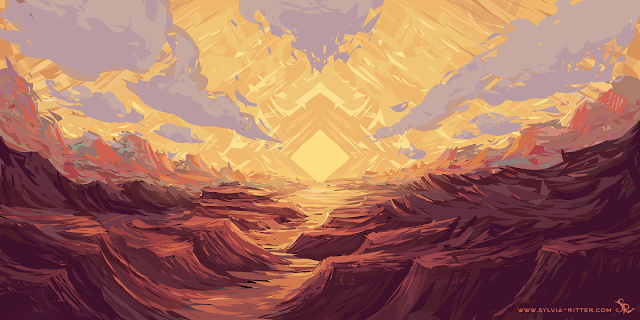
by Sylvia Ritter

WHO ARE YOU?
The category of "human" swells and distends. Mutations beneficial, harmless, and detrimental, nanotechnological augmentations and experiments, and soulcraft curses and geases long ago worked their way into heritability. Two people from the same village may look as different as an insect and a whale, despite nearly all originating from the homo sapiens sapiens we're familiar with today. The largest cladistic groupings organize along their tried and tested methods of surviving Superterra's omnipresent radiation; whether by technological, biological, alchemical, or stranger means.

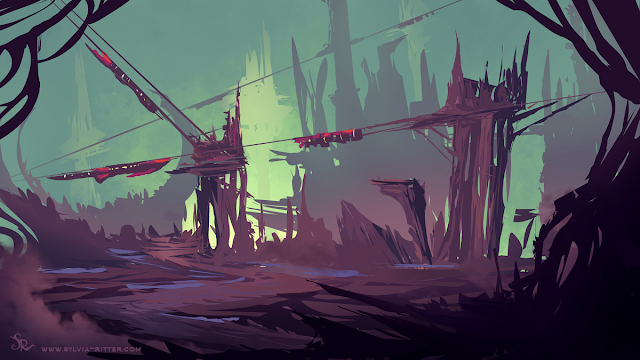
People aren't stupid. They know, broadly, about the old world - how could they not, in the shadows of its greatest achievements and greatest follies? Details are forgotten in their irrelevance to the modern landscape, or consigned to treatises as comprehensive as they are dense. The cultural consensus regarding the old world centers around how powerful they were, how superstitious they weren't, and how their hubris inevitably ensured their undoing.
by Sylvia Ritter


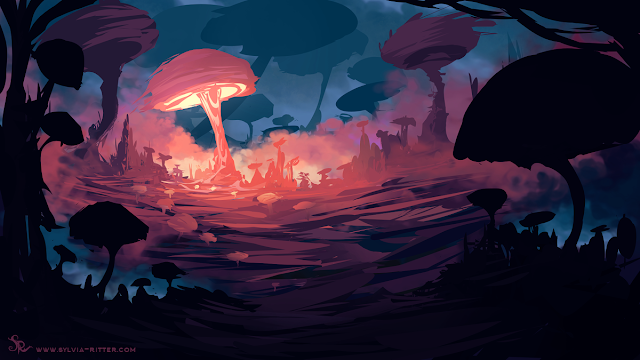
The soul is the unit of meaning and meaning-making. A soul in a complex system becomes a person. Complex systems sometimes spontaneously generate souls on their own, but freedom, safety, and comfort are required to generate soul. Souls have flavors based on the consciousness they emerged from. Soulmelliers will tell you that machine and mortal souls taste a lot alike. If you're quick enough, you can grab soul out of the air after it's discharged, but that's just rude - especially if you're planning on eating it for power.

The mass discharge of souls in the end times, at the hands of radiation angels, created atmospheric soul deposits (the Stratospheric Heavens), which precipitates in soul-storms (with various forms of soul-lightning, soul-hail, soulsnow), and discharges into the ground (the Hells-In-Earth). These soulsoils can then be purified at a Soulforge, jealously-guarded Old World structures refitted through occult means to refine the dross out of base soulsoil and elevate its dreaming consciousness into infernal metals. Most notably in the increasingly financialized wastelands of Superterra, control of a Soulforge permits the minting of soul-backed currency.

The rarity of soul-catalytic conditions makes them perfect as currency, especially as the Heavens, Hells, and Soulforges enable fungibility; in short, currency is the cycle of eternal torment. If you're killed by a radiation angel, it sends you straight to hell, burned into the earth and the dust as a shadow; areas like the Scar that were struck heavily by angels in the war are rich in hell-dirt. Nothing grows in these cursed hell-soils except fungus, because fungus is merciless and willing to torment the souls trapped within its mycelial net for energy and nutrients.

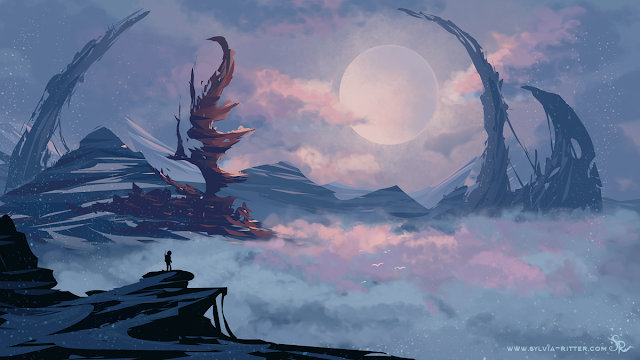
Soulcraft is the art of shaping and manipulating souls. Soul-lightning is the easiest trick; create a soul gradient and you can get a crackling discharge that chars and scorches flesh. Necromancy is the art of putting soul back into dead things; fossils are actually better for this because no one's going to try to get the body back. The soul has power over the body (and vice-versa, that's how killing someone works) - powerful soulcrafters can imprint the map of their changed soul on their flesh, shifting their shape to fit their whims.
by Sylvia Ritter
How do you survive the radiation?

1. Regimen of powerful antiradiation drugs with equally powerful side-effects.

2. Mechanical hazard suit. Filters, purifies, and recycles air and water. Requires charging. The highest-quality suits are built in the City of Domes, one of the only locations that can manufacture new microchips, but kitbashed suits are common across the Scar and suitshops are a fixture in even small villages. Often mount powerful devices and weapons.

3. Organic hazard suit. See above, but it's an organism and requires food. Plates of shell or bark, wiring of capillary or vine. Grown in the Hells and the Thorn Kingdoms; Thorn Knights wear menacing suits of leaf-green and rose-red.

4. Cancer-cult prayers, cleanses, exercises, and meditations. Some work, some don't, but you can't tell which is which. Each sect has their own regimens, and debates over correct technique or efficacy are the basis for bitter internecine feuds.

5. Living fast and dying young. The radiation isn't that bad if you never intended to make it past 25. Maybe you'll get some interesting mutations and insightful hallucinations along the way.

6. Soulcraft rituals anchor and tailor your form to its soul's template, forcing cancerous cells to stay in line through sheer willpower. People with training as soulcrafters are in high demand, for obvious reason, and travel widely to contract out their services.

7. Made of more robot parts than flesh. Hardened circuits and thick plating go a long way. Common in the Junk Sea, by the Spire, deep within the Subversion, and in the Technotheocracy's cyborg armies.

8. Symbiotic colony of cryptococcus neoformis, a fungus which feeds on radiation. It's taken up residence just beneath your skin, and pokes out through your mucous membranes.

9. Blood replaced with the Luminescent Ooze, upwelling from deep within Subterra, duplicating and rewriting your chromosomes. The Ooze has a slow, alien cognition of its own, communed with through dreams that are forgotten on waking but that influence your psyche all the same.

10. Nanomachine rad-scrubbers in your bloodstream, passed down through generations. Can be shorted out temporarily with an electrical charge. They build external ports and nodes on your skin for maintenance and information transfer with other nanite colonies. Some strains are transmissible through fluid mediums.

11. Buying life from others with soul currencies as a medium of exchange. The economancers of Tall Street in the Broken City have pioneered this art, and woven a Scar-spanning network of trade in soulsoils and trinitite crystals to fuel their techniques.

12. Joining a soulhive and adopting new bodies as the old ones wear out. Soulhives descend from  ancient bunkers, where bodies were in too short supply for the wealth of minds and souls seeking entry. It's like a time-share, where you spend most of your time in a communal noosphere waiting your turn to pilot around one of a dozen bodies. Soulhives have the dankest memes in Superterra.

13. Weekly tank treatments; long baths in radscrubber solution. The people of the Crawling Cities love communal antirad steam baths, heated by the fires of their city's engines. Others spend weeks on end fully immersed in tanks at the end of long voyages, reknitting their genome together in a psychedelic haze.

14. Autonecromancy! Dead things can't get cancer. Necromancy remains deeply taboo, as the Wizard War staunchly refuses to pass from living memory, but that doesn't stop the curious and ambitious from seeking out the Wizard's last apprentices and plundering his tomb-towers for the secrets of eternal death.

15. Physically removing tumors and replacing them with new parts, whether organic or mechanical. Difficult and resource-intensive, but there's a certain charm to exercising one's right to true morphological freedom.

16. Soul-bond with an eidolon, a much hardier creature that mutates for you in exchange for food and shelter. Think the Picture of Dorian Grey, except instead of a painting it's an owlbear.

17. Living in an ecosynthetic biosphere where the radiation has mostly been successfully scrubbed from the environment by a local reterraforming AI's machines.

18. Eating part of an angel's corpse. On one hand, this is an awful idea. On the other hand, if you're filled with divine irradiance, it may be strong enough to push back the radiation from the outside. Don't worry about what the radiation will do to you from the inside.

19. Contract with a Hell to tithe it souls in exchange for additional life. The Mycelial Hells and Metastas the Meat Hell make these deals with distressing regularity.

20. Roll twice; you're doing both. While most stick to whichever method they grew up practicing, redundancy is important in such a hostile world, especially for the adventuring sort.
by Sylvia Ritter

Infernal Matter

Hell-soils are wrought into an entire periodic table of Infernal Metals. Different soils can be forged into different metals. Each metals freezes one moment of delectable torment in perpetuity, which can be seen in reflections. Metals used for construction are painted bright matte colors to paper over this inconvenient reminder. Coinage, in variously stamped denominations of sin-silver, cryptgold, or stranger alloys, keeps its natural luster of grief as an anti-counterfeiting measure.

Scarstuff, the red and raw cracked matter of the Scar, can be forged into cold iron - the base infernal metal. Sturdy but not too sturdy, easily worked. Rusts over time, but the rust doesn't hurt its structural integrity; it's only a new form of torment for the souls within.

The soulsand dunes of the Scar can be forged into glass-steel. Translucent, thin, and sharp, but brittle in the light. Rings with the final scream of the damned within when struck. Not great for windows unless you like torture. Conductive like nobody's business, excellent for microtechnology.

Mycelial Substrate is hellsoil shot through with fungal growth, eternally tormented to fuel the fungus. Economically useless, but often holds nexi of valuable soils that it's saving for a deliciously surprising meal of pain.

The unpredictable tides of the Quicksilver Sea leave behind wet sands that can be evaporated into Quicksalt, a preservative that rapidly dehydrates and chills anything packed in it. Farmed by the City of Domes on the delta of the Coil, and by the Tubedwellers who live within the forests of Carnivorous Tubeworms.

Soulglass is a glowing green crystalline structure that permits the souls within some freedom to roil and writhe. The Old World term for it, Trinitite, is hypothesized to be linked to some ancients' beliefs in a Holy Trinity of three linked deific figures.Outcroppings of soulglass are abundant in the scar, from swirling shards of glass blown around by the burning wind to great crystals that act as landmarks for miles around. Unlike soulsoils, the souls in trinitite can't be economically extracted, even at a Soulforge, but it's very powerful for soulcraft. Even without soulcraft expertise, it glows in the presence of strong emotion, and by reading the glow's shades and perturbations you can tell someone's emotional state.

TRADE IN SUPERTERRA
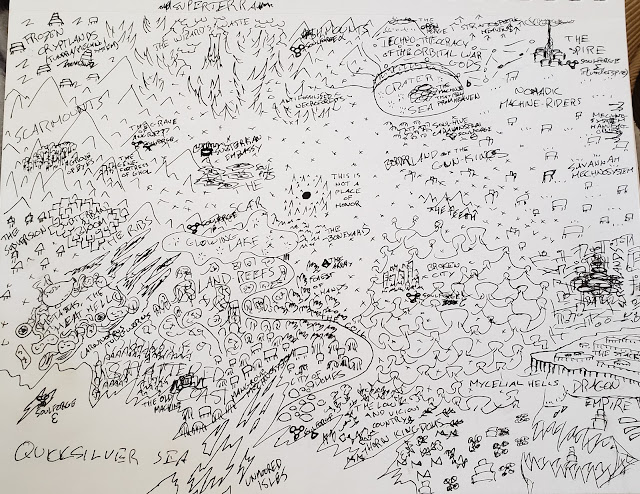
I'll do a better map at some point.


Meat from Metastas the Meat Hell for vegetables from the Thorn Kingdoms. Food and microtechnology from the City of Domes for soul-soils and archaeotech uncovered by the Crawling Cities. Bullets are traded for food along the eastern rim of the Scar. Souldirt and soulglass are refined and sold for jerkied meat around the Glowing Lake and the Array, while an abundance of supplies for Scar-travel attract merchant-venturers at the Array and the Soulhive Serai.

Metastas is the one place meat can be reliably grown on an industrial scale, which is much more calorically efficient (and less irradiated!) than anything else. This meat feeds the entire Shattered Coast, transported by hermetically sealed refrigerator-ships built at the bubble-docks of the City of Domes. These ships navigate the Unmoored Isles, evading pirates and krakens and soulstorms, and travel up the Coil once they've passed the City's extensive checkpoints. The City, of course, takes a literal cut of the meat trade, and has an extensive tariff regime on all other goods passing through the Coil's delta.

While the Thorn Kingdoms are broadly considered a primitive feudal backwater, their local biota has aggressively flushed the soil and made it fertile for a few species of thorny, hardy crops. Nowhere else is anything close to conducive to large-scale agriculture, so the Dukes with coastal fiefs trade inland vegetables for meat, and jealously guard their caloric bounty.

Ships charter to a variety of concerns headquartered either in the City of Domes, Metastas, a Thorn Kingdom port duchy, or up the Coil at the Array. Flags from the Dragon Empire, a rising power to the southeast, are a rarity - but are becoming more common sights in recent years. Unaffiliated ships "go missing" due to kraken attacks or are chalked up lost to soulstorms and pirates. Pirates in the Unmoored Isles hack and redirect ships to feed their towns; whether convict brigades from the Godforsaken Prison-Dome, denizens of the Pirate Bay Processing Collective, or the brave sailor women of Parthens.

Up the Coil, goods feed the Forest of Hands and make their way throughout the Scar. The Land-Reefs provide for their denizens, who in return protect their local fauna vigorously (plus, the reef-dwellers are the only ones who either know which are poisonous or have the genetweaks to eat them without haemhorraging from every orifice). By the Glowing Lake, the Array acts as an informal trading point for the Crawling Cities, as well as a variety of caravans who take goods into the Scar. The Array also processes food into hardier, preserved forms that'll survive its upcoming long and treacherous journeys.

by Sylvia Ritter


 The Crawling Cathedral feeds the Gene-Fortress of Ghol (though their Old World seed-stores could feed them for decades if pressed or besieged), and trades refined soulglass from the Soul Pits and their own trinitite harvests for food and goods from the coast. Crawling Cities often trade at the Broken City, and while the Mycelial Hells don't want for food, they're always willing to facilitate the food-for-souls trade in exchange for a percentage. This food then goes on to feed the armies of the Borderland of the Gun-Kings, who trade their immensely valuable guns, bullets, and vehicles in return.

Further north, any trade around the eastern rim of the Scar heading to the Crater Sea stops at the Soulhive to replenish supplies. Then it goes to the Technotheocracy of the Orbital War Gods, the Spire, or braves the Wizard's Waste to supply the Frozen Cryptlands. A north-south trip around the Scar will travel west from the Soulhive or the Technotheocracy, skirt the edge of the Antifossilized Necroforests, and stop at the Soul Pits and the Subterran Embassy before going south to the Glowing Lake.

The City of Domes has a faddish weakness for the beautiful, currently fuelled by tulip farmers in the Thorn Kingdoms and Metastasian meat-artisans. The carno-botany department of the Insulatan Academe now allows outside students' tuition to be paid in rare bulbs and tumors. While the tumor-trade is deeply illegal in a society that holds cleanliness sacrosanct, transgression only increases its luster.

The Crawling Cities have the most developed financial markets in Superterra, matched only by the Economancers of the Broken City and perhaps some Subterran regimes. Their practices of futures-trading have recently spread to the City of Domes, but have failed to take hold in the Soulhive (which refuses them on principle) and the Technotheocracy (which believes that the future is the domain of the priesthood and the Orbital War Gods, and therefore speculation is wholly immoral except by said caste).

There is ample room in this paradigm for enterprising smugglers, pirates, soldiers-of-fortune, merchant-adventurers, con artists, and speculators - and that's only scratching the surface of the perennial parasitic industries that crop up around developing markets. Explorers plumb the depths of the Junk Sea for ancient relics that will buy them entire towns. Defrosted refugees from the darkest periods of Old World history make their way south from the Frozen Cryptlands, awakened into a world that looks perhaps too familiar. The Dragon Empire encroaches on Orbital War God-fearing subjugated territories of the Technotheocracy, and cries are raised across the Crater Sea for something to be done. All the while, angels moulder in their launch cradles, gods twinkle in the night sky, souls scream in torment as their coinage changes hands, and the many oozing hearts of Subterra beat faster, seeking blessed, cursed light.

Most Recent Post

Mothership: Alternative Trauma Responses

My current weekly drop-in game of Mothership: Gradient Descent is now twelve sessions and thirteen characters deep. The extant four (or six,...