Pages

Showing posts with label races. Show all posts

Saturday, June 6, 2020

More Weird Race-As-Classes

And here's three more, in the vein of last post!

Next steps are posts about arcane casters and divine casters, probably. Don't hold me to it.

Demigod
Do you know who my father is?

Gods, demons, elemental princes, fae, titans, machine-minds from beyond the stars, even extradimensional outsiders - they all love to tool around in the mortal world and indulge in the pleasures of the flesh. Sometimes they leave spawn behind, half mortal, half something far greater. Whether you want this lineage or not, it's yours. It comes with power, responsibility, and an unrefusable invitation to the games higher powers play. You stand with a foot in this world and a foot in the next, and the concerns of both tearing you in twain.

To explain some of the Demigod's abilities, we've got to go over how divine casting works in this upcoming hack. Miracles are lumped into Domains, like in my original Cleric class. Each Domain has a certain number of Commands, things that an entity with that Domain will give you power to do. Follow a Domain's Commands to invoke a miracle you know that belongs to that Domain. For each Command you follow, you get 1 Magic Die for the miracle, up to your Devotion. All divine casting classes will give you Devotion as you take more templates; the same way arcane casting classes (like the Wizard) provide Magic dice. Rolling duplicates while invoking a miracle causes a Disfavor roll, as does breaking any command of the domain with the miracle. I'll elaborate more in a later post.

Hit Dice: 1d6 Grit, 1d6 Meat
Failed Career: 1. Atheist, 2. Charmed Life, 3. Monk
Starting Equipment: Token of your parent's favor, holy text (accurate, as opposed to most local translations), blessed weapon

There's only one template. You only get so much of a leg up on mortals; you must travel the rest of the path yourself.

Template 1: Divine Lineage, Divine Enemies, Manifestation, 1 Devotion

Divine Lineage: Pick a deity or other nominally-benevolent power, and pick up to 3 Domains it holds sway over. They're one of your parents, whatever that means given the nature of their divinity and capacity for reproduction with mortals. You're obviously of immortal stock, and the devout will throw themselves at you in town for benedictions or to serve you as hirelings. You can hire either (Devotion)d4 peasant believers or (Devotion) mercenaries who will swear an oath to your protection this way; they demand no compensation besides rations and blessings. The priesthood will give you access to their stores of holy armaments and theological treatises.

Divine Enemies: As an agent of your parent's will in the mortal world (whether you're willing or not), the followers of their enemies will strike at you to harm your parent. Roll a d6 at the start of each session. On a 1, you've attracted the notice of your parent's enemies, who will take the opportunity to strike as soon as possible. This stacks if you haven't yet been attacked; more enemies will marshal against you. The GM is encouraged to scale these enemies to match your own power in the world.

Who's angry?
1. Deific family with a aeons-long grudge against yours, reasons lost to history
2. Divine diplomat, you've somehow upset the balance of the universe and they're here to right it
3. Fully divine sibling who wants more of your parent's attention
4. Grandparent who disagrees with how your parent raised their children
5. Incredibly distant relation who doesn't even know who you are, just that you exist
6. Local power, mad at you bringing your family's chaos into their territory
7. One of your demigod half-siblings, trying to stay the favored child
8. Parent's childhood rival trying to one-up them
9. Parent's jilted ex-lover trying to settle a grudge
10. Parent's older sibling, trying to ensure they don't succeed
11. Parent's younger sibling, jealous of their success
12. Your parent, who wants you back on the straight-and-narrow

Who've they sent?
1. Adventuring party, cutthroat and greedy, hired to capture you alive.
2. Bounty hunters, all competing for the price on your head.
3. Cultists, poorly-organized but numerous.
4. Demigod, at the behest of their parent.
5. Divine hunting beast that will not stop until either it or you are dead.
6. Inquisitor, singlemindedly driven and singularly well-armed.
7. Mob of misinformed, superstitious peasants.
8. Preacher with a tempting offer in exchange for a favor.
9. Serial killer who specifically targets your parent and their followers.
10. Trial sent to test your mettle.
11. Warriors seeking the most dangerous game.
12. Wizard with a petty grudge they've blown up to titanic proportions.

Manifestation: You can manifest your parent's power, surrounding yourself with a visible aura of divinity. Your eyes and mouth glow bright, your god's holy music reverberates through the area, and you're surrounded by an angelic (or demonic) visage. When you do this, you can wield all the miracles from one of your parent's domains for 10 minutes, but doing this prevents you from disobeying any of the associated commands for a day. On an X-in-6, where X is the number of times you've used this ability today, this attracts the attention of Divine Enemies.


Dragonborn
Believe, believe, the dragonborn comes.

Dragons are the culmination of lives of avarice. Not everyone who becomes immensely wealthy sets themself on the path to dragonhood, but sometimes the glint of gold catches in the eye and its metallic taste lingers on the tongue in such a way that its call cannot be ignored. Possession becomes obsession becomes transformation. Some stave off the call of wealth, of scaled draconic majesty and the power to topple kingdoms. Some simply fail to hoard enough to satisfy their lust, and live forever unfulfilled. And a few become nightmares with names weightier than history, carving up continents, holding entire kingdoms for ransom.

Hit Dice: 1d6 Grit, 1d6 Meat
Failed Career: 1. Apprentice Mage, 2. Banker, 3. Dragon Cultist, 4. Hapless Farmer, 5. Miner, 6. Virgin Sacrifice
Starting Equipment: 100gp you've hoarded so far, a draconic name

It's a 10-level GLOG, so here's a ten template class. Each level brings you further towards full dragon-hood, and further from your humble beginnings, but taking even one level in another class prevents you from reaching those particular kingdom-conquering heights.

Template 1: Dragonbreath, Gold-Lust, 1 Dragon Die
Templates 2-9: +1 Draconic Mutation
Template 10: Draconic Rebirth

Dragonbreath: You have a breath weapon. Roll and spend a Dragon Die (d6) to deal that much elemental damage (choose the type of damage when you gain this ability) in a 60' long cone. Creatures in the cone may make a Dexterity save to avoid the damage, but additional effects from the elemental damage still occur. Dragon Dice recharge after daily rests.

Gold-Lust: You can smell precious metals and gems (through up to 10' of solid stone), and eat them as rations at a rate of 25gp to a ration, or 100gp to a Dragon Die.

Draconic Mutations: Can be taken in any order, or rolled randomly. Can't take the same one twice.
1. Dragonspeech: You can instinctively speak and understand the language of dragons, which is more real than the world it is spoken into. You may spend Dragon Dice as Magic Dice to power your spells. +1 Dragon Die.
2. Gaze: Your pupils slit and your irises gleam like precious gems. You no longer need to blink, and have infravision but for monetary value instead of heat. Breaking eye contact with you takes a successful Wisdom save.
3. Horns: Gain a d6 damage natural weapon. It knocks back enemies, and the horns are hard enough to dent metal and break through wooden walls.
4. Lair: Designate an area under your exclusive control as your lair. Gain an extra Grit die for every order of magnitude of gold pieces (10 = +1, 100 = +2, 1000 = +3, 10000 = +4, etc) in your lair. After resting in your lair, get +1 Dragon Die for the day.
5. Scales: Gain natural armor as chain. This doesn't encumber you. You can't wear armor.
6. Tail: Grow a long, spiked, whip-like tail. You can wield it as a d6 damage natural weapon, and if you stand still you get an extra attack with it on your turn.
7. Vast: You grow twice as tall, striding as a god among mortals. Gain +4 Strength, +4 Constitution, +1 Meat die, and you require four times as many rations to regain Hit Dice.
8. Wings: You have a pair of large, scaled wings. Spend a Dragon Die to fly for 10 minutes; this die returns to your pool on a 5-6. +1 Dragon Die.

Draconic Rebirth: You complete your metamorphosis into a great wyrm. Grow to the size of a house. +4 Meat dice. Your breath weapon now deals 6d6 damage. You can fly at will. By spending a Dragon Die, you can polymorph into a specific mortal form. In mortal form, you only have access to Gold-Lust, Dragonspeech, and Gaze, but can return to your true draconic form at will.


Lycanthrope
Exercise your right to bear arms.

Hit Dice: 1d6 Grit, 1d6 Meat
Failed Career: 1. Butcher, 2. Hunter, 3. Pariah, 4. Shepherd, 5. Raised by Weres, 6. Witch
Starting Equipment: The clothes on your back, satchel you can carry in your wereform.

Template 1: Werebeast, Animalistic
Template 2: Dire Were, Animalistic
Template 3: Alpha Were, Animalistic, +1 Grit die, +1 Meat die

Werebeast: You can turn into an animal form. While in your wereform, your unarmed attacks deal d6 base damage, and you have all other abilities that the creature would possess, whether extra combat effects, better senses, or new forms of movement. This doesn't change your Hit Dice, and you can't wield weapons or wear armor in your wereform unless you've got the opposable thumbs or fitted armor to do so. You can pass as a totally mundane beast in this form, unsuspicious in its natural habitat, and can communicate with other beasts of its kind. You drop everything you're carrying when you shift. Wounds and scars carry over between forms.

Moonlight or the command of an alpha were can force you into your wereform; save to resist with difficulty based on the amount of moonlight shining on you - automatically fail under the full moon; automatically succeed under the new moon. Once forced into your wereform this way, you cannot shift back until the end of your next daily rest.

Silver deals double damage to you, and wounds inflicted by silvered weapons cannot be healed.

Animalistic: You gain one of your wereform's abilities (and the accompanying physical features) while in your mundane form.

Dire Were: In addition to your wereform, you also gain a dire wereform that's monstrous and roughly humanoid (or a swarm, if your wereform is something small like a rat or a beetle). It has an new ability that your normal wereform lacks, +1 Meat die, +1 Grit die, and all weaknesses of your wereform.

Alpha Were: You're instinctively recognized as a leader by creatures of your wereform, and by other lycanthropes who aren't also alphas. You can command them unquestioningly to the degree of intelligence they display; dogs are enthusiastic but not very bright, pigs are smarter and get vindictive, bees will follow complex tactical formations.

d20 Wereforms
1. Bear
2. Bee
3. Bull
4. Crab
5. Crow
6. Frog
7. Gator
8. Hawk
9. Octopus
10. Ram
11. Rat
12. Robot
13. Scarab
14. Shark
15. Snake
16. Spider
17. Tiger
18. Turtle
19. Tyrannosaur
20. Wolf 

Tuesday, May 19, 2020

Weird Races as Weird Classes

When I first posted about my new hack, 2 blogposts and one whole month ago, I said the following:
"I have a complicated relationship with race/folk/ancestry/background options in tabletop games. On one hand, I love the ability to mix and match folk/calling (race/class, for those of you who can read those words and not get distracted by what they signify in meatspace). On the other... race really doesn't end up having a mechanical effect on the game, certainly not to the same degree that class does... There's a few ways to solve this that I'm poking at - one is including race-as-class as a multiclassing option... and another is including it as a background skill, like previous failed career, putting it on similar mechanical footing to skills."

So this is my attempt at the race-as-class multiclassing part of the deal. Stuff like Elf or Dwarf or Goblin or Human can be just backgrounds, but some like tieflings or vampires or whatever come with other abilities that are a little weightier than just how you grew up. These will rarely have 4 templates - I've tried to innovate in a few ways here, from single-template classes to classes you could take forever if you wanted to. I think it came out nicely, plus it's still (as always) compatible with the rest of the GLOG.

Taking a level of a race-as-class later in your character's path just involves them discovering part of their ancestry and family tree that was previously hidden from them, or them being turned into something new - contracting a troll-cancer, or being bitten by a vampire.

I want to write more of these. Angelspawn, lycanthropes, dragonborn, generic undead, a psychic... we'll see how it goes. I don't want this to feature creep any more than it already has.

Hellspawn
 

Way back down the family tree, one of your ancestors made a pact. Perhaps it was for love, or for victory, or for riches. Perhaps it was a grief-maddened sacrifice; perhaps it was freely chosen in pursuit of ill goals; perhaps there was hellish trickery afoot. Maybe, just maybe, the demon was doing something for itself for once (instead of its infernal masters). Regardless, you are the product of a child born of an unholy union between mortal and devil. The traits reemerge every few generations, to raise havoc and bring dark plans to fruition. You are marked as one of hell's, and hell follows with you.

Hit Dice: 1d6 Grit, 1d6 Meat
Failed Career: 1. Artist, 2. Demon Hunter, 3. Noble, 4. Preacher, 5. Soldier, 6. Thief 
Starting Equipment: Nothing but the clothes on your back.

There is only one template for hellspawn. Everything beyond that is up to you.

Template 1: Devil's Tell, Infernal Lineage

Devil's Tell: You have a mutation that clearly marks your hellish nature. You should probably try to conceal it.
1. Animalbane. You have an aura of unease. Mortals feel queasy and are instinctively standoffish towards you. Animals keep their distance; they won't attack you unless you attack them first.
2. Ash-trail. Everywhere you go, you leave the stink of sulfur and a trail of ash. You can write in indelible ash with your fingers, and eject a small cloud of blinding sulfurous ash at will.
3. Burning Hair. Your hair is a pillar of flame. It counts as a torch. You can't stifle it and it only burns out upon your death.
4. Cat Eyes. You have infravision and can see magic.
5. Claws. Your fingers twist into rending spines of keratin and bone. Dual wield d4 damage unarmed attack.
6. Clockwork Heart. There's a mysterious ticking everywhere you go. You always know the time, and can speak with contraptions.
7. Corpseflesh. You are a walking corpse. Your heart does not pump; your blood dried long ago. You count as undead, can't be poisoned or contract disease, and wounds cannot incapacitate you (only kill or scar).
8. Fractal Fingers. Your fingers have fingers, and those fingers have fingers, all the way down. You can finely manipulate anything down to the level of a hair.
9. Goat Legs. They bend forwards and backwards and end in clacking hooves. You can't be knocked down and can climb uneven surfaces without rolling.
10. Goldilocks. Your hair and nails grow as coinage of hell like overlapping scales. You sink in water. Who would take the devil's coin?
11. Heat Metal. Any metal you touch with your bare skin heats to the point where it'll boil water. Your weapons cauterize the wounds they leave. Touching metal armor will start to cook its wearer alive.
12. Honeytongue. Your words are like the anesthetic a mosquito injects before it drinks from a vein. When you lie, if someone catches you, they will give you at least one more chance before lashing out.
13. Horns. Great horns twist from your skull. Have fun with hats. d6 damage unarmed attack.
14. Leech Mouth. You can bite others and siphon their blood as rations. This deals d4 meat damage and counts as 1 ration. Looks like a round toothy maw.
15. Levitating. You're always floating at least 1 inch off the ground (and up to 6). This lets you avoid rough terrain, pressure plates, leaving tracks...
16. Magnetic. Metal that touches you takes a strength test to remove. You sink in water.
17. Many Mouths. You have mouths on your palms, in your navel, and a few others scattered across your body. You can digest anything. Counts as 2 slots of free hidden inventory space, though it'll be a little sticky.
18. Shifting Skin. Your skin constantly bubbles and burns. You don't mind the pain, not anymore. You look unrecognizable every week.
19. Skull Face. Your face lacks skin and muscle, just dry bones and the hint of a flicker of life in your eye sockets. You're the most terrifying thing in the dungeon. You count as undead and can't be blinded/deafened/frightened/etc.
20. Tail. Prehensile. Works like an extra limb.

Infernal Lineage: Your family traces its line right back to a devil. Perhaps there was a contract. Perhaps there was a sinful love. Whatever the case, you have power, and every time you wield it your heart sings and sears with delighted flame. Send others to the fire. Revel in your power. Pick a lineage, and gain the accompanying ability. You can use it at will, so long as it's making someone else's life worse.

1. Commander. Your ancestor was a commander in the armies of Hell. Anyone who you outrank must save or obey orders you give them in combat. If they succeed on a save, they're immune to this going forwards.
2. Duke. You have royal devilblood and your family name is recognized by anyone who's anyone. You are automatically obeyed by devils of lower status and non-sapient undead, and can summon d6 impish minions (1 Meat, wings, 1 damage unarmed attack) to do your bidding.
3. Hell Itself. Hell is a vast creature in and of itself, separate and yet inextricable from the devils that call it home. It has kids. You are one of them. Your flesh, like that of hell, is conducive to heat: you have a d6 damage ranged attack that sets things on fire.
4. Lawyer. The devil makes deals. Any contract you write, signed in blood and of the free will of the parties involved, is binding. It will be enforced by hell's forces to the letter, even and especially if that means inflicting consequences on you.
5. Lost Soul. Not all in hell are devils. There's an ocean-underclass of souls, tormented and fluid, both laborer and fuel for the fires. You can see and speak to these lost souls and spirits when you find them in the world, and can tell what's anchoring them to heaven, hell, or the mortal coil. You don't have to make someone's life worse with this ability.
6. Reaper. Every life ends. Reapers speed it along, showing up at the moment of death to usher the soul to the pit (or the gates of the heavens, or the elemental realms, or stranger worlds beyond). Pick a method of death (falls, poisonings, disease, magic, assault with a bladed weapon). You know how people will likely die if you do not intervene (a duke may die of poison, a knight may die of a rival's blade). You have advantage on rolls to bring that likelihood to pass, and revealing someone's fate to them rings true - you don't have to explain your powers.
7. Seer. Hell's predictive modeling department is lean, mean, and efficient in the way that only corporate bureaucracies can be. On one of their many department retreats (to a backwater village, that leaves nothing but a smoking crater after a week of debauchery), your ancestor made a deal that would eventually produce you. When you rest, you can ask a question about the future (between then and the next rest you'd be able to take of that type) and get a response if hell deems this knowledge appropriately actionable in the service of suffering.
8. Temptation. Pick one of the seven deadly sins (or one of the twenty-one lesser sins, or the manifold sin-like actions disputed by scholars of heaven and hell alike). You can induce others who can hear your voice to act in accordance with that sin, implanting subconscious commands to give in to a desire they already possess. They must make a Wisdom save or act upon it. You can smell sinful desires and differentiate the sins involved, though not the specifics.
9. Torturer. Hell's currency is pain, its motive force agony. Lost souls cannot be threatened with anything besides torment, and reward is antithetical to the very premises of the infernal ecosystem. You have inherited the predilection to torture that your ancestor inflicted, and can induce physical or mental agony with a touch. This deals d6 damage, and can't deal Meat damage. You can cause specific pains and insert specific torturous mental images with this ability.

Troll
by TheDijb
Trolls are cancerous. Not in a perjorative way - their bodies are literally unchecked growth, mediated not by programmed cell death but by inevitable environmental ablation of their outermost layers. Anything living can become a troll, if the right switch is flipped in their biology. And after enough time, all trolls tend towards the same gangly, knobby, chunky, warty physique with a few more limbs than polite company appreciates.

Hit Dice: 1d12 Meat
Failed Career: 1. Impromptu Siege Weapon, 2. Sheepeater, 3. Toll Collector
Starting Equipment: Club. Sack.

Take Template 1 to start. You may take Template T (for Troll) any number of times.

Template 1: Trollhide
Template T: +1 Meat die. Heal a Scar.

Trollhide: Regenerate Meat at the end of each turn equal to the number of templates of Troll you have. You may restore Meat instead of Grit during rests. Roll for two Troll Weaknesses. Your regeneration does not function when exposed to them, and when you take damage to your Meat from that source or in those conditions, you permanently reduce your maximum Meat by the amount of damage you took.

Troll Weaknesses
1. Acid. Bursts cells and scours veins, leaving behind blanched tissue that refuses even to rot.
2. Cold. The frost chills your blood, and your cells go into hibernation - choosing survival over reproduction.
3. Darkness. Anything darker than the light of a full moon. When the torches fail (and they always do), death slithers its way atop your shoulder and whispers its soporific song in your ear.
4. Faith. The miracle of life falls quite short of the miracle of, well, miracles.
5. Fear. The little death that brings utter obliteration. When flight beats fight and you turn tail to save your skin, you are most vulnerable.
6. Fire. A classic. Turns out cauterization cures all wounds, including you.
7. Impacts, such as from a fall, or the blow of a warhammer. Don't trip. Second floors are the work of malevolent sorcerer-architects.
8. Metal. Iron, gold, copper, silver, bronze - exposure is like an allergy; their bite is as death.
9. Poison and disease. Death slips beneath life's guard in many guises, and it finds life wanting.
10. Pungent smells, like that of sewage, or a broken sack of spice, or a rotting corpse. You keep meticulously clean.
11. Sunlight. Its light is the light of law, and death is its most absolute command. You travel by night and sleep entombed in earth.
12. Water. The pure stuff, from a spring or a canteen or the sea. Your dreams are plagued by drowning.

 Vampire

Vampirism is a pathogen as old as death. The things that lurk in the night, the predators that call humans prey. We are as livestock: even the more "moral" vampires merely act as shepherds (and of course occasionally butchers). Their seductive offer is the only thing more dangerous than their bite: what would you give up, to taste immortality?

Hit Dice: 1d8 Meat
Failed Career: 1. Artist, 2. Doctor, 3. Noble, 4. Vagrant, 5. Vampire Hunter, 6. Virgin Sacrifice
Starting Equipment: Cloak, blade, brooding diary, flask of 2 Meat points of blood

To take the first template of vampire after starting play, you must find a progenitor who is willing to turn you. As you level up as a vampire, you may take Template V up to four times, until you have all the Vampire Weaknesses (you can't get the same one twice). After that, you may take Template V+, and become a Lord (or Lady or Liege or any other title that strikes your fancy).

Template 1: Bloodsucker, 1 Vampire Power, 2 Vampire Weaknesses
Template V: +1 Vampire Power, +1 Vampire Weakness
Template V+: Vampire Lord, +1 Vampire Power, +2 Meat dice

Bloodsucker: You're a vampire; an undead creature of the night. You can consume nothing but the blood of living, thinking, mortal beings (humans and goblins are in, cattle are out). Your teeth count as a d4 damage melee weapon, and for each point of damage you inflict with a bite (if your target has blood to consume), you can restore that many of your Meat points. You can't heal lost Meat in any other way.

Whenever you return to full Meat, heal a Wound. Whenever you restore Meat points equal to your maximum, heal a Scar. You may spend a Meat point to reroll a failed Strength, Constitution, or Dexterity test. You cannot truly die unless killed via one of your Vampire Weaknesses; you will only take more Scars after being reduced to 0 Meat. These can keep you very well incapacitated, but nothing more.

You are enthralled to whichever vampire turned you. You cannot refuse an order from them, nor can you hurt them directly or indirectly.

Vampire Powers

1. Apex Predator. You move utterly silently, don't have to roll to climb rough surfaces, and have double movement speed. Your nails sharpen into claws that deal d6 damage unarmed. You can no longer pass as a mortal, and everyone has opinions about vampires.
2. Fleshcraft. You can mold your flesh and that of others like clay. This inflicts 1 Meat damage on anyone you mold, including yourself, for each change you want to make (on the level of facial features or adding a hand). If you try to use this on an unwilling target, you must make an attack roll as normal and it counts as a d6 damage attack.
3. Hypnosis. If you're making eye contact with a mortal, you may issue them simple commands. They get to make a Charisma save against the command. If they fail their save and follow the command, you must spend a Meat point for each word in the command.
4. Leech. When you drink something's blood, you can gain a skill or ability they possess for 10 minutes for each point of blood you drank. This doesn't let you change your physical form (unless you also have Fleshcraft).
5. Shadowstep. You can walk between shadows of the same light level as if they were adjacent, so long as you have line of sight to them. You have infrared vision.
6. Shapeshifting. You can turn into a creature of the night. This costs half your Meat, and lasts up to that many minutes*10. Roll a d6 when you get this power to determine what you can shapeshift into (1. Cloud of bats, 2. Giant python, 3. Murder of crows,, 4. Scourge of mosquitoes, 5. Smoke cloud, 6. Wolf).

Vampire Weaknesses
1. Faith. Sincere prayer and/or the touch of a holy symbol can turn you away, forcing you to either flee the scene or take 1d6 damage.
2. Pungence. Powerful spices like garlic or cinnamon or saffron overload your senses, effectively pacifying you. It takes 1d6 damage to push through the scent. Rot, decay, and blood do not have this effect on you.
3. Names. Any name you have gone by or that you recognize as your own can be used to command you by voice. Ignoring a command deals 1d6 damage to you. You cannot make up false names that are not anagrams of your name or otherwise derived from it.
4. Running water and thresholds. You can't cross either unless invited by someone who has permission to do so. You cannot be seen in mirrors.
5. Sunlight. Direct sunlight (i.e. if you can draw a line of sight between you and the sun) sets you on fire. Fire won't go out until it's either smothered or you're totally consumed.
6. Wood and silver. Both deal double damage to you, and HP lost to them can't be healed until downtime.

Vampire Lord: You are free from your progenitor. You can create new vampires by feeding a victim your blood after feeding on theirs. Each thrall you have under your control reduces your maximum Meat by 4. You can release them to get the Meat back, but not many people take kindly to being turned into undead killing machines who can't taste chocolate anymore.

Monday, September 30, 2019

Elves and their Cities

by Candra
Elf: Reroll DEX and another score of your choice until you get higher results. Roll a negative mutation whenever wounded by an iron weapon (or other industrial source).

Elves are fragments of a god-machine. They look like humans, just better - taller, lither, stronger-sensed (from their large eyes and pointed ears), perfectly symmetrical, moving with silent, practiced ease. They're hyper-optimized for specific roles, and cutting into an elf reveals twisting, arcane biologies that are nigh-impenetrable to any mortal physician. Such is the physiology of an elf, that every component depends on every other component for every task, interconnected deeply and powerfully in ways only gods (or elves) can understand. They are smarter than you. They are stronger than you. They are more elegant than you. And if anything goes wrong, they fail in catastrophic ways.

Elven reproduction is slow and rare. As each elf is a unique piece of a god-machine, they will tend to take on forms of dead elves, lost pieces, rather than appearing similar to their parents. This is how they instinctively take their names; an identifier for their place in the Machine. These are arcane, obscure, and complex - this is how you get elf-names like Aetenathir, or Lirael'thelian. The names were not meant to be pronounced by mortals, rather, merely to be recognized by gods and other elves. Names are all unique among living elves. What do they mean? What does Part A mean in furniture assembly instructions? Elven rebels and hermits tend to strip themselves of names, or take on obscurative ones, so as to prevent other elves from interacting with them in ways that reproduce elven culture.

They are masters of the emergent. An elf can trace an event back to its thousand thousand causes, each no more significant than a butterfly's wing-flap. Humans instinctively calculate the path of a moving object in their subconscious, then move their hand to catch it. Ask one how they did it, and they'll shrug. An elf will explain each facet of wind speed, of rotational motion, each piece of calculus they went through in parallel to put their hand exactly where it needed to be. Every piece of data that an elf acquires, through its hyper-attuned senses, goes through its thousand parallel conscious processes and comes out collated and factored into its behaviors and knowledge. An elf knows exactly which question to ask to get exactly the answer it needs.

Elves were designed to be perfect, infallible parts of a perfect, infallible machine. But gods are fallible, and petty, and malicious, and shortsighted. They did not account for a changing world. So elves, designed too cleverly for their own good, have residual, debilitating allergies to iron, and to smog, and to every other part of human and dwarven industry - things the gods did not see, and never predicted. They can't evolve past this; they don't evolve at all (for if they did, they'd no longer function for their intended purpose). Because of this, an elf's supposedly immortal life is always cut short by painful, inevitable attrition. Their wounds spread, changing their bodies in unpredictable ways, causing systems to fail and cancers to grow in utterly unexpected parts of the body. An old elf may scarcely resemble one of its younger brethren, with forests of fingers, bark for skin, and toxic fruits hanging from its limbs.

One of the pre-eminent scholars of Elven language has published a fantastic treatise entitled The Perfect Languages of Elves, to which this author makes frequent reference.
by Nadegda Mihailova
Elven societies have no government. Each elf acts on its own, as a perfect cog in a perfect machine. This is what they were made for, after all. All communal needs are met, all resources gathered, all crafts produced in eerie silence and harmony of purpose. If there is noise at all, it's of the wind blowing through carefully sculpted archways, ringing in perfect tones to convey information to elves in frequencies too high and at rates too fast for any other creature to deduce. It is the philosopher-king's utopia, with no dissent, no want, and beauty in every corner. An elf city expands slowly, almost on its own as each action and footstep over the course of decades slowly weathers the surroundings into more city.

If these societies are pushed out of balance, they cannot course-correct back towards perfection. Elven societies are each a horrific dystopia pretending towards perfection, covering their sins in porcelain and greenery. They may keep slaves of the "lesser folk," scurrying around hidden pathways to move products of elven perfection precisely where they need to be. They may poison the soil, their bleaches and chemical disinfectants leeching life out of their surroundings, an oasis of flora in a wasteland of ash. They may eat the brains of the dead, and go to war to find more dead to eat. They may use powerful magic to shape fortune to their designs, cursing all who know of their existence to destitution and hunger. Elves may rediscover hierarchy, and enshrine immortal royals to enforce brutal perfection at the expense of all others within and without. Elves, to those who know them well, are nightmare-creatures. The word commonly taken up for these elves, desperately trying to compensate for unexpected change and spiralling into horror, is drow.


Drow-cities fail. The downward spiral into dystopia inevitably collapses, through scarcity, through revolution, through disease, through infighting, through ennui. The cleaning-hexes run out. Buildings are overtaken by their no-longer-trimmed foliage. Porcelain cracks. Heartwood rots. Fungi and decay spread everywhere, taking what is rightfully theirs from the loosened grip of eternity. The last few elves retreat further and further into the core of their halls, attempting to maintain any semblance of normalcy and purpose in the face of implacable entropy. They take on absurd titles, fight over petty grievances, spiral into mutation, burn their priceless art for warmth. Eventually, the entire city falls to ruin, taken over by scavengers and even perhaps mortals who see the shattered spires as a convenient shelter from the elements. The elves scatter, or die off, or languish for aeons in melancholy and grief.

What was the elf-machine supposed to do? The Purpose of Elvenkind, as the question is phrased in the hallowed halls of elfdom, is the contentious heart of elven religion. Often, this question is taken up by drow-lords trying to repair their failing cities, to find the missing pieces and replicate them through arcane science. Religion becomes engineering, research, experimentation. Holy texts are filled with biotechnical diagrams, musings on the nature of elven-kind merged with histories of failures and speculation on their error. Some believe the machine will bring peace and harmony, that holy grail that so eludes elves and mortals, freeing them from the cycle of decay to which all elves are doomed. Some believe it will birth a new god, merging the elves into a deity that exemplifies all their best qualities. Some believe it's nothing but an art-piece, a proof of concept that is nonetheless so beautiful that it deserves creation solely on its own aesthetic merit. Some think this question is immaterial, and want to unite all elfkind in one great city, bring all the pieces into one harmonious symphony, and let nature shape the machine as it will.

Given the evidence of the drow-cities, some believe the machine's ultimate nature is evil, or a trick to consume elvenkind as they stray from whatever the true path may be. The only moral way for an elf to exist is to disobey their purpose, and venture forth among other mortal folk, never meeting or speaking with another elf. They often turn to adventuring, their own self-hatred and pursuit of alternative religious frameworks pushing them to ever-stranger modes of existence.
by Ukitoki
Not all elven cities fall to drowdom! Or rather, not all have fallen yet. All begin with high-minded visions of being the one to succeed, or at least one that won't fail. Some maintain elven normalcy for decades, or even centuries. Still, the longer one lasts, the harder it will someday fall. Many larger cities find their end in civil war, as passive-aggression spirals into full-on war. Sides are taken, districts are claimed, and battles are fought as part of radical political debate, every destructive alteration of the city as part of a reshaping work that will overhaul the entirety of the society in question - if and only if one side is unquestionably victorious. More often, the war takes too many lives, and either breaks the city into two competing drow-cities in an endless Orwellian cold war, or one side wins a pyrrhic victory and for decades hence must contend with the form-traps their enemies set throughout the course of the war to avoid their inevitable descent.

Elven warriors fight with seemingly wild abandon. They dance through combat, wielding blades and spears many times the lengths of their bodies. When they emerge from the fray entirely untouched by their foes, spattered with little bits of blood that they quickly scrub away, they seem to be just showing off. In fact, their every move and tactic is calculated to minimize their risk of injury, staying physically out of reach, moving too fast for their enemies to figure out how to hurt them. They opt for minimal armor (chainmail or steel plate, of course, gives them monumental hives), so they can maximize their natural speed and grace. Magic augments their prowess. Often, elves (or serfs, for the drow) act as moving loci for powerful enchantments, throwing themselves headlong into battle to put a spell in the right place to turn the tide. Elven wizards have no compunctions about using their magic to fight dirty. Better the enemies fall to horrific means than the enemies inflict horrors upon the elves.

Elves in other societies are typically adventurers or traders. Elven shops are common in many cosmopolitan cities, trading their supernaturally elegant crafts or intellectual services for rare materials, favors, or secrets seemingly irrelevant except to the inscrutable minds of other elves. Elves who wish to  find a way to better themselves against their nature, or who know their place to be in a far-off elven city, or survivors of and rebels against drow-cities, or hermits finding a place entirely divorced from their mechanical purpose, will all turn to the jobs-for-gold mercenary-explorer life. Occasional elf neighborhoods may grow in the largest cities, their particular experiment with elven society leading them to seek interaction with others. These are typically neighborhoods of outcasts and rebels who have no moral antipathy against other elves, and still resist the common elven dogma that other folk disrupt their paradises. As they pretend not to form utopia, their settlements last longer, but fall to simple attrition as the industrial hazards of city life slowly degrade their forms.

Elf-Cities
Location
1. Boughs of enormous tree
2. Artificial island in picturesque lake
3. Oasis of green in dessicated desert
4. Tallest peak of mountain range
5. Back of titanic fauna
6. Outlying district of a multicultural metropolis

Feature
1. Crystalline domes and spires
2. Built seamlessly into natural features
3. Lights and bridges of magical force
4. Menial jobs done by by elegant constructs
5. Filled with elaborate, exquisite artworks
6. Extends deep underground

Hiding
1. Have enslaved and purpose-bred goblins to hide between the walls and make all the "magical" feats possible. 3-in-6 chance the goblins are just about ready to revolt.
2. Forcibly control dissenters and visitors with airborne spore-clouds and surgical interventions
3. Unsustainably drain magic from nearby areas to power magical creations and effects, need to expand violently to maintain quality of life
4. Anyone who enters is cursed to never leave until they have performed a number of services for the elven archmage who has deemed themself lord of the city
5. Active, brutal war between two elven factions who disagree over a minor point of decorum
6. All residents have been dead for centuries, replaced by unthinking necromantic effigies living half-lives, killing newcomers to prolong existence

Thursday, September 12, 2019

Facts About Dwarves


Dwarves are made of solid stone. They carve each other into being. Stocky figures of strata, built short to more efficiently use tunnel-space and wide so the rumblings of the deep-core cannot shake them. They live until their bodies erode, or the exertions of mining and carving prove too much and their form cracks irreparably.

Carving a new dwarf is a labor of two or more dwarves. They don't have gender as such, though some holds restrict who can work together on dwarfcarving for practicality's sake. The dwarves who carve a new dwarf together enter into an arrangement similar to marriage; it's not a thing done lightly. Collaboration on anything is an intimate and personal sharing of ideas, techniques, and even sometimes tools (never use another dwarf's tools in public or without permission, that's obscene). Working alone to create new dwarves is similarly obscene, like incest in human cultures. The combination of multiple dwarves' creative forces is essential to creating well-adjusted new dwarves, for those all created in the image of a single creator will inherit and magnify their creator's worst excesses. This isn't a magical process; it's just how collaboration works.

Counter to popular belief, dwarves don't actually only build each other in the shapes of humanoids. However, only the humanoid dwarves are given legal rights as fully-recognized beings, the rest are treated as a variety of servant castes and tools. The commonly-seen dwarves are merely their workers, though as this work is essential to dwarven society, they're also the most respected caste. When dwarves go to war with surface-folk, they send in soldier-dwarves, as tall as an orc and as broad as a wagon, armed with great weapons that can cut down swathes of enemies. The pinnacle of dwarfare, however, is their siege engines. Elephantine stone turtles with iron shells and battering rams for heads, many-legged stone centipedes carrying dozens of soldiers strapped to their sides, even the occasional giant rising from the earth as tall as a castle bastion. Felling them is a task better suited to pickaxes than spears and arrows.

Not all dwarven creations are dwarves. Their hand-tools are merely tools, their exports have no minds of their own. Anything with smelted metal is certainly not a dwarfmind, the melting and casting process makes sure of that. However, the dividing lines between dwarf and non-dwarf are strange - and none are stranger than their rulers, the dwarven emperors.

Dwarves are no more a hive mind than humans are, though they're commonly stereotyped as such by above-ground folks because of their superficial similarities to ants and termites. The metaphor of an anthive and its queen is actually insufficient to describe a dwarf-hold and its emperor. If you could see through stone, a dwarven hold is just a great skeletal figure, the negative space of tunnels are its bones and the great work-caverns are its organs. Its fingers stretch as transport tunnels and its many, many legs run deeply and greedily into the earth. It grows as the dwarves within excavate. Dwarves in all their forms are a sort of microbiome of their emperor's hold-body. The emperor is the hold, the hold the emperor. It speaks to them in the rumbling drum-speech of the earth. They speak back, with the same reverence humans reserve for their kings and their gods.


The structure of an emperor determines the structure of society within, mediating interactions by their very existence. Every building is the panopticon realized, where surveillance is not merely possible but certain. To revolt, dwarves must literally tear down the structures that imprison them, killing their ruler in the process. Regicide is impossible without changing society. Dwarves hold lively debates, but know always that the walls have ears. A dwarf revolutionary travels far away by rule, not to escape a society that ostracizes them, but because they literally cannot plan revolution within the confines of their emperor.

An emperor has no wasted space, its tunnels barely wide enough for two dwarves to walk abreast, with only just enough vertical clearance for a walking dwarf to avoid scraping its head. However, it's far from spartan - a long-lived emperor is immaculately decorated with carvings and memories of its inhabitants' deeds, with polished floors and gemstone-inlaid furnishings. Dwarves as a rule are not claustrophobic, and live in either communal barracks or have small personal rooms for rests and recovery (they must sleep as any other mortal race does; though large enough dwarves (like emperors) need only put half their mind to sleep at once).

Dwarven nobility direct the expansion of the emperor where it deems delegation necessary, mining deeper, marshaling defenses, and calling for the construction of new dwarves. They live in comparative luxury, speaking with the emperor on closer terms, but always knowing that their dwellings and privileged positions are granted at the emperor's behest and can be taken away at any time. The emperor may feel the agonizing pain of caving-in to kill dissidents, but it's undeniably an effective remedy to sedition or disloyalty.

by Börkur Eiríksson
Dwarves are famous for consuming alcohol above all other forms of nourishment; and any alcohols of dwarven make are famously potent and utterly nauseating to everyone else. As they're made of stone, they lack tastebuds, and they can't easily metabolize anything else. Alcohols are a potent energy source, and dwarves ferment vast quantities of any biological matter they can find (from mushrooms to root vegetables to tree bark) in great pool-caverns underground. These pools not only act as reserves of unspoilable nourishment for dwarven holds, but as food for the hold-emperor itself. One could look at these caverns as a titanic digestive system, with the base of the pools constantly digesting alcohols to power the emperor's omnipresent cognition. Kegs are like fuel cans for the dwarven engines, and a common sight is a dwarf tapping a keg to refill an engine's stone stomach after a busy day of work.

Dwarves of a religious persuasion know that the world itself is the Ur-Dwarf, the crust and magma beneath fuelling a intelligence vast, slow, and very much interested in the antics of its fast-living stone children. The conceptions of mind, soul, and body are all one (and the separation of such is confusing to dwarves who haven't studied human religion). When a dwarf dies, its constituent parts are buried and returned to the earth from whence it came, in striking parallel with human burial customs. Statues of the deceased are considered the highest honor in some holds, but in others such a precise replica is disconcerting.

Human dwellings are uncanny and disturbing to dwarves. They cannot hear the thrum of the emperor, or request service from the furnishing-dwarves. It's like if you moved into a house without windows, lighting, or running water. Dwarves feel similarly uncomfortable under the open sky. They expect to look up and see stone they can speak with, familiar as their own maker. The emptiness of the sky and space and horizon makes them profoundly lonely. This is why you find dwarven emigrant communities in cities; while the dead buildings are uncomfortable, it's far better than having to adjust to the empty, barren expanse of sky. In locations where it's practical, some dwarven communities carve new emperor-districts into the stone below the city or the mountains it's within. These emperors are stylistic and cognitive hybrids, incorporating mentalities from the other architects in the city, sometimes expanding into existing districts built in alien traditions. Older dwarves worry about these emperors greatly.

In human language, the word for human is Wise Folk. In elf language, elves call themselves the Beautiful Folk. Dwarves call themselves the Making Folk. Their personal names are a rumbling hum, like an avalanche played in slow motion. This is usually transliterated with lots of hard consonants and elongated, open vowels, though more cosmopolitan dwarves prefer to have their names translated directly - traditionally a type of stone connected with a certain value set, combined with the chosen name-marks of its creators.

Don't cast Stone to Flesh on a dwarf. That's rude.

Dwarves (GLOG Race): Reroll CON or WIS. Speak with stone at will (1-in-6 of it responding). Made of solid stone. Can't run.

Wednesday, June 12, 2019

Molluscfolk


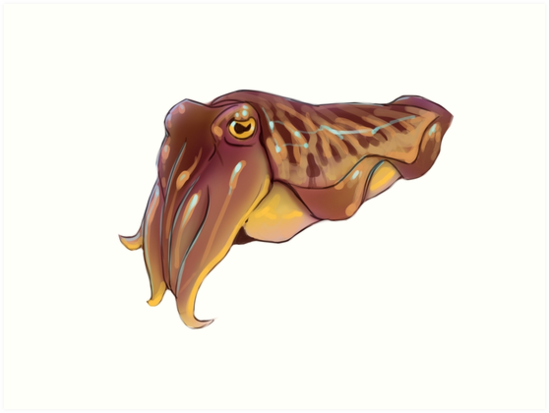
The land is a trifling curiosity, a mess of squabbling primates and reptiles devouring each other in a neverending pointless struggle. The Sepiidan Empire scorns the landfolk - it rules the sea. Long ago, the cuttlefolk learned that their camouflaging skin could be used for so much more. Certain patterns and colors could stun, or charm - or trigger subservience instincts in a variety of other molluscs. They built an empire, as brutal and vast as its rulers are squishy. What they can't control through their own powers, they dominate with their legions. The last thousand years of oceanic history are a long record of holding actions, surrenders, and extermination campaigns against the indomitable and ever-expanding Sepiidan forces.
Related image
THE GREAT ENEMY, DOMINATOR OF ALL THAT SWIMS(by jschuta)
1. Cuttlefolk: reroll CHA, can change colors, 1/day cause strong emotion in everyone looking (save negates), step down hit die

The Cuttlefolk are small, short-lived, weak, and squishy. Is it then any wonder that they rule an empire? Long millennia of hiding and running as a consummate prey species them made them paranoid, convinced them of the essential hostile nature of the universe, and gave them long unique grudges against every other creature in the oceans. With new and terrifying powers of psychology at their disposal, they're working down that list of grudges, enacting tenfold vengeance on every predator species who has ever tasted cuttle. They are the new top of the food chain - and it's only a matter of time until the landfolk fall under their gaze.

2. Nautilid: reroll CON, +4 AC but can't wear armor, 50% chance to act in surprise rounds

Nautilids once had a long, bright histoy reaching back aeons upon aeons. They claim they predate the gods, and they once had artifacts to prove it. Now, under Sepiidan rule, those artifacts collect dust in the great golden cuttlefolk treasuries. As the first to fall under the sway of the Empire, the nautilids are now naught but the cuttlebone of the Sepiidan armies. A force of nautilids is nigh-invincible to conventional arms or subterfuge, and backed up by the psionic might of the cuttlefolk, they've become an ominous sign across the oceans that dark times are nigh.

3. Octopodes: reroll INT, eight hands (works as 2 hands for combat/lifting), arms don't always follow your orders when frightened or feeling strong emotions
1. Bluering: Venomous spots; save vs. 1d12 necrotic damage, doesn't work when covered by armor
2. Giant: Eight hands of carrying capacity
3. Mimic: Can imitate colors and textures; camouflage when not moving.
4. Vampire: Regain [level] HP on unarmed hit, unarmed attacks deal necrotic damage

Octopodes are solitary folk, coming together only to reproduce and trade knowledge. Curious, insightful, and deep thinkers, each has a complex set of philosophies and theories developed over the course of decades. Of course, everything changed when the Sepiidan Empire attacked. Their octopode servants are forced into close proximity, to build new war machines and research new fell magics - or just to cater to the ever-changing psuedo-intellectual whims of the cuttlefolk, who demand new paradigms that place them at the top and justify their atrocities.

4. Slugfolk: reroll DEX, can secrete trails of sticky, slippery, or poisonous slime, halve speed, salt inflicts acid damage

5. Snailfolk: reroll WIS, halve speed
1. Flail: eyestalks double as flail heads, can make a d6 bludgeoning damage melee attack that ignores shields
2. Giant: +4 inventory slots, shell takes on a property of stuff you eat (1/day, expires at end of day)
3. Whelk: 30' tremorsense, can identify creature through consuming traces

The landfolk molluscs baffle the cuttlefolk emperors. On one tentacle, they're brethren, of a sort. Squishy, curious, eminently susceptible to cuttlefolk mind-magics. On the others, they're landfolk. They're irrelevant, like all other superoceanic affairs. So the slugfolk and snailfolk keep their independence, for now, existing in small slow settlements on the edges of civilization. Many of their colonies delve deep into ancient ruins and dungeons, with long communal memories stretching back to when the ruins were constructed.

6. Squidfolk: reroll STR, tentacles give you two additional hands of carrying capacity and can inkbloom as a Fog spell 1/day, senses are halved out of water

Squidfolk are the resistance. Able to dive deeper and survive far greater pressures than any cuttlefolk or their servants, they strike at Sepiidan reef-fortresses and supply lines from abyssal trenches in a guerilla war of attrition. Yet every captured squidfolk is another addition to the cuttlefolk armies, and every year those armies push closer to the squidfolk strongholds. Many now make desperate runs to the surface, to make allies or find lost landfolk magics that could turn the tide.

Related image
Skot Olsen

Thursday, May 30, 2019

This Post Might Eat You

It's quiet. You cleared the last five rooms; lost Ygmar the barbarian to a spiked poisoned pit trap, and Naelare the wizard's head detonated after a particularly potent fireball spell. Finally, you can rest, in the room that used to be the kobolds' ooze-growing chambers. It's covered in kobold blood and ochre slime, but at least nothing's trying to slit your belly. You rest against a wall and light your pipe.

Look closer.

Was that corpse there before? Did you miss it? It's certainly got a bunch of loot on it that you must have skipped.

Poke at it with curiosity. It flops limply. Dead, thank god.

Open its coin purse with your knife. You realize your mistake a moment too late, when the inside smells of meat and is full of writhing, snarling teeth.

It splits lengthwise, to reveal a gaping maw in a sickly facsimile of a grin. Its breath is warm and foul, its long, segmented tongue slaps at you and leaves sticky residue behind.

Then - it speaks? It speaks, in a deep cheery burbling.

"Hi! I'm Mimic! You seem nice, can I join up?"

Mimic
Related image
Strange times call for strange bedfellows. Or chestfellows, or doorfellows, or ladderfellows...

Level 1: Literally a Mimic, Swallow Whole
Level 2: Dextrous Tentacles, Improved Mimicry, +HD
Level 3: Adventurer Mimic, +HD
Level 4: Mimic Clutch

Hit Die: d6
Starting Equipment: Roll 1d6 to determine what you begin the game mimicking.
1. Treasure chest
2. Table
3. Anvil
4. Barrel
5. Fireplace
6. Pile of garbage
Skills (d3): 1. Disguise, 2. Gourmet, 3. Furniture Assembly

Literally a Mimic: Don't pick or roll a character race. Instead, you are a mimic, a roughly crustacean-esque creature that can take the form of mundane artificial items. You're limited to mimicking items the rough shape and size of a treasure chest, that you can see. When you see fit to move, you scuttle on little crab legs. You are a perfect imitation of the mimicked object, but when someone tries to use you then your true nature as a voracious beast is revealed as your toothy maw splits open wide. With your maw, you can make a d8 slashing damage bite attack (obviously this reveals you as a mimic). You also have a sticky tongue that extends up to 15'; it deals no damage but can grapple enemies and drag them into your maw with startling speed. You must eat living creatures or raw meat as rations.

Swallow Whole: You know the rule that anything that fits in your mouth doesn't take up an inventory slot? You have a *very* large mouth. Consider anything smaller than a one-handed weapon to fit in your mouth for this rule (though your mouth is much larger). You can fit one entire person inside you, and if you wish, you can deal d4 acid damage to them each round. Anything that you choose not to deal damage to remains miraculously undamaged.

Dextrous Tentacles: In addition to your tongue, you have three 10' long tentacles that are each as strong as a human hand.

Improved Mimicry: You can now mimic anything from the size of a longsword or other two-handed weapon up to the size of a carriage.

Adventurer Mimic: You can now mimic anyone you've eaten. When you do, you perfectly impersonate their mannerisms and speech patterns, but not memories or skills. You may use one of their mental attributes instead of yours. You may mimic one of their 1st-level class abilities, if they have them.

Mimic Clutch: You hatch a clutch of several hundred adorable baby mimics, around the size of a gold coin each. They act as a 3-HD swarm (or several smaller swarms), and can follow simple instructions with great enthusiasm. Their mimicry is imperfect, but they can mimic much smaller items. When they take damage, they can't heal it - instead, some number of the swarm die squirming and squealing. When they consume a creature, there's a (consumed creatures)-in-20 chance of one growing into another full-grown mimic, which may travel with you as a companion of its own volition until it finds somewhere nice to settle down, perhaps in a 10-foot-square dungeon room guarded by an orc.

Image result for mimic artImage result for mimic artImage result for mimic artImage result for mimic art
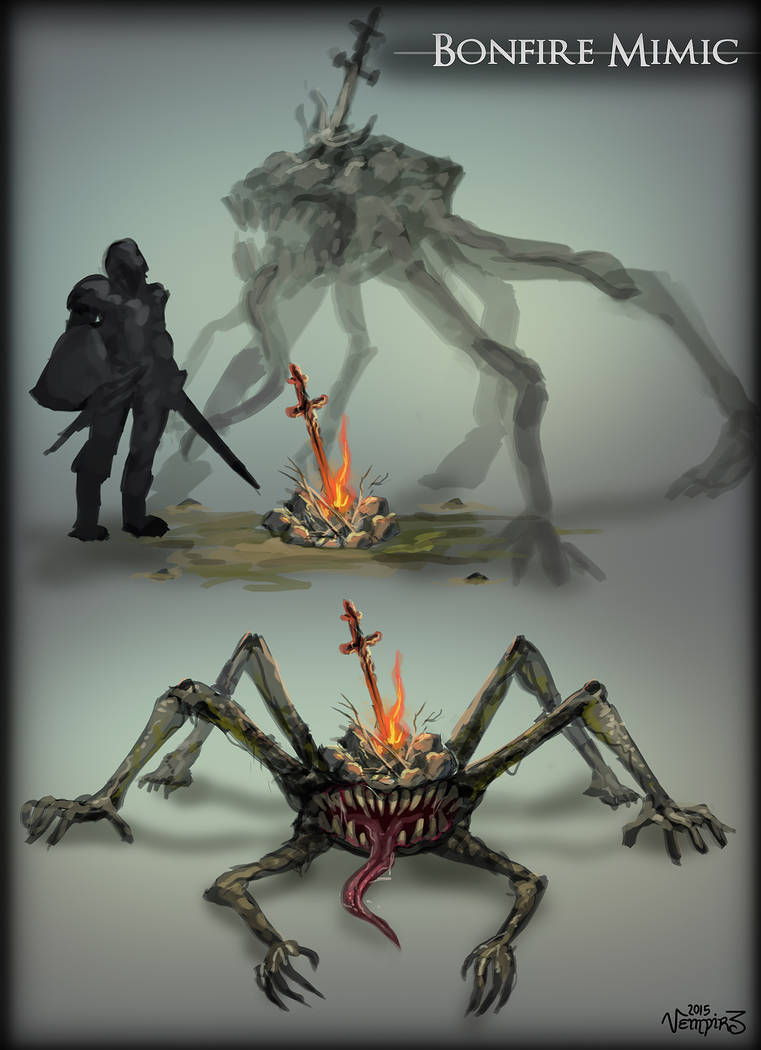
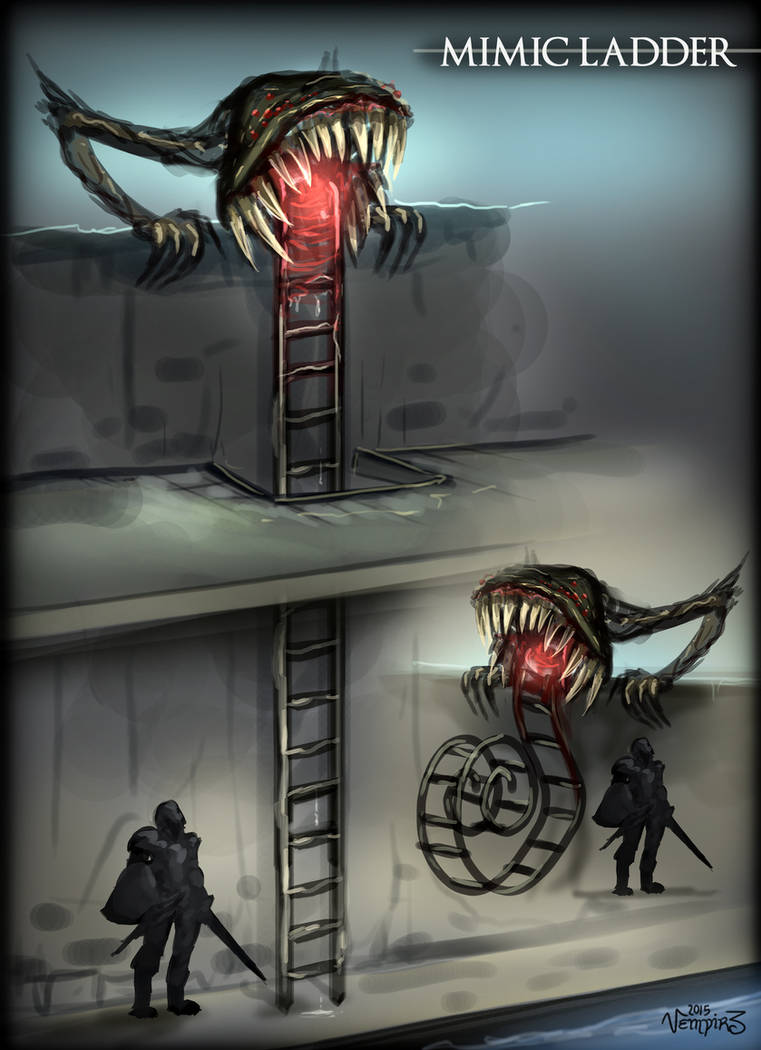
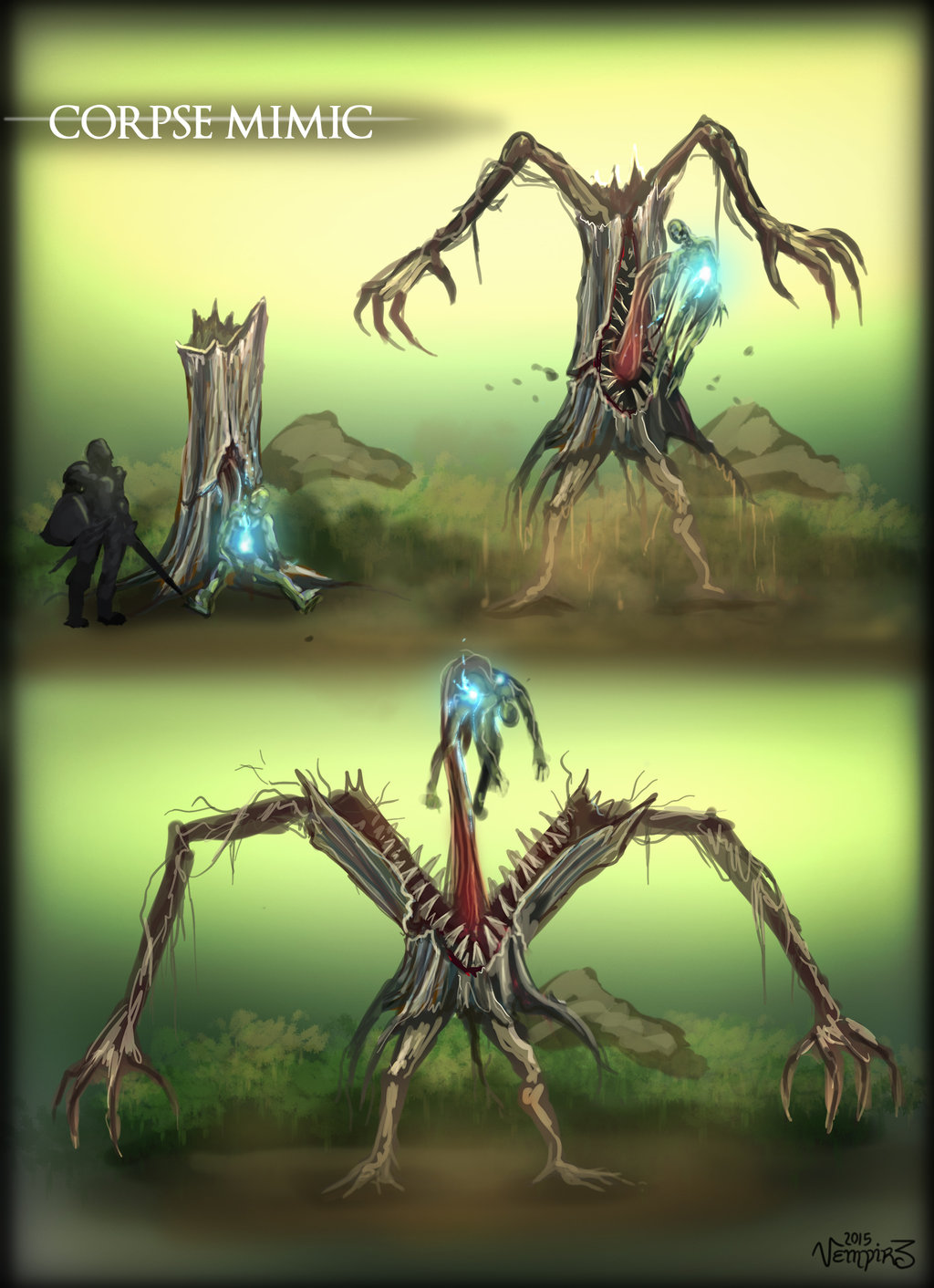
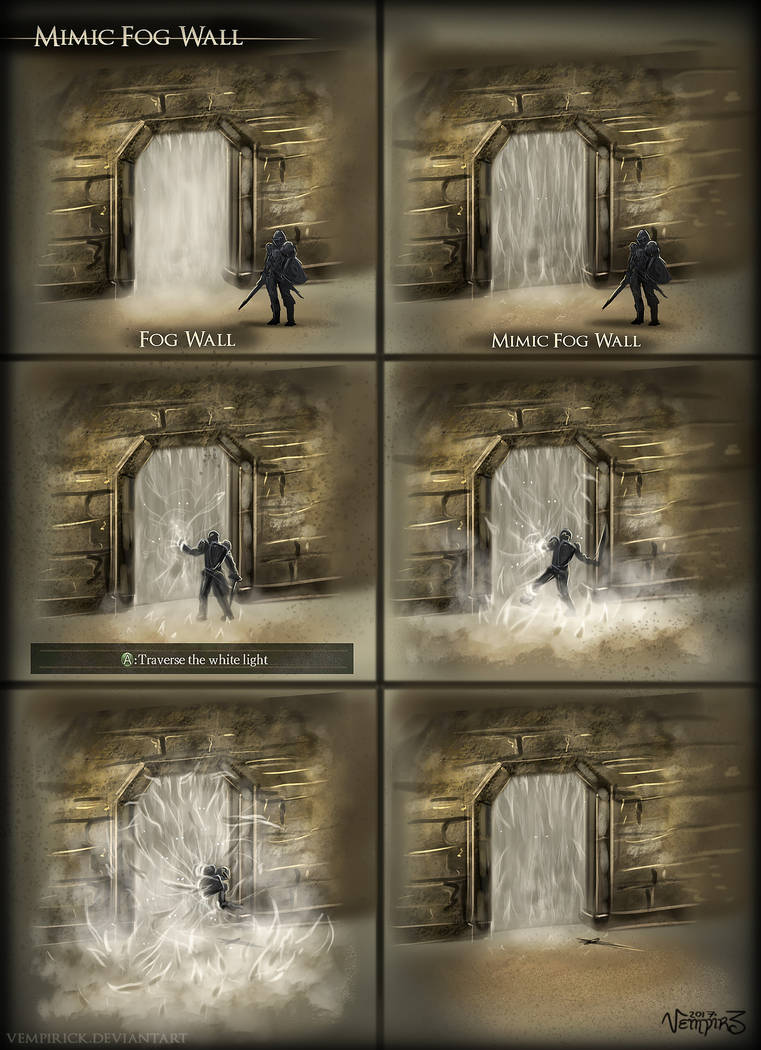
Image result for dark souls mimicImage result for dark souls mimic
all the above are by vempiric on DeviantArt

Image result for switch mimic art
by Citysaurus_ART

Image result for k6bd mimic
by Abaddon of Kill 6 Billion Demons

Monday, May 13, 2019

Reconstructed

You died. Someone disagreed. At great expenditure of mundane coinage and magical power, your soul was pulled agonizing bit by agonizing bit from the ether and pressed into your body, reconstituted from whatever materials the necromancer had lying around.
You remember the Psychopomp taking you from the mortal coil. You remember a Heaven or a Hell. You know what lies beyond and you will never, ever see it; your traumatized soul forsaken by Death itself. Naught awaits you but the present - go forth and live again.
Related image
Who wanted you back?
1. A lover, heartbroken by your untimely demise
2. A creditor, to whom your service is not yet complete
3. An employer who found your work irreplaceable
4. A rival, who wants to beat you fair-and-square for once
5. A parent, who could not bear to outlive their child
6. A necromancer, to whom you are but an experiment
7. A torturer, who still needs information from you
8. Yourself, unwilling to accept Fate
9. An admirer who never got to meet you in the flesh
10. A close friend who owes you their life

What do you remember from beyond?
1. Losing a game to the reaper
2. The faces of your loved onces, welcoming you once more
3. The judging visage of a deity you spurned
4. The beginnings of your endless torment
5. The birth of what would have been your next reincarnation
6. A glimpse of the dice game the gods play with the fates of mortals
7. Opening a book from the Akashic Records
8. A snapshot of higher-dimensional reality, from whence your soul was trapped
9. Conscription into the Blood War
10. Utter, all-consuming, beautiful oblivion

Reconstructed: Reroll no ability scores; you had no special death-defying talents - that’s why you died. You can, with the aid of a practiced necromancer and a laboratory, remove pieces of your body to implant replacements. You begin with one such replacement, randomly rolled from the table below. You have a weakness associated with the removed body part.
Blood: Must drink blood from other living, unwilling creatures as rations. 1 HD = 1 ration.
Bones: Take double slashing and piercing damage.
Brain: The sound of your name forces you to CHA save vs. fear.
Guts: Toxins, diseases, drugs, and poisons negatively affect you at their maximum duration and power. You can’t heal them except by magic.
Muscles: Water and other natural liquids deal acid damage to you (glass of water = 1 damage)
Skin: The light, it burns! Halve your HP in sunlight, and you can’t recover HP outside of complete darkness.

1. Bugs
1. Blood
Spend 2 HP to split off 1 HP swarm of bug minions, can follow simple orders but distracted by sweet things
2. Bones
Can put your swarm into another body’s boneless corpse and puppet it (can’t move without your swarm)
3. Brain
Speak to vermin, vermin recognize you as one of their own
4. Guts
Digest anything, take on 1 property of eaten substance for 10 min 1/day
5. Muscles
Can remove limbs and make them autonomous, follow an order you gave them when detached
6. Skin
Get more bugs to recover HP, 1 beehive ~ 1 HD


2. Glass
1. Blood
Mirror someone else’s ability immediately after you see them use it
2. Bones
Magically conductive, spells cast on you are spread across everything you’re touching
3. Brain
Capture spell 1/day, capturing a new one requires casting old one
4. Guts
Generate subsonic whine that transfers your emotions to everyone around you, can’t turn it off
5. Muscles
Teleport from bright light source to another in line of sight 1/day
6. Skin
Deal d4 slashing damage when you Take It in melee or are touched.


3. Ink
1. Blood
Leave trail with blood, know when someone touches it
2. Bones
Can take apart and reconfigure your bones.
3. Brain
Perfect recall, can mimic voices and mundane actions
4. Guts
Surrounded by 15’ radius ink cloud, can crudely manipulate its shape
5. Muscles
Can become a 2D silhouette on walls/flat surfaces, move as cartoon character
6. Skin
Change skin pattern and color at will


4. Meat
1. Blood
Drink meat-blood to get temporary mutation, deals 3 damage to you
2. Bones
Roll to recover HP with advantage
3. Brain
Substitute CON for WIS, STR for INT, DEX for CHA on saves
4. Guts
When you take a wound, you can tear out a chunk of your guts to patch it up. -3 HP to immediately heal.
5. Muscles
Burn 1 HP to get +1 STR, DEX, or CON on a roll
6. Skin
Malleable, clay skin (anything a 4-year-old could sculpt, artists can do more)


5. Metal
1. Blood
Always warm, when your blood is spilled it starts fires
2. Bones
Ignore CON and STR penalties from minor wounds
3. Brain
You can’t sleep and don’t need to sleep.
4. Guts
Can take out your guts as random one-handed weapon. Different weapon each time.
5. Muscles
Physical activity doesn’t tire you; you can sleep while moving
6. Skin
+2 Armor, sink in water


6. Thread
1. Blood
Can extrude your blood as spiderwebs. Strong as steel, sticky. 1 HP per 10’.
2. Bones
Can extend limbs up to 4x length
3. Brain
Can tie yourself and someone else together, share senses
4. Guts
As grappling hook + rope, made of thread and bone
5. Muscles
Can pull thread out of fingers and tie it to things to move them by willpower
6. Skin
If not wearing armor, can ablate a layer of clothes to negate a minor wound

Most Recent Post

Mothership: Alternative Trauma Responses

My current weekly drop-in game of Mothership: Gradient Descent is now twelve sessions and thirteen characters deep. The extant four (or six,...