 |
art by Sylvia Ritter
|
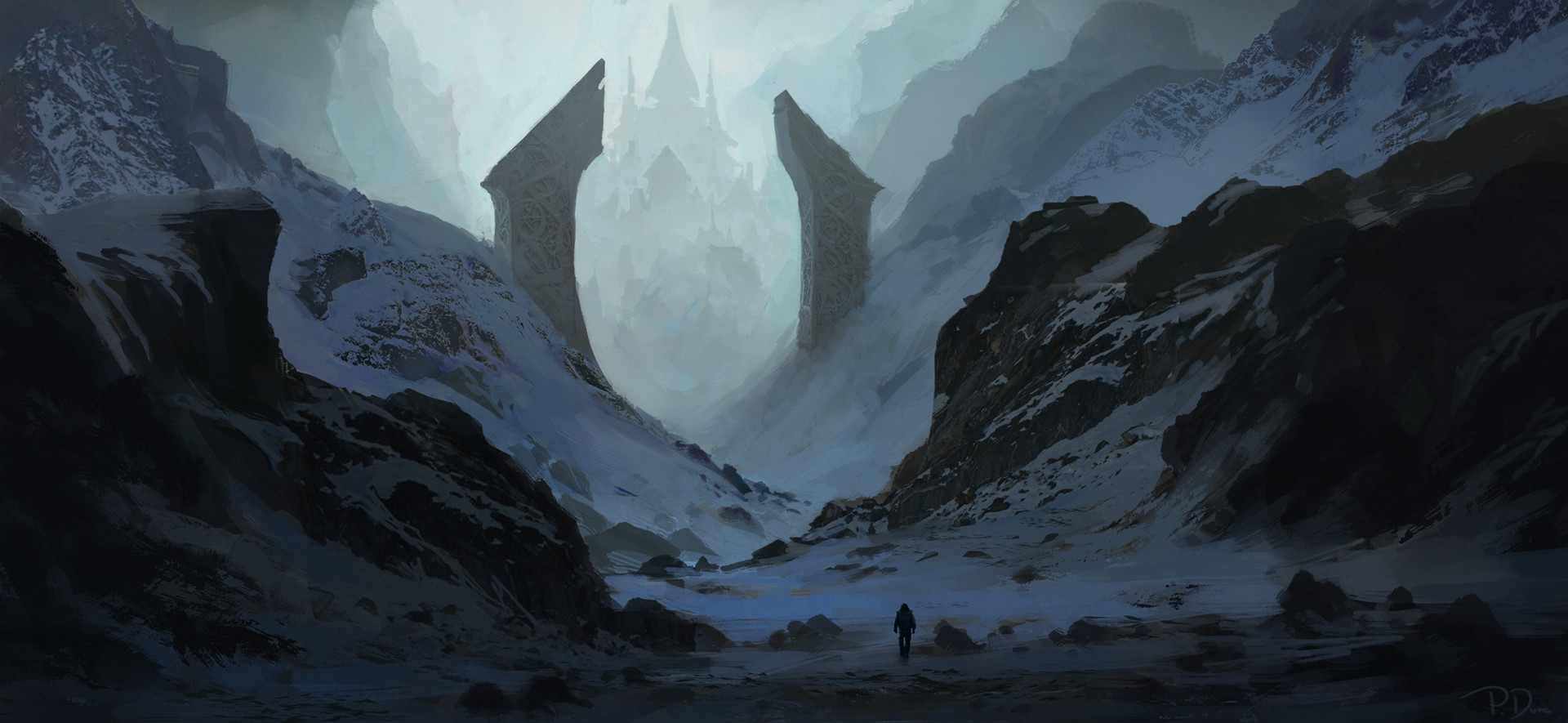
A BRIEF HISTORY OF SUPERTERRALong ago, there was a war that ended the world. Everyone knew it was coming, and so they ceaselessly prepared both to prosecute that war and to continue after its end. They built bunkers, installed autonomous systems to rebuild after the end, launched ships into the endless blackness of space to return in distant aeons.
Then the war occurred, the world ended, and their best-laid plans went awry. The vast discharge of mortal souls from their fragile frames, in bursts of incandescent radiation and ash-shadows on the rubble of great cities, shifted the very balance of reality. The Radiation Angels and Orbital War Gods trace their ancestries to this one moment of utter senseless obliteration, bestowed divinity through destruction in proportions that could only be divine.
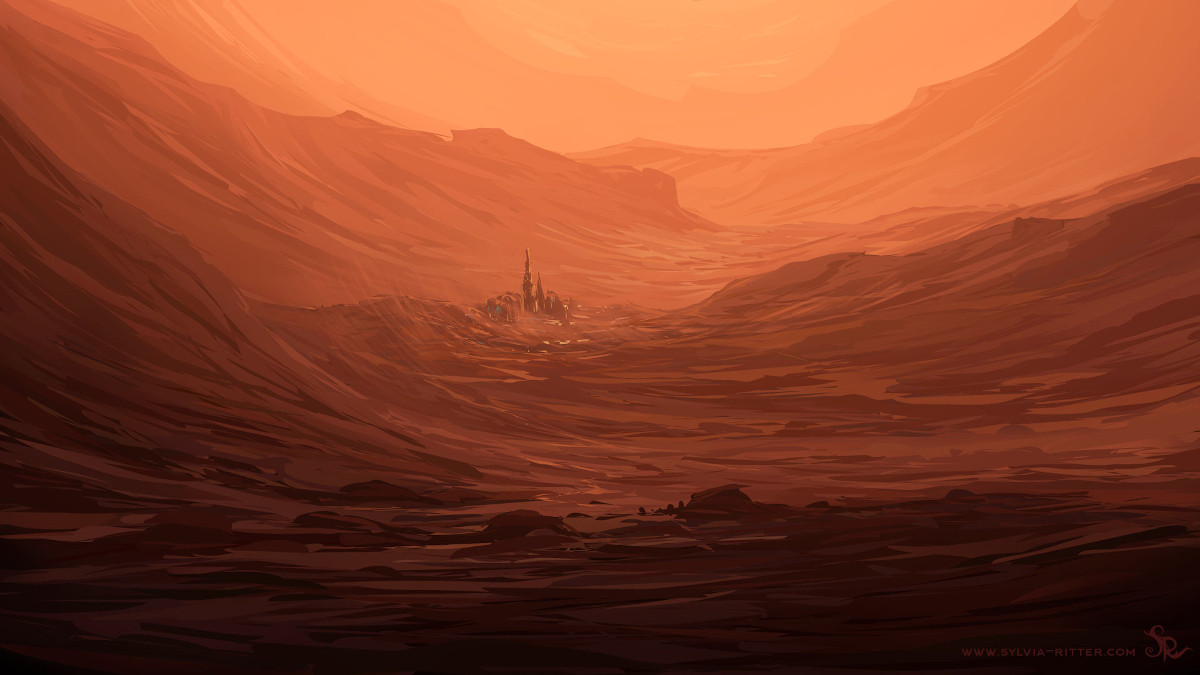
While billions perished in the first nuclear strikes, their souls riven from bodies and expelled into what would become the Stratospheric Heavens and the Hells-in-Earth, billions more lived on - to die in famine, in plague, in climate disaster, in soulstorm, in retaliatory hunter-killer drone attack. The Old World died with a bang, and then rotted in whimpering decades. The few that lived were the lucky, the experimentally-protected, or those who made deals with new powers before the rest of the world cottoned on. For centuries, survivors eked out a meagre existence as scavengers in a dead world, their numbers winnowing every generation.
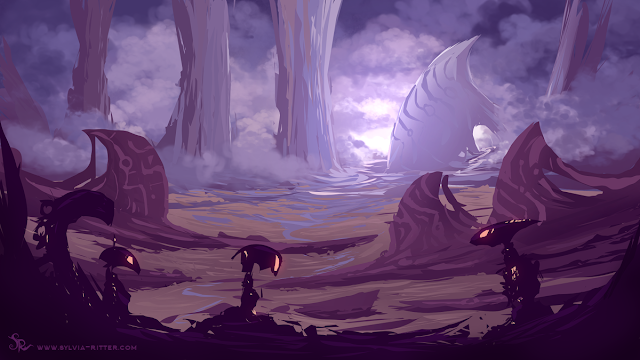
All the while, other things grew in the dark and the dust. Plans to survive the End Times soured and twisted but never died, new entities emerged into vast power vacuums they could not help but fill. Souls precipitated from the Heavens and Hells into new embodiments, merging into strange new forms that were never designed to think for themselves. Reterraforming machines woke to a world outside of any expected parameters, but dutifully set off to cleanse the air and soil of radiation. Thousands hiding in bunkers slowly broke their way to the surface, modifying themselves with the strange biotechnologies they discovered in deep Subterra. New life-ways grow and old life-ways adapt as cultures sustain themselves in a world of gods and souls and machines and angels. The world is irrevocably scarred, but healing into something unrecognizable - and intensely alive.
 |
by Sylvia Ritter
|
WHO ARE YOU?
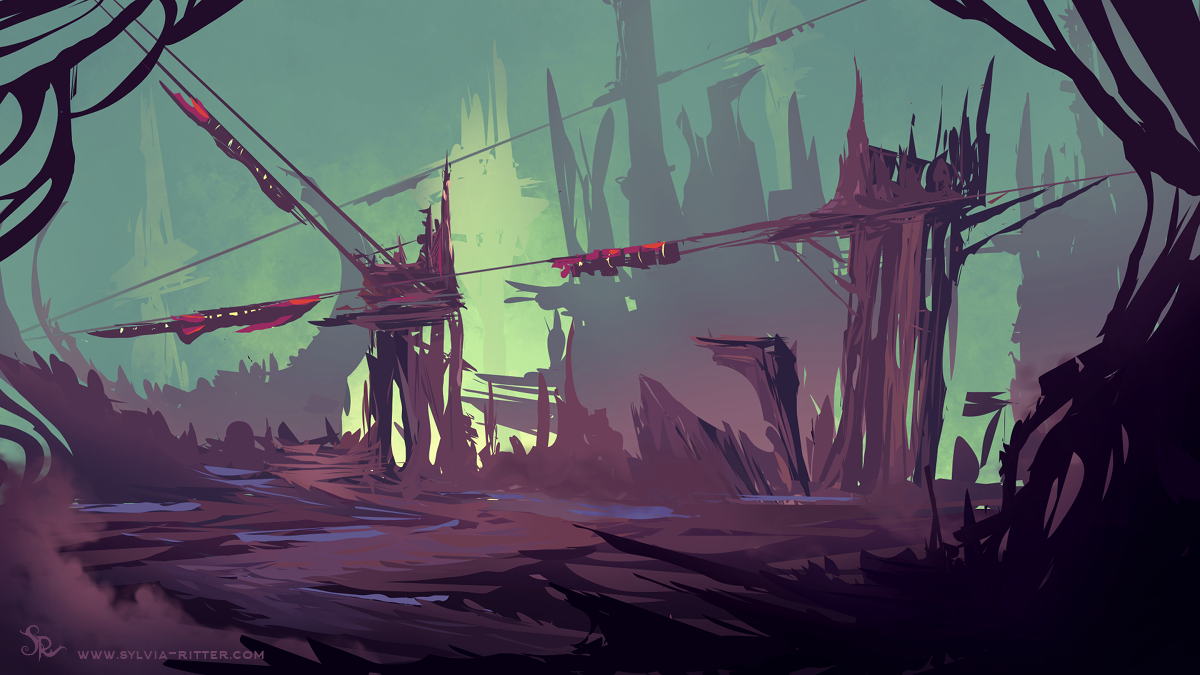
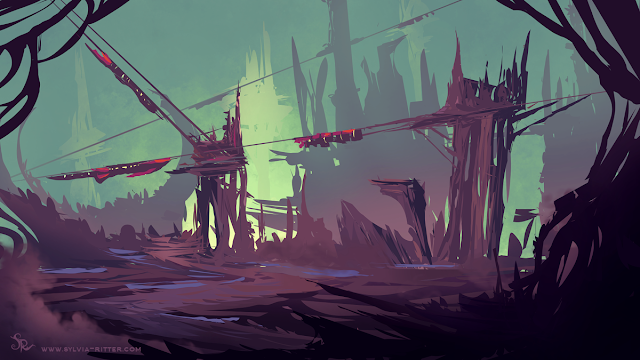
The category of "human" swells and distends. Mutations beneficial, harmless, and detrimental, nanotechnological augmentations and experiments, and soulcraft curses and geases long ago worked their way into heritability. Two people from the same village may look as different as an insect and a whale, despite nearly all originating from the homo sapiens sapiens we're familiar with today. The largest cladistic groupings organize along their tried and tested methods of surviving Superterra's omnipresent radiation; whether by technological, biological, alchemical, or stranger means.
People aren't stupid. They know, broadly, about the old world - how could they not, in the shadows of its greatest achievements and greatest follies? Details are forgotten in their irrelevance to the modern landscape, or consigned to treatises as comprehensive as they are dense. The cultural consensus regarding the old world centers around how powerful they were, how superstitious they weren't, and how their hubris inevitably ensured their undoing.
 |
by Sylvia Ritter
|
The soul is the unit of meaning and meaning-making. A soul in a complex
system becomes a person. Complex systems sometimes spontaneously
generate souls on their own, but freedom, safety, and
comfort are required to generate soul. Souls have flavors based on the consciousness they emerged from.
Soulmelliers will tell you that machine and mortal souls taste a lot
alike. If you're quick enough, you can grab soul out of the air after it's discharged, but that's just rude - especially if you're planning on eating it for power.
The mass discharge of souls in the end times, at the hands of
radiation angels, created atmospheric soul deposits (the Stratospheric
Heavens), which precipitates in soul-storms (with various forms of
soul-lightning, soul-hail, soulsnow), and discharges into the ground
(the Hells-In-Earth). These soulsoils can then be purified at a
Soulforge, jealously-guarded Old World structures refitted through
occult means to refine the dross out of base soulsoil and elevate its
dreaming consciousness into infernal metals. Most notably in the increasingly financialized wastelands of Superterra, control of a Soulforge permits the minting of soul-backed currency.
The rarity of soul-catalytic conditions makes them perfect as currency, especially as the Heavens, Hells, and Soulforges enable fungibility; in short, currency is the cycle of eternal torment. If you're killed by a
radiation angel, it sends you straight to hell, burned into the earth
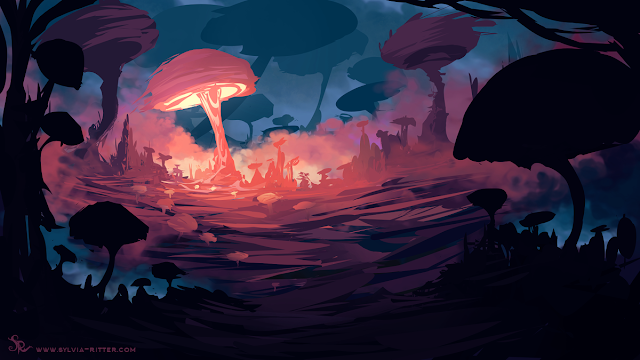
and the dust as a shadow; areas like the Scar that were struck heavily by angels in the war are rich
in hell-dirt. Nothing grows in these cursed hell-soils except fungus,
because fungus is merciless and willing to torment the souls trapped
within its mycelial net for energy and nutrients.
Soulcraft is the art of shaping and manipulating souls. Soul-lightning is the easiest trick; create a soul gradient and you can get a crackling discharge that chars and scorches flesh. Necromancy is the art of putting soul back into dead things; fossils are actually better for this because no one's going to try to get the body back. The soul has power over the body (and vice-versa, that's how killing someone works) - powerful soulcrafters can imprint the map of their changed soul on their flesh, shifting their shape to fit their whims.
 |
by Sylvia Ritter
|
How do you survive the radiation?1. Regimen of powerful antiradiation drugs with equally powerful side-effects.
2. Mechanical hazard suit. Filters, purifies, and recycles air and water. Requires charging. The highest-quality suits are built in the City of Domes, one of the only locations that can manufacture new microchips, but kitbashed suits are common across the Scar and suitshops are a fixture in even small villages. Often mount powerful devices and weapons.
3. Organic hazard suit. See above, but it's an organism and requires food. Plates of shell or bark, wiring of capillary or vine. Grown in the Hells and the Thorn Kingdoms; Thorn Knights wear menacing suits of leaf-green and rose-red.
4. Cancer-cult prayers, cleanses, exercises, and meditations. Some work, some don't, but you can't tell which is which. Each sect has their own regimens, and debates over correct technique or efficacy are the basis for bitter internecine feuds.
5. Living fast and dying young. The radiation isn't that bad if you never intended to make it past 25. Maybe you'll get some interesting mutations and insightful hallucinations along the way.
6. Soulcraft rituals anchor and tailor your form to its soul's template, forcing cancerous cells to stay in line through sheer willpower. People with training as soulcrafters are in high demand, for obvious reason, and travel widely to contract out their services.
7. Made of more robot parts than flesh. Hardened circuits and thick plating go a long way. Common in the Junk Sea, by the Spire, deep within the Subversion, and in the Technotheocracy's cyborg armies.
8. Symbiotic colony of cryptococcus neoformis, a fungus which feeds on radiation. It's taken up residence just beneath your skin, and pokes out through your mucous membranes.
9. Blood replaced with the Luminescent Ooze, upwelling from deep within Subterra, duplicating and rewriting your chromosomes. The Ooze has a slow, alien cognition of its own, communed with through dreams that are forgotten on waking but that influence your psyche all the same.
10. Nanomachine rad-scrubbers in your bloodstream, passed down through generations. Can be shorted out temporarily with an electrical charge. They build external ports and nodes on your skin for maintenance and information transfer with other nanite colonies. Some strains are transmissible through fluid mediums.
11. Buying life from others with soul currencies as a medium of exchange. The economancers of Tall Street in the Broken City have pioneered this art, and woven a Scar-spanning network of trade in soulsoils and trinitite crystals to fuel their techniques.
12. Joining a soulhive and adopting new bodies as the old ones wear out. Soulhives descend from ancient bunkers, where bodies were in too short supply for the wealth of minds and souls seeking entry. It's like a time-share, where you spend most of your time in a communal noosphere waiting your turn to pilot around one of a dozen bodies. Soulhives have the dankest memes in Superterra.
13. Weekly tank treatments; long baths in radscrubber solution. The people of the Crawling Cities love communal antirad steam baths, heated by the fires of their city's engines. Others spend weeks on end fully immersed in tanks at the end of long voyages, reknitting their genome together in a psychedelic haze.
14. Autonecromancy! Dead things can't get cancer. Necromancy remains deeply taboo, as the Wizard War staunchly refuses to pass from living memory, but that doesn't stop the curious and ambitious from seeking out the Wizard's last apprentices and plundering his tomb-towers for the secrets of eternal death.
15. Physically removing tumors and replacing them with new parts, whether organic or mechanical. Difficult and resource-intensive, but there's a certain charm to exercising one's right to true morphological freedom.
16. Soul-bond with an eidolon, a much hardier creature that mutates for you in exchange for food and shelter. Think the Picture of Dorian Grey, except instead of a painting it's an owlbear.
17. Living in an ecosynthetic biosphere where the radiation has mostly been successfully scrubbed from the environment by a local reterraforming AI's machines.
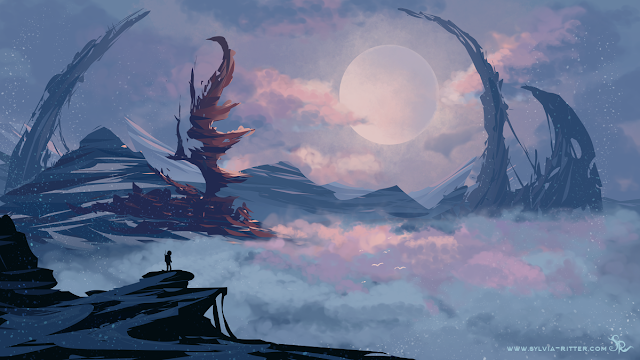
18. Eating part of an angel's corpse. On one hand, this is an awful idea. On the other hand, if you're filled with divine irradiance, it may be strong enough to push back the radiation from the outside. Don't worry about what the radiation will do to you from the inside.
19. Contract with a Hell to tithe it souls in exchange for additional life. The Mycelial Hells and Metastas the Meat Hell make these deals with distressing regularity.
20. Roll twice; you're doing both. While most stick to whichever method they grew up practicing, redundancy is important in such a hostile world, especially for the adventuring sort.
 |
by Sylvia Ritter
|
Infernal Matter
Hell-soils are
wrought into an entire periodic table of Infernal Metals. Different
soils can be forged into different metals. Each metals freezes one
moment of delectable torment in perpetuity, which can be seen in
reflections. Metals used for construction are painted bright matte
colors to paper over this inconvenient reminder. Coinage, in variously stamped denominations of sin-silver, cryptgold, or stranger alloys, keeps its natural luster of grief as an anti-counterfeiting measure.
Scarstuff, the
red and raw cracked matter of the Scar, can be forged into cold iron -
the base infernal metal. Sturdy but not too sturdy, easily worked. Rusts
over time, but the rust doesn't hurt its structural integrity; it's
only a new form of torment for the souls within.
The soulsand
dunes of the Scar can be forged into glass-steel. Translucent, thin, and
sharp, but brittle in the light. Rings with the final scream of the
damned within when struck. Not great for windows unless you like
torture. Conductive like nobody's business, excellent for
microtechnology.
Mycelial Substrate is hellsoil shot through
with fungal growth, eternally tormented to fuel the fungus. Economically
useless, but often holds nexi of valuable soils that it's saving for a
deliciously surprising meal of pain.
The unpredictable tides
of the Quicksilver Sea leave behind wet sands that can be evaporated
into Quicksalt, a preservative that rapidly dehydrates and chills
anything packed in it. Farmed by the City of Domes on the delta of the
Coil, and by the Tubedwellers who live within the forests of Carnivorous
Tubeworms.
Soulglass is a glowing green crystalline structure
that permits the souls within some freedom to roil and writhe. The Old
World term for it, Trinitite, is hypothesized to be linked to some
ancients' beliefs in a Holy Trinity of three linked deific
figures.Outcroppings of soulglass are abundant in the scar, from
swirling shards of glass blown around by the burning wind to great
crystals that act as landmarks for miles around. Unlike soulsoils, the
souls in trinitite can't be economically extracted, even at a Soulforge,
but it's very powerful for soulcraft. Even without soulcraft expertise,
it glows in the presence of strong emotion, and by reading the glow's
shades and perturbations you can tell someone's emotional state.
TRADE IN SUPERTERRA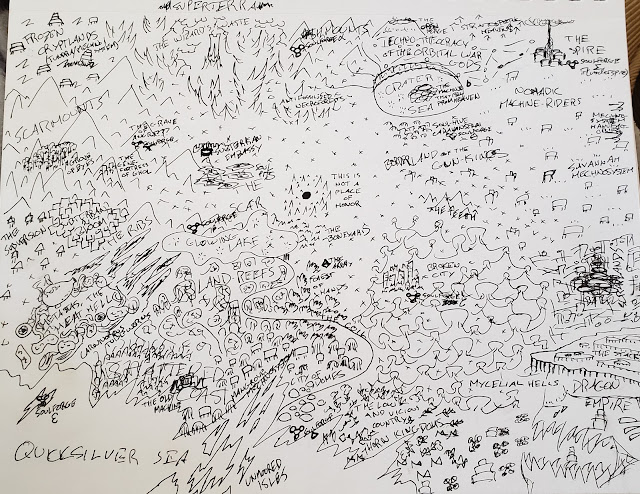 |
I'll do a better map at some point.
|
Meat from Metastas the Meat Hell for vegetables from the Thorn Kingdoms. Food and microtechnology from the City of Domes for soul-soils and archaeotech uncovered by the Crawling Cities. Bullets are traded for food along the eastern rim of the Scar. Souldirt and soulglass are refined and sold for jerkied meat around the Glowing Lake and the Array, while an abundance of supplies for Scar-travel attract merchant-venturers at the Array and the Soulhive Serai.
Metastas is the one place meat can be reliably grown on an industrial scale, which is much more calorically efficient (and less irradiated!) than anything else. This meat feeds the entire Shattered Coast, transported by hermetically sealed refrigerator-ships built at the bubble-docks of the City of Domes. These ships navigate the Unmoored Isles, evading pirates and krakens and soulstorms, and travel up the Coil once they've passed the City's extensive checkpoints. The City, of course, takes a literal cut of the meat trade, and has an extensive tariff regime on all other goods passing through the Coil's delta.
While the Thorn Kingdoms are broadly considered a primitive feudal backwater, their local biota has aggressively flushed the soil and made it fertile for a few species of thorny, hardy crops. Nowhere else is anything close to conducive to large-scale agriculture, so the Dukes with coastal fiefs trade inland vegetables for meat, and jealously guard their caloric bounty.
Ships charter to a variety of concerns headquartered either in the City of Domes, Metastas, a Thorn Kingdom port duchy, or up the Coil at the Array. Flags from the Dragon Empire, a rising power to the southeast, are a rarity - but are becoming more common sights in recent years. Unaffiliated ships "go missing" due to kraken attacks or are chalked up lost to soulstorms and pirates. Pirates in the Unmoored Isles hack and redirect ships to feed their towns; whether convict brigades from the Godforsaken Prison-Dome, denizens of the Pirate Bay Processing Collective, or the brave sailor women of Parthens.
Up the Coil, goods feed the Forest of Hands and make their way throughout the Scar. The Land-Reefs provide for their denizens, who in return protect their local fauna vigorously (plus, the reef-dwellers are the only ones who either know which are poisonous or have the genetweaks to eat them without haemhorraging from every orifice). By the Glowing Lake, the Array acts as an informal trading point for the Crawling Cities, as well as a variety of caravans who take goods into the Scar. The Array also processes food into hardier, preserved forms that'll survive its upcoming long and treacherous journeys.
 |
by Sylvia Ritter
|
The Crawling Cathedral feeds the Gene-Fortress of Ghol (though their Old World seed-stores could feed them for decades if pressed or besieged), and trades refined soulglass from the Soul Pits and their own trinitite harvests for food and goods from the coast. Crawling Cities often trade at the Broken City, and while the Mycelial Hells don't want for food, they're always willing to facilitate the food-for-souls trade in exchange for a percentage. This food then goes on to feed the armies of the Borderland of the Gun-Kings, who trade their immensely valuable guns, bullets, and vehicles in return.
Further north, any trade around the eastern rim of the Scar heading to the Crater Sea stops at the Soulhive to replenish supplies. Then it goes to the Technotheocracy of the Orbital War Gods, the Spire, or braves the Wizard's Waste to supply the Frozen Cryptlands. A north-south trip around the Scar will travel west from the Soulhive or the Technotheocracy, skirt the edge of the Antifossilized Necroforests, and stop at the Soul Pits and the Subterran Embassy before going south to the Glowing Lake.
The City of Domes has a faddish weakness for the beautiful, currently fuelled by tulip farmers in the Thorn Kingdoms and Metastasian meat-artisans. The carno-botany department of the Insulatan Academe now allows outside students' tuition to be paid in rare bulbs and tumors. While the tumor-trade is deeply illegal in a society that holds cleanliness sacrosanct, transgression only increases its luster.
The Crawling Cities have the most developed financial markets in Superterra, matched only by the Economancers of the Broken City and perhaps some Subterran regimes. Their practices of futures-trading have recently spread to the City of Domes, but have failed to take hold in the Soulhive (which refuses them on principle) and the Technotheocracy (which believes that the future is the domain of the priesthood and the Orbital War Gods, and therefore speculation is wholly immoral except by said caste).
There is ample room in this paradigm for enterprising smugglers, pirates, soldiers-of-fortune, merchant-adventurers, con artists, and speculators - and that's only scratching the surface of the perennial parasitic industries that crop up around developing markets. Explorers plumb the depths of the Junk Sea for ancient relics that will buy them entire towns. Defrosted refugees from the darkest periods of Old World history make their way south from the Frozen Cryptlands, awakened into a world that looks perhaps too familiar. The Dragon Empire encroaches on Orbital War God-fearing subjugated territories of the Technotheocracy, and cries are raised across the Crater Sea for something to be done. All the while, angels moulder in their launch cradles, gods twinkle in the night sky, souls scream in torment as their coinage changes hands, and the many oozing hearts of Subterra beat faster, seeking blessed, cursed light.