Pages

Showing posts with label exploration. Show all posts

Sunday, January 29, 2023

Caravans

You are a band of itinerant traders; hungry, destitute, and unwelcome in Society. Your wagons are battered, your beasts are crotchety, and your reputation is foul. To escape these unacceptable conditions and claim the riches that are your right, you will do anything: lie, steal, kill, and worst of all – arbitrage.

CARAVAN STATS

➢ Wagons. Each point of wagons allows you to carry 6 cargo.
➢ Beasts determine the speed at which your caravan travels.
➢ Reputation determines how you are received by locals. You learn reputation rumors per week in town.

Each stat starts at 1. To improve the caravan’s stats, see Caravan Upgrades. Your caravan also begins with 3d4 crowns (♛) and a partial map of the region.

art by yoggurt

TOWNS

Start in town. Each week you spend in town costs 1♛for basic lodging, food, and board. Better lodgings cost more ♛. You must spend at least one week in town to sell off your wares and acquire new goods or supplies.

➢ Supplies (☒) cost 1♛ each. A unit of supplies will sustain your caravan for one caravan turn.
➢ Commodities are either scarce or common in a location. Common commodities can be bought for
d3♛ per unit. Scarce commodities can be sold for d3+3♛ per unit. All other commodities can be sold for d4♛ per unit. Only common commodities are available for wholesale, unless a rumor says otherwise.

You may also take on Passengers. Fares are based on destination and are paid half up front and half on arrival.
➢ Some passengers are rich and will pay d6 times the normal fare. Such passengers include unapparent heirs, incognito diplomats, eccentric wizards, wealthy merchants, notable scholars, or successful adventurers. Taking on rich passengers is a great way to improve your reputation, but requires status to attract them.
➢ Passengers need to be protected along the journey. Each lost passenger decreases your reputation by 1.
➢ You may carry 1 passenger per full wagon, or 3 passengers per wagon with no commodities. Rich
passengers refuse to travel with cargo or passengers of a lower social strata.

➢ Villages have 1 common and 2 scarce commodities, appear along trade routes or around keeps; local lord demands tithes from traders. Passenger fare 20 nibs (⇃). 100⇃ is 1♛.
➢ Keeps have 2 common, 3 scarce, d3 trade routes linking them to other locations. Traders must give lord first pick of wares. Passenger fare 20⇃.
➢ Towns have 3 common, 6 scarce, d3+1 trade routes. Local nobles’ guards enforce taboos and confiscate contraband. Passenger fare 50⇃.
➢ Cities have 6 common, 3 scarce, d3+3 trade routes. Requires trading license (10♛, halved if reputation 3+) for access to market stalls. City watch checks cargo for contraband. Passenger fare 100⇃.

CARAVAN UPGRADES

Increases in stats are tied to specific material changes in your circumstances, and so can be lost in similar ways. You may gain beasts through more, faster, or hardier mounts, wagons through more, larger, or sturdier wagons and pack animals, and reputation through positive relations with important individuals and colorful characters.

Special Upgrades
1. Banners. Visible far and wide; you're a traveling spectacle with wares to ply. Raises your reputation with locals, people will approach more often (whether for good or ill).
2. Beasts of burden. -1 tick of distance on all journeys (minimum 2).
3. Exploration gear. Good for exploration, weathering storms, fording rivers. Takes up an entire wagon.
4. Dire beasts. Eat live prey, not supplies. Double your beasts.
5. Hidden compartments. Deep enough to conceal 1 contraband per wagon from careful scrutiny.
6. Hired guards. Will defend your caravan; fee of 1♛ per guard per trip (may vary based on guard level). May abandon or turn on you if it appears they won’t be paid on time.
7. Passenger carriage. Rich passengers won’t grumble (as much). Counts as an extra wagon for purposes of route length.
8. Quality saddlebags. Carry 2 additional cargo per point of beasts.
9. Well-kept books. Keep meticulous records of prices and goods available. Can hide shady transactions in clever accounting. Raises reputation with bureaucrats and honest merchants.
10. Writ of Passage. Immunity from tax collectors and guards while engaging in lawful commerce. Authority figures grudgingly respect this writ, though they will try to make your life hell through any remaining avenues.

art by Tooth Wu

RUMORS

Each week in town, roll reputation times on the rumor table. You may buy another round for 50⇃ to hear an additional rumor, as many times as you want (up to the level of
your accommodations). Rumors will help you fill out your map, warn you about hazards, provide
deals on cargo, and more.

1. A local common commodity is scarce elsewhere, and the reason why.
2. A local scarce commodity is common elsewhere.
3. A commodity you’re carrying is scarce here! What luck!
4. A deal on supplies! 1☒ costs 75⇃.
5. Danger or characteristic of a nearby trade route.
6. Opportunity on a nearby trade route.
7. Local common commodity available for 1♛ per unit!
8. A commodity is available for wholesale at common prices!
9. Rich passenger needs transport.
10. Learn of a local opportunity to upgrade your caravan for only 2d3♛!
11. Learn of a new trade route from this location.
12. +1 reputation, roll again, and remember nothing else from the night.

ROUTES

Once you've loaded up your wagons and are too broke for another night at the inn, choose a route to a destination.

➢ Routes have a danger level from 1 to 5, representing the number of slots on their d6 encounter table that are filled with random encounters. Slot 6 is always an opportunity. Other results are neutral, or may be modified by the route’s characteristics.
➢ Routes also have a distance to their destination, measured in ticks. A tick is an abstract unit of distance that represents the distance your caravan can travel, comfortably, on one unit of supplies. If you have more beasts than wagons, subtract the difference from the distance. If you have more wagons than beasts, add the difference to the distance. Minimum distance 1.
➢ If you’re insane or well-prepared, you can set off on your own into the wilds. Treat this as a route with danger equal to its distance. Your stats cannot decrease this distance. 

art by Boris Martsev

Travel proceeds in Caravan Turns. Each caravan turn, do the following in order.
1. Move 1 tick closer to your destination.
2. Roll for an encounter.
➢ Danger. Encounter occurs.
➢ Opportunity. Choose to either take the opportunity or move 1 tick closer to your destination.
3. Take a Caravan Action.
4. Consume ☒.

CARAVAN ACTIONS

➢ Speed up. Move 1 tick closer to your destination.
➢ Pursue a specific danger or opportunity that you've heard of or encountered on this route. You may replace non-Danger results with that danger or opportunity until you successfully encounter it.
➢ Stop for rest and repairs. All characters may take a long rest. You may consume 1☒ to repair any damage that your caravan has sustained this journey.
➢ Forage for local supplies. Make an appropriate skill check. On a success, gain 1☒.
➢ Something else.

d20 route characteristics

1. Heavily traveled.
2. Long and winding. +2 distance.
3. Poorly mapped.
4. Pilgrimage route.
5. Highly populated.
6. Smuggler’s route.
7. Wet, swampy. -1 tick per wagon.
8. Sparse. No foraging en route.
9. Dense foliage. Can't speed up.
10. Tight paths. At max 2 beasts.
11. Underground.
12. Heavily patrolled.
13. Rampant beasts.
14. Storm-wracked.
15. Plagued.
16. Embattled.
17. Cursed, according to locals.
18. Monster hunting ground.
19. Ruined route, from a past era.
20. Doesn’t go where marked.
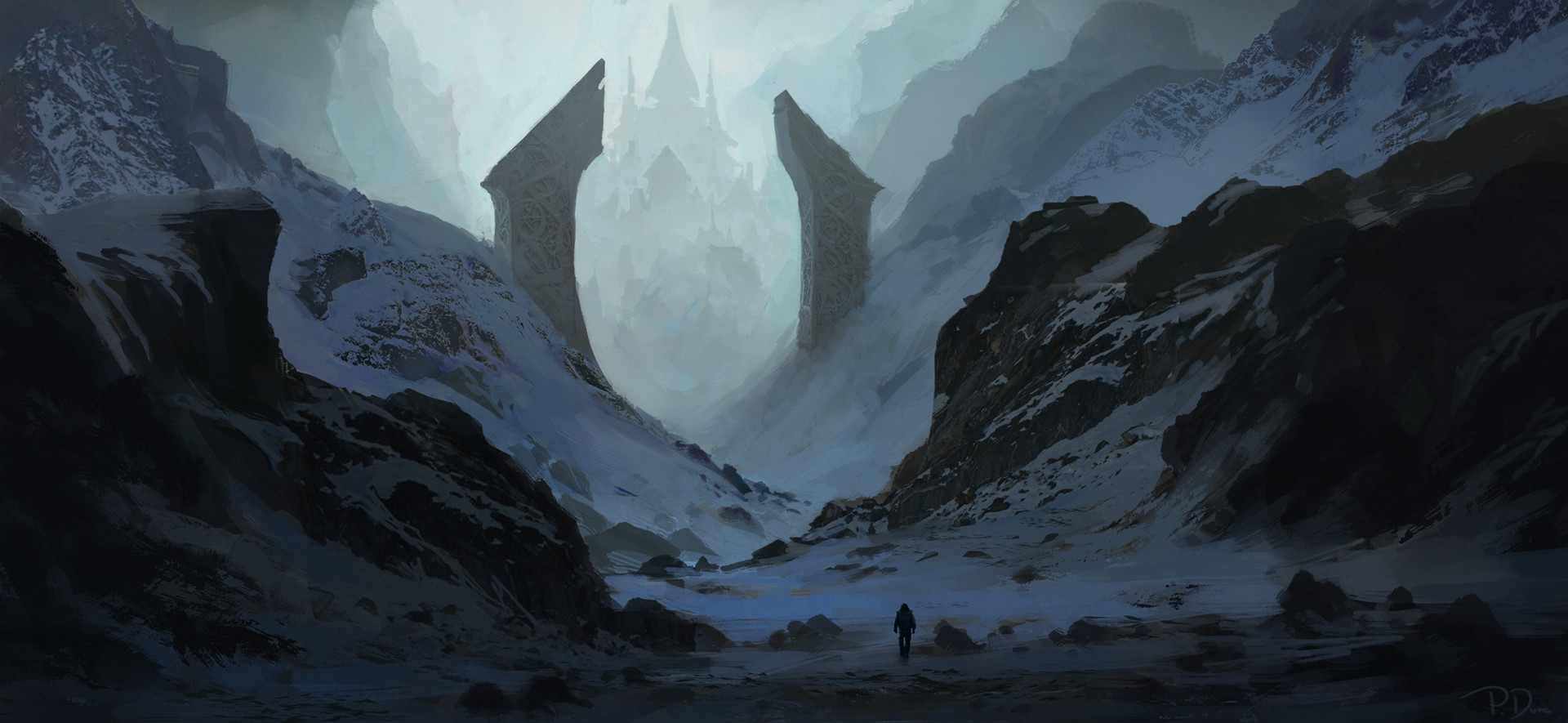
art by Piotr Dura

d20 random route encounters

1. Highwaymen, demanding toll.
2. Bandits, demanding your cargo.
3. Lawmen, checking contraband.
4. Tax collectors.
5. Rival caravan.
6. Mercenary company, disgruntled.
7. Traveling preachers and flock.
8. Adventurers, looting.
9. Storm!
10. River. Must be forded.
11. Plague! -1 beasts until cured.
12. Wolves or other pack hunters.
13. Bear or similar megafauna.
14. Dragon or similar gigafauna.
15. Bridge troll, bridge optional.
16. Goblins or similar nuisance.
17. Ghosts.
18. A battle!
19. A stowaway!
20. Roll twice; both at once.

d20 opportunities en route

1. Village, not on map.
2. Crossroads and trading post.
3. Campsite & travelers. d4 rumors.
4. High vantage; expand map.
5. Wrecked caravan, unlooted.
6. Rich passenger, needs ride to city.
7. Pilgrims, need ride to sacred site.
8. Monster nest, seems unguarded.
9. Fork in road, leads to new route.
10. Standing stones, magical.
11. Local commodity for harvest.
12. Shortcut! -2 ticks of distance.
13. Supply cache. +d4☒.
14. Adventurers, questing.
15. Abandoned keep.
16. Ancient ruins.
17. Lost temple.
18. Noble mansion, taking visitors.
19. Wizard tower.
20. Buried treasure (likely cursed).

➢ Don’t put every encounter on every trade route.
➢ Some encounters are best addressed without violence, but none can be avoided.
➢ Create new entries or tables for your setting.

COMMODITIES

When buying or selling commodities, a price is given up front. In response, you may haggle. If you are successful, you may roll another price and take whichever result is more advantageous. If you fail, roll another price and take whichever result is less advantageous.

art by Ilia12345
d20 commodities
1. Grain.
2. Iron, copper, tin, etc.
3. Gold, silver, other precious metals.
4. Foodstuffs. Can be eaten as supplies in a pinch.
5. Booze.
6. Salt.
7. Spices.
8. Weapons, armor, & ammunition
9. Tools & manufactured goods.
10. Ceramics.
11. Fabric.
12. Fauna, alive.
13. Livestock. Does not count towards beasts.
14. Narcotics
15. Relics.
16. Books, whether holy, rare, or magical.
17. Art.
18. Magical reagents.
19. Trinkets.
20. Roll twice, it’s both.

d20 reasons why it’s scarce
1. Brand name.
2. High quality.
3. Subject of recent fad among wealthy.
4. Impossibly rare.
5. Magical.
6. Contraband in major polities.
7. Other traders bought it all out.
8. Dangerous or difficult to carry.
9. Recent shortage.
10. Easily disguised as something more valuable.
11. Eccentric aristocrat wants lots of it for "reasons".
12. Recently proscribed by clerical decree.
13. Bandits raiding caravans along common routes.
14. Necessary for recent innovation.
15. Monopolized by cartel, syndicate, or guild.
16. Supply shortage due to recent disaster.
17. Difficult or dangerous to harvest.
18. Royally-imposed punitive taxes.
19. Recently discovered; subject of gold rush.
20. No one knows – profit by finding out why!

Sunday, May 8, 2022

Superterra: This is Not a Land of Honor

art by Sylvia Ritter
A BRIEF HISTORY OF SUPERTERRA
Long ago, there was a war that ended the world. Everyone knew it was coming, and so they ceaselessly prepared both to prosecute that war and to continue after its end. They built bunkers, installed autonomous systems to rebuild after the end, launched ships into the endless blackness of space to return in distant aeons.

Then the war occurred, the world ended, and their best-laid plans went awry. The vast discharge of mortal souls from their fragile frames, in bursts of incandescent radiation and ash-shadows on the rubble of great cities, shifted the very balance of reality. The Radiation Angels and Orbital War Gods trace their ancestries to this one moment of utter senseless obliteration, bestowed divinity through destruction in proportions that could only be divine.

While billions perished in the first nuclear strikes, their souls riven from bodies and expelled into what would become the Stratospheric Heavens and the Hells-in-Earth, billions more lived on - to die in famine, in plague, in climate disaster, in soulstorm, in retaliatory hunter-killer drone attack. The Old World died with a bang, and then rotted in whimpering decades. The few that lived were the lucky, the experimentally-protected, or those who made deals with new powers before the rest of the world cottoned on. For centuries, survivors eked out a meagre existence as scavengers in a dead world, their numbers winnowing every generation.

All the while, other things grew in the dark and the dust. Plans to survive the End Times soured and twisted but never died, new entities emerged into vast power vacuums they could not help but fill. Souls precipitated from the Heavens and Hells into new embodiments, merging into strange new forms that were never designed to think for themselves. Reterraforming machines woke to a world outside of any expected parameters, but dutifully set off to cleanse the air and soil of radiation. Thousands hiding in bunkers slowly broke their way to the surface, modifying themselves with the strange biotechnologies they discovered in deep Subterra. New life-ways grow and old life-ways adapt as cultures sustain themselves in a world of gods and souls and machines and angels. The world is irrevocably scarred, but healing into something unrecognizable - and intensely alive.

by Sylvia Ritter

WHO ARE YOU?
The category of "human" swells and distends. Mutations beneficial, harmless, and detrimental, nanotechnological augmentations and experiments, and soulcraft curses and geases long ago worked their way into heritability. Two people from the same village may look as different as an insect and a whale, despite nearly all originating from the homo sapiens sapiens we're familiar with today. The largest cladistic groupings organize along their tried and tested methods of surviving Superterra's omnipresent radiation; whether by technological, biological, alchemical, or stranger means.

People aren't stupid. They know, broadly, about the old world - how could they not, in the shadows of its greatest achievements and greatest follies? Details are forgotten in their irrelevance to the modern landscape, or consigned to treatises as comprehensive as they are dense. The cultural consensus regarding the old world centers around how powerful they were, how superstitious they weren't, and how their hubris inevitably ensured their undoing.

by Sylvia Ritter


The soul is the unit of meaning and meaning-making. A soul in a complex system becomes a person. Complex systems sometimes spontaneously generate souls on their own, but freedom, safety, and comfort are required to generate soul. Souls have flavors based on the consciousness they emerged from. Soulmelliers will tell you that machine and mortal souls taste a lot alike. If you're quick enough, you can grab soul out of the air after it's discharged, but that's just rude - especially if you're planning on eating it for power.

The mass discharge of souls in the end times, at the hands of radiation angels, created atmospheric soul deposits (the Stratospheric Heavens), which precipitates in soul-storms (with various forms of soul-lightning, soul-hail, soulsnow), and discharges into the ground (the Hells-In-Earth). These soulsoils can then be purified at a Soulforge, jealously-guarded Old World structures refitted through occult means to refine the dross out of base soulsoil and elevate its dreaming consciousness into infernal metals. Most notably in the increasingly financialized wastelands of Superterra, control of a Soulforge permits the minting of soul-backed currency.

The rarity of soul-catalytic conditions makes them perfect as currency, especially as the Heavens, Hells, and Soulforges enable fungibility; in short, currency is the cycle of eternal torment. If you're killed by a radiation angel, it sends you straight to hell, burned into the earth and the dust as a shadow; areas like the Scar that were struck heavily by angels in the war are rich in hell-dirt. Nothing grows in these cursed hell-soils except fungus, because fungus is merciless and willing to torment the souls trapped within its mycelial net for energy and nutrients.

Soulcraft is the art of shaping and manipulating souls. Soul-lightning is the easiest trick; create a soul gradient and you can get a crackling discharge that chars and scorches flesh. Necromancy is the art of putting soul back into dead things; fossils are actually better for this because no one's going to try to get the body back. The soul has power over the body (and vice-versa, that's how killing someone works) - powerful soulcrafters can imprint the map of their changed soul on their flesh, shifting their shape to fit their whims.

by Sylvia Ritter
How do you survive the radiation?

1. Regimen of powerful antiradiation drugs with equally powerful side-effects.

2. Mechanical hazard suit. Filters, purifies, and recycles air and water. Requires charging. The highest-quality suits are built in the City of Domes, one of the only locations that can manufacture new microchips, but kitbashed suits are common across the Scar and suitshops are a fixture in even small villages. Often mount powerful devices and weapons.

3. Organic hazard suit. See above, but it's an organism and requires food. Plates of shell or bark, wiring of capillary or vine. Grown in the Hells and the Thorn Kingdoms; Thorn Knights wear menacing suits of leaf-green and rose-red.

4. Cancer-cult prayers, cleanses, exercises, and meditations. Some work, some don't, but you can't tell which is which. Each sect has their own regimens, and debates over correct technique or efficacy are the basis for bitter internecine feuds.

5. Living fast and dying young. The radiation isn't that bad if you never intended to make it past 25. Maybe you'll get some interesting mutations and insightful hallucinations along the way.

6. Soulcraft rituals anchor and tailor your form to its soul's template, forcing cancerous cells to stay in line through sheer willpower. People with training as soulcrafters are in high demand, for obvious reason, and travel widely to contract out their services.

7. Made of more robot parts than flesh. Hardened circuits and thick plating go a long way. Common in the Junk Sea, by the Spire, deep within the Subversion, and in the Technotheocracy's cyborg armies.

8. Symbiotic colony of cryptococcus neoformis, a fungus which feeds on radiation. It's taken up residence just beneath your skin, and pokes out through your mucous membranes.

9. Blood replaced with the Luminescent Ooze, upwelling from deep within Subterra, duplicating and rewriting your chromosomes. The Ooze has a slow, alien cognition of its own, communed with through dreams that are forgotten on waking but that influence your psyche all the same.

10. Nanomachine rad-scrubbers in your bloodstream, passed down through generations. Can be shorted out temporarily with an electrical charge. They build external ports and nodes on your skin for maintenance and information transfer with other nanite colonies. Some strains are transmissible through fluid mediums.

11. Buying life from others with soul currencies as a medium of exchange. The economancers of Tall Street in the Broken City have pioneered this art, and woven a Scar-spanning network of trade in soulsoils and trinitite crystals to fuel their techniques.

12. Joining a soulhive and adopting new bodies as the old ones wear out. Soulhives descend from  ancient bunkers, where bodies were in too short supply for the wealth of minds and souls seeking entry. It's like a time-share, where you spend most of your time in a communal noosphere waiting your turn to pilot around one of a dozen bodies. Soulhives have the dankest memes in Superterra.

13. Weekly tank treatments; long baths in radscrubber solution. The people of the Crawling Cities love communal antirad steam baths, heated by the fires of their city's engines. Others spend weeks on end fully immersed in tanks at the end of long voyages, reknitting their genome together in a psychedelic haze.

14. Autonecromancy! Dead things can't get cancer. Necromancy remains deeply taboo, as the Wizard War staunchly refuses to pass from living memory, but that doesn't stop the curious and ambitious from seeking out the Wizard's last apprentices and plundering his tomb-towers for the secrets of eternal death.

15. Physically removing tumors and replacing them with new parts, whether organic or mechanical. Difficult and resource-intensive, but there's a certain charm to exercising one's right to true morphological freedom.

16. Soul-bond with an eidolon, a much hardier creature that mutates for you in exchange for food and shelter. Think the Picture of Dorian Grey, except instead of a painting it's an owlbear.

17. Living in an ecosynthetic biosphere where the radiation has mostly been successfully scrubbed from the environment by a local reterraforming AI's machines.

18. Eating part of an angel's corpse. On one hand, this is an awful idea. On the other hand, if you're filled with divine irradiance, it may be strong enough to push back the radiation from the outside. Don't worry about what the radiation will do to you from the inside.

19. Contract with a Hell to tithe it souls in exchange for additional life. The Mycelial Hells and Metastas the Meat Hell make these deals with distressing regularity.

20. Roll twice; you're doing both. While most stick to whichever method they grew up practicing, redundancy is important in such a hostile world, especially for the adventuring sort.

by Sylvia Ritter

Infernal Matter

Hell-soils are wrought into an entire periodic table of Infernal Metals. Different soils can be forged into different metals. Each metals freezes one moment of delectable torment in perpetuity, which can be seen in reflections. Metals used for construction are painted bright matte colors to paper over this inconvenient reminder. Coinage, in variously stamped denominations of sin-silver, cryptgold, or stranger alloys, keeps its natural luster of grief as an anti-counterfeiting measure.

Scarstuff, the red and raw cracked matter of the Scar, can be forged into cold iron - the base infernal metal. Sturdy but not too sturdy, easily worked. Rusts over time, but the rust doesn't hurt its structural integrity; it's only a new form of torment for the souls within.

The soulsand dunes of the Scar can be forged into glass-steel. Translucent, thin, and sharp, but brittle in the light. Rings with the final scream of the damned within when struck. Not great for windows unless you like torture. Conductive like nobody's business, excellent for microtechnology.

Mycelial Substrate is hellsoil shot through with fungal growth, eternally tormented to fuel the fungus. Economically useless, but often holds nexi of valuable soils that it's saving for a deliciously surprising meal of pain.

The unpredictable tides of the Quicksilver Sea leave behind wet sands that can be evaporated into Quicksalt, a preservative that rapidly dehydrates and chills anything packed in it. Farmed by the City of Domes on the delta of the Coil, and by the Tubedwellers who live within the forests of Carnivorous Tubeworms.

Soulglass is a glowing green crystalline structure that permits the souls within some freedom to roil and writhe. The Old World term for it, Trinitite, is hypothesized to be linked to some ancients' beliefs in a Holy Trinity of three linked deific figures.Outcroppings of soulglass are abundant in the scar, from swirling shards of glass blown around by the burning wind to great crystals that act as landmarks for miles around. Unlike soulsoils, the souls in trinitite can't be economically extracted, even at a Soulforge, but it's very powerful for soulcraft. Even without soulcraft expertise, it glows in the presence of strong emotion, and by reading the glow's shades and perturbations you can tell someone's emotional state.

TRADE IN SUPERTERRA

I'll do a better map at some point.


Meat from Metastas the Meat Hell for vegetables from the Thorn Kingdoms. Food and microtechnology from the City of Domes for soul-soils and archaeotech uncovered by the Crawling Cities. Bullets are traded for food along the eastern rim of the Scar. Souldirt and soulglass are refined and sold for jerkied meat around the Glowing Lake and the Array, while an abundance of supplies for Scar-travel attract merchant-venturers at the Array and the Soulhive Serai.

Metastas is the one place meat can be reliably grown on an industrial scale, which is much more calorically efficient (and less irradiated!) than anything else. This meat feeds the entire Shattered Coast, transported by hermetically sealed refrigerator-ships built at the bubble-docks of the City of Domes. These ships navigate the Unmoored Isles, evading pirates and krakens and soulstorms, and travel up the Coil once they've passed the City's extensive checkpoints. The City, of course, takes a literal cut of the meat trade, and has an extensive tariff regime on all other goods passing through the Coil's delta.

While the Thorn Kingdoms are broadly considered a primitive feudal backwater, their local biota has aggressively flushed the soil and made it fertile for a few species of thorny, hardy crops. Nowhere else is anything close to conducive to large-scale agriculture, so the Dukes with coastal fiefs trade inland vegetables for meat, and jealously guard their caloric bounty.

Ships charter to a variety of concerns headquartered either in the City of Domes, Metastas, a Thorn Kingdom port duchy, or up the Coil at the Array. Flags from the Dragon Empire, a rising power to the southeast, are a rarity - but are becoming more common sights in recent years. Unaffiliated ships "go missing" due to kraken attacks or are chalked up lost to soulstorms and pirates. Pirates in the Unmoored Isles hack and redirect ships to feed their towns; whether convict brigades from the Godforsaken Prison-Dome, denizens of the Pirate Bay Processing Collective, or the brave sailor women of Parthens.

Up the Coil, goods feed the Forest of Hands and make their way throughout the Scar. The Land-Reefs provide for their denizens, who in return protect their local fauna vigorously (plus, the reef-dwellers are the only ones who either know which are poisonous or have the genetweaks to eat them without haemhorraging from every orifice). By the Glowing Lake, the Array acts as an informal trading point for the Crawling Cities, as well as a variety of caravans who take goods into the Scar. The Array also processes food into hardier, preserved forms that'll survive its upcoming long and treacherous journeys.

by Sylvia Ritter


 The Crawling Cathedral feeds the Gene-Fortress of Ghol (though their Old World seed-stores could feed them for decades if pressed or besieged), and trades refined soulglass from the Soul Pits and their own trinitite harvests for food and goods from the coast. Crawling Cities often trade at the Broken City, and while the Mycelial Hells don't want for food, they're always willing to facilitate the food-for-souls trade in exchange for a percentage. This food then goes on to feed the armies of the Borderland of the Gun-Kings, who trade their immensely valuable guns, bullets, and vehicles in return.

Further north, any trade around the eastern rim of the Scar heading to the Crater Sea stops at the Soulhive to replenish supplies. Then it goes to the Technotheocracy of the Orbital War Gods, the Spire, or braves the Wizard's Waste to supply the Frozen Cryptlands. A north-south trip around the Scar will travel west from the Soulhive or the Technotheocracy, skirt the edge of the Antifossilized Necroforests, and stop at the Soul Pits and the Subterran Embassy before going south to the Glowing Lake.

The City of Domes has a faddish weakness for the beautiful, currently fuelled by tulip farmers in the Thorn Kingdoms and Metastasian meat-artisans. The carno-botany department of the Insulatan Academe now allows outside students' tuition to be paid in rare bulbs and tumors. While the tumor-trade is deeply illegal in a society that holds cleanliness sacrosanct, transgression only increases its luster.

The Crawling Cities have the most developed financial markets in Superterra, matched only by the Economancers of the Broken City and perhaps some Subterran regimes. Their practices of futures-trading have recently spread to the City of Domes, but have failed to take hold in the Soulhive (which refuses them on principle) and the Technotheocracy (which believes that the future is the domain of the priesthood and the Orbital War Gods, and therefore speculation is wholly immoral except by said caste).

There is ample room in this paradigm for enterprising smugglers, pirates, soldiers-of-fortune, merchant-adventurers, con artists, and speculators - and that's only scratching the surface of the perennial parasitic industries that crop up around developing markets. Explorers plumb the depths of the Junk Sea for ancient relics that will buy them entire towns. Defrosted refugees from the darkest periods of Old World history make their way south from the Frozen Cryptlands, awakened into a world that looks perhaps too familiar. The Dragon Empire encroaches on Orbital War God-fearing subjugated territories of the Technotheocracy, and cries are raised across the Crater Sea for something to be done. All the while, angels moulder in their launch cradles, gods twinkle in the night sky, souls scream in torment as their coinage changes hands, and the many oozing hearts of Subterra beat faster, seeking blessed, cursed light.

Saturday, September 25, 2021

LEGAMON: Travel Across the Land (Searching Far and Wide)

The commonly-accepted layout of the Cataclys Region.
 

Here's some more rules for my Legamon region! What would a 'mon game be without exploration?

On the map, rectangles are biomes, ovals are micro-biomes, diamonds are dungeons, and circles are towns. Stars are the sites of rumors, unexplored landmarks in the distance, and tales of eras past...

Double-lines are established routes. Dotted lines are pathways that you know of, but that require specialized 'mon or expertise to traverse (typically over water, through dark tunnels, or across passes blocked with rubble).

Dozens more pathways exist! It's up to you and your team of hardy adventurers to find them. (I have a copy of the Full Map - it's excitingly interconnected and full of fascinating secrets).

Travel
Days are divided into three segments - Morning, 
Afternoon, and Night. Each segment you're traveling in the wild, roll two dice on the biome's Signs table. If you roll a result you've rolled before that trip in the biome - or if you roll doubles - the Encounter linked to the Sign occurs.

After rolling for Signs and resolving any encounters, you may either Travel or Investigate. 

Traveling moves you one step further through the biome and closer to your destination. 

Investigating lets you follow up on a Sign you rolled this half-day, deliberately encountering whatever it portends. If you investigate, you make no progress towards your objective - but Legamon is about the journey, not the destination!

Encounters have three grades of Danger (⚠). This measures how hard they are to confront violently - encounters can (and should) be completed in other ways. Danger increases by
⚠ at night, by ⚠ in certain weather conditions, and ⚠ when you're travelling loudly (with large legamon, vehicles, running, shouting, shining bright lights around, etc). Danger starts at ⚠, and cannot increase above ⚠⚠⚠.

Rolling a duplicate sign causes the corresponding encounter at the current Danger level, even if previous signs were rolled at lower (or higher!) levels of Danger.

Investigation
Whether tracking a lost 'mon, seeking out a hidden pathway, or braving the depths of an ancient ruin, the process of investigation is abstracted in the same way. Prepare a list of Rumors and Clues for the players. Rumors are gained from NPCs in town or on the road, while Clues are found in the wild after encounters. Rumors and Clues both hint at Signs the players need to investigate as they encounter them in their exploration.

Modify the Signs that your Rumors and Clues lead to with additional Obstacles, and write down what the players gain when they overcome those obstacles - typically more Clues that help lead players to their objective.

Players who've figured out what Sign a Clue leads to will still need to organically run into that Sign in their exploration, which may take time. Players following up on extraneous Signs in the process will run into encounters that can deplete their resources.

Clues are sequenced, and therefore the players may sequence-break. This is a good thing! If the party stumble into and resolve an encounter that's later in the chain of clues, they can absolutely get later clues - or even find their objective!

Some objectives may require at least one previous obstacle to be overcome. If the party encounters the objective's Sign without overcoming a previous obstacle, they've just found a different part of the biome with similar characteristics. After all, there's more than one Serpyne nest in Iridesce Forest.

Sample Encounter Tables
Chalice Highlands
1. Circling shape high above ➔ ⚠ Prowowl searching for Dugratts or Permafrogs.
        ⚠⚠ Paragrine, hunting a stray Gruffle.
        ⚠⚠⚠ Cuatlass, hunting an entire herd.
2. Distant herd ➔ ⚠ Gruffle grazing on tall grass.
        ⚠⚠ Rundeer.
        ⚠⚠⚠ Group of Moostler.

3.
Mischief ➔ ⚠ One of Skrundle, Impossumble, or Racceteer.
        ⚠⚠ Two of them.
        ⚠⚠⚠ All three.

4.
Flock of birds ➔ ⚠ Chirpikeet.
        ⚠⚠ Hunting Sparrowls.
        ⚠⚠⚠ Pair of Hailcon.

5.
Shifting beneath the tundra ➔ ⚠ Hive of Dugratt.
        ⚠⚠ Disturbed colony of hibernating Permafrog.
        ⚠⚠⚠ Glacianura.

6. Tracks in fresh snow
➔ ⚠ Pack of Beaglisk.
        ⚠⚠ Solitary
Moostler.
        ⚠⚠⚠ Retrievyrn.

Iridesce Forest
1. Scuttling in the bushes ➔ ⚠ Isopage swarm.
        ⚠⚠ Ravenous lance of Centiknights.
        ⚠⚠⚠ Milliqueen migrating with her hive of Isopage.
2. Rustling overhead
➔ ⚠ Flock of Chirpikeet.
        ⚠⚠ Impossumble making mischief.
        ⚠⚠⚠
Lushina, seeking your light sources.
3.
Undergrowth shifting ➔ ⚠ Bush of Floresce.
        ⚠⚠
Clingrowth digesting some food.
        ⚠⚠⚠ Mythira appears out of the corner of your eye.

4.
Flickering lights in the middle distance ➔ ⚠ Candlights, looking for new "friends".
        ⚠⚠ Willowisp, starting fires with its prey for fun.
        ⚠⚠⚠ Faeker, with a spread of offputting delicacies.

5.
Snapping branches and shaking trees ➔ ⚠ Ambling Cordycol.
        ⚠⚠ Rampaging Voraceps.
        ⚠⚠⚠ Kudzilla!

6. Hissing underfoot
➔ ⚠ Bush of Klissilk trying to cocoon themselves.
        ⚠⚠ Nest of Serpyne.
        ⚠⚠⚠ Vydra, hunting.

Exploration Moves
Each 'mon has a default Exploration Move, in addition to their combat moves. This is not an exhaustive list! 'Mon may be taught additional exploration moves based on their physical and cognitive capabilities.

Antivenom. Shed can be brewed into a tonic that is either poisonous or heals poisoning in both humans and 'mon.
Calm Presence. While calm, projects calming aura.
Camouflage. Blends into native surroundings.
Caravan. Provides shelter and travel for a team of smaller 'mon and their Trainer.
Cold Surface. Can be used to cool off or freeze water.
Forecast. Can tell the weather up to a week in advance.
Foresight. Roll an extra Sign when exploring.
Fly. Can fly while carrying a trainer or smaller 'mon.
Herder. Great with kids; will keep other 'mon in line while you're away.
Hot Surface. Can be used as a campfire or stove.
Hive Queen. Lays eggs that are edible when unfertilized.
Illuminate. Sheds bright light in dark areas.
Illusionist. Can make convincing illusory displays.
Intangible. Can walk through solid surfaces.
Intelligent. As smart as a human, and expresses it in unique ways.
Intimidating. Weaker 'mon shy away from it, rather than acting aggressively or friendly.
Magnificent. Projects an aura of awe.
Messenger. Can memorize and carry message to places it's been before. 1 message at a time.
Mount: Can be ridden at high speeds by a human or smaller 'mon.
Prepared. Might have useful items on it.
Radioactive. Slowly irradiates surrounding area and creatures.
Shadowed. Casts a deep shadow, shedding darkness in bright areas.
Silent. Moves without any sound at all.
Slash. Cut through dense undergrowth.
Sneaky. Can get into areas without people noticing intrusion. What it does afterwards might alert them.
Sociable. Highly talkative with other members of its species, can get Clues easier around them.
Stinky. Can spray vile stench, wards area against anything not absolutely determined to enter.
Strength. Strong enough to pull wagons, topple trees, and shove smaller 'mon around at will.
Stubborn. Can't be moved unless it wants to be.
Sunder. Break through tough obstacles.
Surf. Can swim at surface of water while ridden by a trainer or smaller 'mon.
Sweet Fruit. Grows tasty fruits, loved by most 'mon and humans.
Tracker. Given a sample, can follow the scent.
Tunnel. Make a temporary tunnel large enough for smaller 'mon and the trainer to follow.
Warm Coat. Very snuggly, will keep you warm on cold nights. Can be sheared for warm wool.

Roster
001. Elefruit:
 Sweet Fruit.
002. Mastoak: Strength.
003. Palangrove: Sweet Fruit, Strength, Caravan.
004. Scinder: Illuminate.
005. Scindwurm: Tunnel.
006. Scinferno: Illuminate, Tunnel, Strength.
007. Jellobe: Calm Presence.
008. Zoalobe: Foresight.
009. Medusulus: Surf, Foresight, Intelligent.
010. Klissilk: Camouflage.
011. Nulluna: Shadowed.
012. Lushina: Illuminate.
013. Chirpikeet: Messenger.
014. Hailcon: Forecast, Messenger.
015. Paragrine: Forecast, Fly, Messenger
016. Serpyne, 017. Vydra: Antivenom.
018. Floresce: Sweet Fruit.
019. Isopage: Sociable (Isopage, Milliqueen)
020. Centiknight: Strength.
021. Milliqueen: Sociable (Isopage, Milliqueen), Strength, Hive Queen.
022. Rundeer: Mount.
023. Moostler: Mount, Strength.
024. Gruffle: Warm Coat.
025. Beaglisk, 026. Retrievyrn: Herder.
027. Cordycol: Social (Humans).
028. Voraceps: Strength.
029. Skrundle: Stinky.
030. Racceteer: Sneaky.
031. Impossumble: Prepared.
032. Clingrowth: Slash.
033. Kudzilla: Slash, Intimidating, Strength.
034. Crystacean: Sunder.
035. Paguranite: Sunder, Stubborn.
036. Titanicrab: Sunder, Stubborn, Caravan.
037. Silecret: Camouflage.
038. Sparrowl: Silent.
039. Prowowl: Silent, Fly.
040. Anglerblitz: Camouflage.
041. Eelit, 042. Arteray: Tracker (Creatures).
043. Sabrance: Sunder, Sociable (Sabrance, Epearry).
044. Epearry: Slash, Sociable (Sabrance, Epearry).
045. Swordoom: Intimidating.
046. Armoreck: Intimidating, Strength.
047. Candlight, 048. Willowisp: Illuminate.
049. Faeker: Calm Presence, Illusionist.
050. Koboar: Tunnel.
051. Morboar: Tunnel, Tracker (Gems).
052. Korale: Calm Presence
053. Dorminuen: Sociable (Dorminuen, Reveria), Calm Presence.
054. Reveria: Sociable (Dorminuen, Reveria), Calm Presence, Intelligent.
055. Nocturnale: Intimidating, Intelligent.
056. Geisticle: Camouflage.
057. Bunkit, 058. Pallasade: Stubborn.
059. Pyroil: Hot Surface.
060. Pyrannic: Hot Surface, Intimidating, Strength.
061. Dugratt: Sociable (Dugratt, Kingratt).
062. Kingratt: Sociable (Any), Intelligent.
063. Sierchin: Stubborn.
064. Hoardile: Prepared.
065. Pogonagon: Mount, Intimidating.
066. Cirranta: Forecast, Fly.
067. Permafrog: Cold Surface.
068. Glacianura: Cold Surface, Caravan, Surf.
069. Quartigrade, 070. Obsidigrade: Camouflage, Stubborn.
071. Spectrial: Intangible, Foresight.
072. Scarsine: Sunder, Strength.
073. Whirlord: Slash, Sunder, Strength.
074. Ooloo: Warm Coat.
075. Ashira: Shadowed.
076. Avalira: Sunder.
077. Battira: Intimidating.
078. Hivira: Sociable (Bug-types).
079. Mythira: Sneaky, Magnificent.
080. Stormira: Forecast.
081. Velucharaptor: Slash.
082. Mentatherium: Foresight.
083. Alphanthrope: Sociable (Alphanthrope), Intimidating.
084. Chiropyre: Tracker (Creatures), Silent.
085. Blubble: Surf, Strength.
086. Leviabyss: Surf, Strength, Caravan.
087. Cuatlass: Fly, Slash, Magnificent.
088. Impradiate: Illuminate, Radioactive.
089. Demoncore: Intimidating, Illuminate, Radioactive.
090. Eyescraper: Stubborn, Camouflage.

Sunday, February 7, 2021

One Roll (Space) Exploration

My one-roll exploration tables can be adapted for space! Some simple rules for space travel follow.

Travel between star systems is achieved through the jump drive, a technology that lets a ship translate itself into the higher-dimensional parallel realm of gate-space and back into real space at specific naturally-occuring "jump points" or through artificially induced jump gates. Distances in gate-space are sufficiently different to realspace to permit travel between star systems on the order of weeks or months. Gate-space and realspace only coincide at jump points and gates; objects in gatespace cannot otherwise interact with realspace and vice versa (as far as modern science is aware). Jump points can be calculated at long distance given sufficient information about the gravitational bodies in a star system.

Exploration Table (2d6)
2-3: 2 Complications
4-5: 1 Question, 2 Complications
6-8: 1 Question, 1 Complication
9-10: 2 Questions, 1 Complication
11-12: 2 Questions
 
You can forego asking a question to reduce the number of complications you suffer by 1.
 
Interstellar Travel
Travel through gate-space costs fuel just like through realspace. While relative distances don't proportionately translate, most para-astrogation charts measure stars' distances in "jumps". 1 fuel gets you 1 jump of travel. Make the Exploration roll each time you enter into realspace from a jump point.

Questions
Who do I know here?
Where in this system is safest to rest and restock?
What threats can we expect in this system?
What's the most dangerous threat to us in this system?
What's being hidden from the wider galaxy?
Where are we?

Complications
1. Deplete fuel by 1 level.
2. Deplete rations by 1 level.
3. Gain 1 level of Stress.
4. System failure aboard ship, will require repairs.
5. Contact inbound, hailing your ship.
6. Someone in the system is immediately hostile to you - and they know you're here.

Interplanetary Travel
The fuel cost to travel between two bodies in one star system is the number of orbits they are apart. This can be reduced by 1 for each planet you get a gravity assist from on the way, though common assist trajectories are often policed, taxed, or raided. Make the Exploration roll each time you enter the orbit of a planet or sensor range of a station (if it's your destination, or you're getting a gravity assist from it).
 
Questions
Who do I know on this planet (or station or moon or whatever)?
Where can we safely land?
What's the greatest danger to us here?
What is the hardest threat to notice here?
What's out of place here?
What's recently happened here?

Complications
1. Deplete fuel by 1 level.
2. Deplete rations by 1 level.
3. Gain 1 level of Stress.
4. System failure aboard ship, will require repairs.
5. Contact inbound, hailing your ship.
6. Someone near this planet is hostile to you - and they know you're here.
 
Stress, among other things, provides -1 to future Exploration rolls. It can be reduced by getting proper R&R in port, or with a variety of medications that have interesting side effects.


System Generation
 
Systems have 3d4 orbits, each filled on the following d20 table. If the resulting system lacks jump points or stations with jump gates, add one in so the players can actually get there.
 
The galaxy is a stranger place than we could ever have imagined. If some of these results don't make sense at first glance, justify them yourself (that's half the fun). Write new tables for habitation, for plot hooks, for factions inhabiting these systems - Deep Space Bitches might end up using this for setting generation. The implied setting below is vaguely similar to Mothership, a corporatist spacefuture with lots of ill-fated ventures that go horribly wrong but manage to hang on in new and fascinating dystopian conditions.


What's in this orbit? (d20)
1. Terrestrial planet, class Red. Desert, no surface liquid water. Reference Sol IV "Mars", Luyten's Star III "Arrakis".
2. Terrestrial planet, class Orange. Inhospitably hot, typically due to proximity to star and/or tectonic activity. Reference Proxima Centauri I, Delta Pavonis V "Haven" (and accompanying 23XX Haven Goldrush Crisis documentation).
3. Terrestrial planet, class Yellow. Dense, toxic atmosphere. Reference Sol II "Venus".
4. Terrestrial planet, class Green. Lush, extensive biosphere. Highly valuable, most often product of terraforming. Reference Sol III "Earth" and Epsilon Indi IV "Chen's World" for naturally occurring class Green worlds; Procyon VIa "Novaterra" for successful induction and maintenance of class Green conditions on a gas giant moon.
5. Terrestrial planet, class Blue. Primarily liquid surface; not necessarily liquid water. Reference Alpha Centauri II "Cetacea".
6. Terrestrial planet, class Purple. Inhospitably cold, due to distance from primary or atmospheric composition. Reference 61 Cygni V "Billiard", Sol IX "Pluto" (EDITOR'S NOTE: Planetary status irrelevant to example. Whether it's a dwarf planet or a planet-planet, it's still cold. Discussion locked).
7. Terrestrial planet, class Grey. Barren, deemed unfit for human settlement. Covers a myriad range of conditions - high/low gravity, radiation, hostile presence, absence of profitable resources. Reference Sol I "Mercury", Gliese 876 VII "K'thhz".
8. Roll twice and combine (on an 8, roll an extra d8, keep going).
9. Gas giant, class Magenta. Faint ring, d4 major moons (roll up as terrestrial planets). Reference Sol V "Jupiter".
10. Gas giant, class Coral. Major ring, d2 major moons. Reference Sol VI "Saturn".
11. Superjovian sub-brown-dwarf, class Maroon. Reference DT Virginis c.
12. Ice giant, class Navy. d2 major moons. Reference Sol VIII "Neptune", inner-system hot-Neptune Gliese 687 II.
13. Ice giant, class Cyan. Ringed, d2 major moons. Reference Sol VII "Uranus".
14. Asteroid field.
15. Asteroid field, d3 dwarf planets (treat as moons).
16. Debris field (d3: 1. hulled stations, 2. starship junkyard, 3. battlefield debris).
17. Station.
18. Station and jump gate.
19. Jump point (natural).
20. Anomaly. Roll for 3 keywords that describe it on the following d20 table.
    1. RELIC
    2. CONSCIOUS
    3. VAST
    4. GATE
    5. GROWING
    6. VALUABLE
    7. ARTIFICIAL
    8. ONE-OF-MANY
    9. SHROUDED
    10. TRAVELLING
    11. ORGANIC
    12. HOLY
    13. SWARM
    14. WORLD
    15. DEAD
    16. CLOUD
    17. SIGNALLING
    18. INHABITED
    19. HOSTILE
    20. PARACAUSAL
    
Terrestrial planets (results 1-10) have d4-1 moons. Just because a terrestrial planet isn't class Green doesn't imply there's no life, just that it's orders of magnitude less prevalent than Earth - extremophiles develop and thrive in a wondrous range of environments.

Often, a planet cannot be described with a single class designation; standard Agency recording process is to mark down two primary classes and put further clarification in addenda. Examples follow, planet designations referenced from deep-storage archive THRONE-OF-SALT.
 
Gliese 687 I "Han Xiangzhi", Red-Orange. Hyperactive tectonics cause constant lava flows, surface comprised of shifting plains of igneous rock. Surface changes on scale of decades, rather than millennia, exposing valuable minerals that require rapid extraction for maximized rate of return.
 
Wolf 1061 IV "St. Severian", Red-Yellow. Global dust storms of micronized silicates abrade unshielded survey equipment and environment suits within hours. Inhalation through standard suit filters causes permanent lung damage.
 
Luyten's Star III "Arrakis", Red-Green. Dunes conceal vast ecosystem mirroring sea life, but under sand. Source of "sandwurm" pest species and apex predator (Harenaevurmis shaihulud) now endemic to most deserts on life-bearing class Red planets.
 
61 Cygni I "Mirror Mirror", Red-Blue. Planet's surface covered in thin film of mercury (average recorded depth, excluding outliers: 0.3 meters).
 
61 Cygni V "Billiard", Red-Purple. Frozen wasteland. Nevertheless, prevalent helium-3 deposits make mining a profitable enterprise.
 
Epsilon Eridani IV "Dead Heat", Red-Grey. Plans to bombard planet with ice comets from outer system lost economic traction after crash of 'XX. Stellar radiation stripped away what little atmosphere the project had created. Remaining colonists and support workers evacuated (survival rate 85% immediate, 25% ten-year projection).  Grey status appended.
 
Sol II "Venus", Orange-Yellow. High-pressure sulfuric atmosphere, theorized to be the result of a runaway greenhouse effect. Aerostats can be floated on the upper atmosphere with little difficulty, where temperatures are comfortable compared to the blistering surface.
 
Delta Pavonis III "Lathe", Orange-Green. Organisms that would be considered extremophiles in Earth-based biospheres can independently flourish in vastly different conditions. Undersea vents on Earth play host to sulfur-metabolizing archaeobacteria, and hothouse worlds have been found to play host to entire ecosystems of sessile or free-floating colony-creatures that evolved in an environment where those conditions are common.
 
Epsilon Indi A I "Whiskey-on-the-Rocks", Orange-Blue. Oceans perpetually boiling, storming. Only source of liquid water in system.
 
YZ Ceti II "Chimera", Orange-Purple. Tidally locked; one side burning, one side freezing. Efforts to classify tidally locked planets in their own color, due to their prevalence, are ongoing.
 
Barnard's Star I "Hellmouth", Orange-Grey. Small, close to its parent star. Metal deposits are relatively poor, but proximity has led to disputes between rival hypercorporate celebrity-executives over who gets to dismantle it to build a Dyson swarm (a concept which still remains outside their capabilities, according to Agency analysts).
 
Lacaille 9352 III "Sekhmet", Yellow-Green. Atmosphere filled with fungal blooms; corrode most metals, all organics not native to the planet. Ecosystem fascinating, diverse, and hyper-competitive on microscopic level, atmosphere ensures nothing larger survives.
 
Teegarden's Star II "Circe", Yellow-Blue. Ammonia oceans and atmosphere. Avoids class Grey status because of ease of harvesting by properly shielded craft, necessity for farming and terraforming operations in-system and across sector.
 
Struve 2398 B IV "Menelik", Yellow-Purple. Cold, dense atmosphere where semi-solid cloudbergs drift across the sky. Construction of sky-palaces for tourist ventures and megarich getaways currently underway, highly promising.
 
Groombridge 34 A VII "Bad News", Yellow-Grey. Atmosphere of volatile fluorides. Miraculous that it hasn't exploded yet.
 
Sol III "Earth", Green-Blue. Class maintained through artificial reterraforming/radiation-scrubbing techniques and legacy status due to cultural importance to off-world population.
 
Sirius V "Nessus", Green-Purple. Highly elliptical orbit has led to ecosystem that hibernates in near-cryostasis conditions for centuries, waking for a decade on close approach to its star. First waking cycle since initial discovery will occur in X years.
 
Wolf 359 II !!QUARANTINE ZONE DO NOT APPROACH!!, Green-Grey. BREACH OF QUARANTINE VOIDS HUMAN-SPACE RIGHTS TO LANDING, RESUPPLY, TRIAL BY JURY.
 
Tau Ceti IV "Ram Setu", Blue-Purple. Water oceans beneath ice crust, kept liquid by tidal forces. Green status rejected due to corporate request despite recent megafauna discoveries to protect sub-crustal hotels from environmentalist interference.
 
GJ 1061 VI "So I Get to Name This Planet Anything I Want?", Blue-Grey. Ocean of hydrochloric acid makes mining operations economically unfeasible.
 
Interstellar Object 9b2193r.3X12 "Polyphemus", Purple-Grey. Rogue planet. Location discovered in course of establishing trade route through third-expansion antispinward worlds. Subject of various baseless conspiracy theories, equidistant position from twelve different ICARUS AXIOM anomalies deemed coincidental.
    
Each terrestrial planet, gas giant, asteroid field, anomaly, or jump point may have d3-1 notable stations.

Roll again for each planet, moons, or station to see if it's inhabited. Based on how developed you want the system to be, it can be anything from 1-in-6 to a 5-in-6 chance. Then, roll for the nature of the habitation (d20)
1. Metropolitan hub, administrative/luxury.
2. Metropolitan hub, manufacturing.
3. Metropolitan hub, independent.
4. Waystation port, refueling/resupply.
5. Extractive operation (1. precious metals, 2. food, 3. water, 4. helium-3 fuel, 5. plastics, 6. unique).
6. Research installation.
7. Outlaws. Left alone by authorities, for now.
8. Wildlife preserve.
9. Refugee camps fleeing recent disaster in-system.
10. Luxury production (1. medical, 2. entertainment, 3. technology, 4. vacation destination, 5. fashion, 6. food)
11. Frontier goldrush, started d20 years ago. The higher the number, the closer it is to fizzling out.
12. Subsistence farming, mostly self-sufficient. Have adapted to environment in novel ways.
13. First-wave colony, from pre-FTL era. Diverged for centuries without outside contact.
14. Trillionaire's private world. Playground for their whims.
15. Fortification, tactically vital for system/sector defense. Fleet in parking orbit, armed to the teeth.
16. Starship drydock and construction facility (1. military, 2. corporate, 3. local planetary gov't, 4. independent, 5. criminal, 6. contested between 2+ factions).
17. Archeological dig
18. Experimentalist colony (1. anarcho-capitalist, 2. doomsday cult, 3. fascist ethnonationalist, 4. leftist splinter, 5. singularitarian transhumanist, 6. historical reconstructionist).
19. Roll twice, both are present.
20. Roll three times, all three are present.

Some stations will be uninhabited. No station is built and just left there - there's a reason it was abandoned.
1. Plague.
2. War.
3. Famine.
4. Necropolitics.
5. Cult ideology.
6. Economic incentives.
7. Lost funding before completion.
8. Failed uprising.
9. Mechanical failure, 5d20% evacuated.
10. [CLASSIFIED]

Most Recent Post

Mothership: Alternative Trauma Responses

My current weekly drop-in game of Mothership: Gradient Descent is now twelve sessions and thirteen characters deep. The extant four (or six,...