Pages

Wednesday, September 25, 2024

The Bravo (GLOG Class)

Decades ago, the Inheritors of the Steppe Lord traded their lineage of violence for the seductive prosperity of unjust peace. The docks and markets of their mighty coastal cities swell with trade in all manner of well- and ill-gotten gains. As the memory of war fade into mythic tales of heroes past, a new generation takes up the sword to fight for honour and fame rather than safety or conquest.

These bravos trade insults and rallying cries across the daemon-forged bridges of the City at the Crossroads, hold rooftop duels on the mining shantytowns of Khanra, and delve deep into the Venyan catacombs to prove their mettle. Bored scions, social climbers, and would-be pirates rub shoulders in taverns across the Salt Road, all seeking danger seemingly denied by their age of relative peace.

No wonder they choose the adventuring life — they know not the dangers beyond the Demon Road nor the cold touch of the Witch-King’s geas, and they have never lived in the Ashen East from whence the Steppe-Lord rode. They play at lordship in their fathers’ clothes, gambling away false heritage and ill-gotten fortunes on foolhardy schemes and enormous plumed hats.

That said, I still wouldn’t rate my chances against their blades.

The Bravo


Backgrounds (d6): 1. Sellsword, 2. Fop, 3. Highwayman, 4. Artist, 5. Vigilante, 6. Pirate
Starting Equipment: Long one-handed blade of your choice, parrying dagger, large fancy hat, cape.

Bravo 1: Flourish, First Impressions
Bravo 2: Swashbuckle, Duelist's Dance
Bravo 3: Bravado
Bravo 4: Dance of Death 

This class refers to Maneuvers, which are any action besides an attack or casting a spell in combat. Some of the Bravo’s abilities also provide a +Bravo bonus, which is equal to the number of levels that the character has taken in the Bravo class.

Flourish: Whenever you fail an attack roll, a Dexterity test, or a Charisma test in combat, you may make a distracting and flamboyant Flourish to succeed anyway. If you do, take a -4 penalty to your Armor Class until the start of your next turn. Your Flourish also draws attention to you, and enemies will prioritize you over your allies if you're within range of their attacks.
You can always choose to Flourish as an action on your turn if you want to draw attention on purpose.
You may Flourish multiple times in a round, but the AC penalty from Flourishing stacks.
You must narrate what your Flourish is.

First Impressions: You gain +Bravo to Initiative rolls. You also gain +Bravo to attack rolls, Dexterity tests, and Charisma tests against people you haven't acted against yet in this scene or combat.

Swashbuckle: Once per turn, on your turn, you may make a Charisma test. On a success, take an additional maneuver that turn. The maneuver cannot deal damage.
Here's some ideas: trip, disarm, kick sand in their eyes, run away, chug a potion, sing a battle-cry, climb a rope, swap your off-hand or main weapon, reload, etc.

Duelist's Dance: If you're wielding a one-handed weapon in your dominant hand, gain a benefit associated with whatever you're wielding in your off-hand.
- Empty: Your flourishes give you -2 AC rather than -4.
- Parrying item: Once per round, when an enemy hits you with a melee attack, you may make a Dexterity test. If you meet or beat their to-hit roll, you Parry and negate the hit. If you also meet or beat their Armor Class, you Riposte and immediately hit them with your main weapon. You cannot Riposte if you did not successfully Parry.
- Weapon: If you hit with your first attack, you may immediately make a second attack with your off-hand weapon for free. The attack does not need to target the same enemy.
- Magical focus: Whenever you cast a spell, you may channel it into a melee attack with your main weapon. The attack inflicts the spell effect on a hit, in addition to dealing its usual damage.

This is not an exhaustive list. Work with your GM to figure out what items such as a light source, a musical instrument, or a battle standard would do, if anything.
If your character is ambidextrous, they may choose which hand is their main immediately after they roll initiative. If your character has many arms, choose one to be dominant and one item in an off-hand to benefit them this combat. They only count as empty-handed if all their off-hands are empty.

Bravado: Whenever you Flourish, gain +Bravo temporary hit points.

Dance of Death: Whenever you're hit by an attack, if your Armor Class has been lowered by Flourishing, you may make a free Maneuver or a melee attack against the target if they're within range.

Offhand Items

Buckler. +1 AC, parrying (see Duelist’s Dance).

Torch (lit). Once per turn, when you Flourish, you may attempt to set something around you alight. Make an attack roll. On a hit, that thing is set on fire (Bravo damage per round, save ends) and your torch is put out.

Parrying dagger. 1H, 1d2 slashing damage, parrying. When you successfully Parry a melee weapon, if your Riposte succeeds, you may choose to disarm your opponent instead of inflicting damage.

Grappling hook. 1H, 1d4 piercing damage within 15'. When you hit, you hook the target. While you're holding the grappling hook, your hooked target cannot leave your grappling hook's range without an opposed Strength test to dislodge it. You can pull your target closer with an opposed Strength test; this deals an additional 1d4p damage and moves them 5' on a success.

Dueling pistol. 1H, 1d4 untyped damage within 30'. Single-shot, parrying. Deals 1d3 damage to the target on a successful parry, even if you failed to Riposte. Requires a maneuver to reload; cannot parry while empty.

Enchanting cloth. Acts as a magical focus. As a Maneuver, you can wipe the cloth along your weapon to imbue it with a magical damage type associated with the cloth's enchantment until the start of your next turn.
1. Oilcloth. A specially-treated cloth that leaves oily residue across the weapon’s edge and ignites it with a flint tied to the rag’s end. The weapon deals fire damage instead of its normal damage type.
2. Venom-soaked cloth. A simple silk handkerchief doused in a potent contact poison distilled in the Grand Menagerie of Khanra. The weapon deals poison damage instead of its normal damage type.
3. Sparkcloth. The wool of sheep that graze on the grasslands around the Copperwood possesses a unique charged property when woven into fabric. The weapon deals lightning damage instead of its normal damage type.
4. Sharpening cloth. A clever improvement on a grindstone. While its benefits last but for a moment, a moment is all a duelist needs to strike a killing blow. If the weapon deals slashing or piercing damage, it gets +2 damage.
5. Silvercloth. These kerchiefs were originally woven as glittering accessories for the vain duchesses of Eyra. While it’s fallen out of fashion in the ballrooms, it’s a potent and eye-catching tool for those Bravos who expect to encounter the strange and infernal. Treat the affected weapon as silvered.
6. Plasmic cloth. Renegade witches from the Volat mountains have brought their necromantic arts into contact with the martial traditions that conquered the Twice-Forsaken North. By spinning ectoplasm into wraithcord on modern looms, these witches have created a fabric that pierces the boundary between life and death itself (for very affordable prices). The treated weapon inflicts damage to spirits as if they were corporeal.

Tuesday, September 24, 2024

For My Sins, I Use Citadel Paints

 For my sins, I buy Citadel paints. As a matter of both principle and practicality I’ve branched out into a lot of Vallejo and Army Painter (and the occasional AK because all the matte black paints are sold out at every local store except the one that deliberately over-orders) but Citadel has an obnoxiously effective combination of market saturation and utility that mandates I cover my hobby space in a dizzying array of the worst-shaped paint pots ever made.

Because GW has discovered how to make both solid and liquid plastic more expensive pound-for-pound than gold, I’ve looked up and ignored a vast quantity of resources regarding which paints are worth buying. Most online painting tips don’t quite mesh with my workflow, on account of the fact that I’m a lazy airbrushless peon who spray-primes on her apartment balcony and rarely bothers to put more than two layers of paint on any particular area of a model.

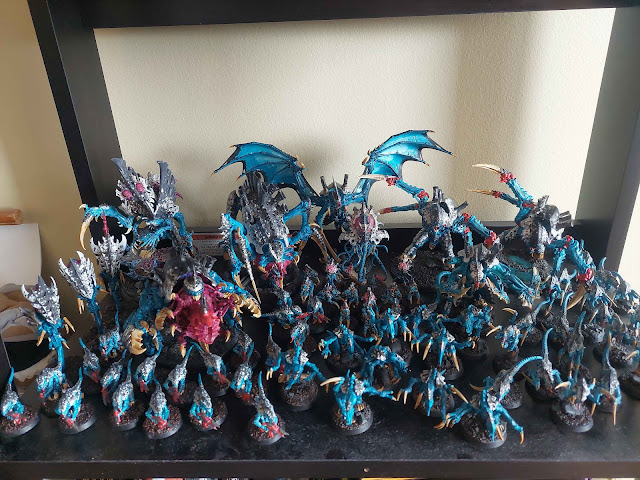
Despite this, I’ve painted a lot of stuff I’m proud of. Thousands of points of Tyranids, a few Necromunda gangs, some kitbashes of a kill team for a Rogue Trader tabletop campaign. Throughout this odyssey, I developed some medium-strong takes about the Citadel paints I enjoy using and the ones that I don’t. Some of these takes will be wrong for you and the way you paint! But I’ve got a system, and even if the system sucks, it’s mine.

Hive Fleet Cyanax, about to feed itself into a meat grinder with style


First, some blanket advice:

  • GW pots suck for higher-viscosity paints. I’ve gotten so many pots stuck open with dried paint, and then they just end up gross and unusable. Their design is good for low-viscosity washes and contrasts, though and I actually prefer them to ones in dropper bottles.
  • I don’t like their non-metallic base or layer ranges, and I recommend Vallejo as a replacement both because they’re cheaper and because they have genuinely better paints.
  • GW dry paints are a racket. They don’t all dry up instantly, but enough do that you shouldn’t bother. Because you can drybrush with any regular paint, the best investments for drybrushing are actually dollar-store makeup brushes and a rough non-absorbent surface like a scrap of wood or some basing material.
  • Speaking of basing materials, this isn’t a painting tip, make yourself a container of basing mix if you haven’t already. It’s a lifesaver and it makes bases look good basically for free.

Or you can just use Necromunda bases. I love these little guys -- House Delaque is way more fun to paint than I expected!

Noncomprehensive tier list to follow. I sure haven’t used every single Citadel paint and I don’t intend to (unless I get them all for free, in which case I’ll feel obligated to reprise this post with a comprehensive 300-paint-long review).

S Tier

I recommend these paints wholeheartedly, and personally prefer them to other brands and formulations. You can pry my stockpile of Black Legion contrast out of my cold, dead, paint-stained hands. If you don’t have any paints yet, or you need to restock, it’s hard to go wrong with these.

Black Legion. It’s a black contrast paint that goes on fast and gets great coverage. If I haven’t primed a model black, a layer or two of this gets a beautiful and smooth base coat. I stock up on this regularly, because it’s always sold out.

Seraphim Sepia. I slather this shit on everything that needs to be a warm brown. Skin, gold, claws, you name it. Love the stuff, would drink it in my morning coffee.

Agrax Earthshade. It’s like Seraphim Sepia, but for things that need to be slightly darker and muted. Works great on skin, bases, metals, etc. I keep running into tutorials that want me to use it, and I keep being annoyed that it works as well as they say it does.

Ratling Grime. My new favourite. Water it down for a beautiful shade to throw over metallics, or just put it anywhere you need to look grody. The shade of every catwalk and wheel-well in the grim darkness of the 41st millennium.

Leadbelcher.
I’ve tried a lot of metallics and I just keep coming back to this classic. If I could get Army Painter Fanatic metallics reliably I’d probably go for those instead, but this is my go-to gunmetal.

Retributor Armor. I don’t paint gold often, but when I do I accept no substitutes. The one thing I’ll thank Age of Sigmar for — GW made a beautiful goddamn gold paint.

Frostheart, Karandras Green. I paint a lot of bright colours, especially with my Tyranids and my penchant for plasma guns, and I love throwing contrast paint over some drybrushed highlights. I think my analysts were calling this something called “Slap Chop” but I had them thrown into a Haruspex for confusing me with strange words they dredged from the horrid realm of “On-Line”.

Rhinox Hide. It just works. I can’t explain why. Trust me on this one; if you need a generic earth-tone brown for basing just use it.

Blood for the Blood God. I need more excuses to put blood on my models so I can use this paint more. Maybe I should redo my Hormagaunts like they’ve spent the last few hours neck-deep in a grox carcass. Maybe I should get neck-deep in a grox carcass; my Hormagaunts seem like they’re having fun.

A Tier

I like using these, but I have a very niche use case or specific minor gripes. Probably not going to switch away from them, because I’ve tried alternatives and found them wanting.

Doomfire Magenta.
It’s really fun to make things pink, okay? My one note is that it’s not quite as bright pink as I want it to be, but I just throw a quick highlight of a real woman’s pink (something from Vallejo, I think?) along the raised bits and it looks great.

Wraithbone. My problematic fave, mostly because I keep having to throw out pots that get crusty and dry. I use this for claws, I use it for fangs, I use it for purity seals. An excellent base coat for a shade like Seraphim Sepia. I tried Army Painter’s Skeleton Bone as an alternative and it just didn’t have the same warmth.

Soulblight Grey. I don’t use this for actual base coats, but I’ve found that it works really well as an undercoat/guide coat on models that I’ve primed white. I use a lot more of it than I think, especially given my penchant for doing bright colors with contrast paints.

Nuln Oil. I swear it used to be better. Actually, everyone does, and everyone’s right. The new formula just doesn’t have the same oomph, and I’ve pivoted to watered-down Ratling Grime instead. Still, I’ve been slathering this motherfucker on metallics for years and I don’t intend to stop now.

Drakenhof Nightshade. Gives Frostheart a nice depth, and I want to try it in other places too. Haven’t quite found where, but I’ll keep looking.

B Tier

I’m looking for alternatives for these, but haven’t found any that strike my fancy yet. If you have suggestions I’d love to hear them.

Cygor Brown.
I need a brown base color that looks good for leather. Cygor Brown is just a little too dark to make out the details, and the pouches and straps I use it on are a motherfucker to edge highlight or drybrush without getting more paint around it than on it. No, I will not “git gud”.

Gryph-Hound Orange, Dark Angels Green.
Some contrast paints are meh. I like painting orange, but these just don’t have the vibrance I get out of favourites like Frostheart.

Mechanicus Standard Grey. Sometimes I need to put grey on plastic, and it sure is right there on my desk. No complaints, but there are cheaper options for a perfectly serviceable grey.

White Scar. I use this to drybrush white and it works just okay.

C Tier

Tried it, don’t like it, but I keep using it because the pot’s there on my desk and I’ll be damned if I don’t get my ~$6.00CAD worth.

Thondia Brown, Catachan Flesh. Not quite what I’m looking for as a replacement for Cygor Brown. Works okay as a base skin color, but I prefer to use contrasts for faces and hands to get a little more depth and shading before I highlight.

Luxion Purple. Some contrast paints kinda suck, in my experience. This one clumps and ends up way too murky for my tastes, even though it’s really pretty in theory. Maybe I’ll try watering it down, but I’d prefer to have a purple that just looks the way I imagine it in my head. Truly I am put-upon.

Runelord Brass. I do like a dirty brass as a metal accent, but it doesn’t differentiate itself enough from the gunmetal that I use to really pop.

Averland Sunset.
We all know that yellow paints suck, but I love to paint hazard stripes, so I’m in an abusive relationship with my pot of Averland until the sun grows cold. Perturabo, call me, I understand your pain.

Iron Warriors. Speaking of Perturabo! I want to like this paint more because it’s named after my favorite legion, but this is decidedly more Iron Without than Iron Within. It’s fine, but if this is the energy the IVth Legion was bringing to the Great Crusade I understand why they got sent off to fight the Hrud in the ass-end of the galaxy.

Bugman Glow. I keep finding weird places where I need to use this, but it’s never good, only ever good enough. Don’t bother.

Corax White. Too grey for me in practice. I know it’s a base and I’m supposed to drybrush or edge highlight it up, but I’m lazy and painting white is hard.

Ironbreaker. It works okay, but I managed to score a vial of Army Painter Fanatic Plate Mail Metal. Probably gonna swap back to Ironbreaker if I can’t re-up once that runs out, because I’m blowing through it like there’s no tomorrow.

D Tier

Languishing in my paint array, abandoned for better colors, but I can’t bring myself to throw them out. Maybe I’ll find a better use case for them. Someday.

Abaddon Black. Now that I’ve found Black Legion, I don’t bother with the base formulation. I just prime black if I need it and touch up with a better paint. Sorry Abaddon, some of us still remember the days where you had nothing but 12 Ls to your name.

Genestealer Purple, Xereus Purple, Macragge Blue, Ahriman Blue, Runefang Steel, Trollslayer Orange. What do these all have in common? They’re base and layer paints that I abandoned for other brands. Don’t make Citadel your go-to for regular acrylics, they’ll just let you down.

Dawnstone, Necron Compound, Terminatus Stone, Praxeti White. I don’t see a reason to use Citadel Dry paints when I can just make my regular paints pull double-duty.

Tessaract Glow. Maybe I’m using it wrong, but it just doesn’t show up properly on surfaces. I’ve switched over to yellow-greens from other brands and those work much better.

I have plenty of other paints from other brands that I enjoy, but this is a Citadel review about Citadel paints. One thing I do legitimately enjoy from Citadel is this infographic, which takes a lot of the stress of experimenting with various color combinations off of me and lets me work from a known baseline, even if some of the colors are ones I’d go to other brands to look for.


Wednesday, February 14, 2024

GλOG: Item Templates

Lambda templates are associated with items rather than a character class. Gaining a λ template is simple: spend a downtime action training with the associated item. This may also require an XP investiture or be limited in other ways, such as once per level - ask your GM. You cannot gain the same λ template more than once unless otherwise specified.

A good λ template does not invalidate the need for the item, nor does it require the item to use. Rather, it complements the item and unlocks new applications for the associated item and the rest of the character's inventory. Not all items have λ templates. If a month training with an item wouldn't make you significantly better at using it in a mechanically interesting way, it doesn't need one.

Some of these items have Consumable rules. I've never found a satisfying solution to tracking inventory slots, so these are references to measure the scale of the item I'm writing about. Insert your own inventory tracking and encumbrance rules here - and let me know about ones that work best for you so I can crib them for my own games.

 Abbreviations: 1H = one handed, b = bludgeoning, p = piercing, s = slashing

Crowbar: 1H 1d6b, advantage on Strength tests to lift/pry/move objects
λ - Leverage:
At a glance, you can see structural weaknesses in objects and constructs such as doors, walls, automatons, and siege engines, and you learn their current hit points. Once you know of a weakness in such a construct, you have advantage on melee attacks and damage rolls against it.
You can share the knowledge of a weakness with your allies so long as you have the time to accurately describe what you're talking about. Pitched battles don't count. 

Rope & pitons: Surfaces with a securely-anchored rope can be safely and slowly scaled without a test. Surfaces with a rope can be climbed at double speed. Consumable: Comes in 50' lengths of rope and packs of 2 pitons. Reusable.
λ - Second-Story Worker:
Double your climbing speed. You can slowly and safely scale any non-sheer surface. Halve the difficulty of tests to climb surfaces quickly.
This ability is most obviously useful for a character to climb a surface, scout an area, then let down a rope for their allies to climb after them. 

Roll of bandages: During a rest, give an injured character temporary hit points up to the difference between their current total HP (including temporary HP) and their maximum HP. These hit points wear off at the next rest. Consumable: A single roll of bandages provides 12 temporary hit points before running out.
λ - Field Medic:
You can apply bandages or other mundane medical treatments to an adjacent character with a single action, rather than a longer duration. Any temporary hit points granted this way expire at the end of combat or in 10 minutes, whichever comes first. You can't do this if you or the target character are engaged in melee combat.

Backpack: +2 inventory slots inside the backpack, +2 slots on the outside of the backpack. Items in the backpack are protected from mundane physical hazards like rain.
λ - Hoarding Impulse: Whenever you need a mundane piece of equipment that isn't listed in your inventory, you may make a Wisdom test. If you succeed, you have a ratty version in your bag that will work just this once and then break. Either way, write the item down next to this ability and cross it off; until you return to town for downtime, you can't get it from this ability again. 

Helmet: +1 AC. When you would suffer critical damage, you may splinter your helmet to reduce damage from that source to 1. Your helmet provides no further AC benefits and is disenchanted if magical.
λ - Warsight: You can see the HP, AC, Morale, and command hierarchy of enemy combatants. Roll initiative with advantage.
Warsight does not let you literally see numbers, but you gain that game-mechanical information. Much like riding a bike, you do not need a helmet to use Warsight, but you should wear a helmet anyway.
 

Torch: 1H. Sheds light in a 30' radius. Covering a torch is a free action or reaction, but lighting a torch takes a full combat turn and 2 hands of fiddling with a flint and steel. Many things extinguish torches, including fighting, getting wet, and sprinting. Consumable: Every exploration turn, roll 1d6. On a 1, the torch is consumed and goes out. 3 torches take up 1 inventory slot.
λ - Torchbearer: You can wield a torch as an effective melee weapon without burning yourself or it going out. It deals 1d6 fire damage and the target must save vs. being set aflame for 1d2 damage a round. Burning ends when they take 2 damage from the roll, when they stop, drop, and roll, or when they are otherwise extinguished.
I chose the 30' range so you can see as far as you can move in one action. Look before you leap. 

Lantern: 1H. Sheds light in a 30' radius. Follows torch rules for lighting, but is more difficult to extinguish than a torch. Requires oil. Semi-Consumable: Every exploration turn requires 1 unit of oil or the lantern goes out.
λ - Lightbearer: While in a dark area, you and all allies within the radius of a light source you're holding (or casting if magic) have +1 to hit and +1 AC.
I want to incentivize players to engage with lighting mechanics. 

Healing herbs: When eaten, provides 1d6-2 temporary HP (negative temporary HP deals damage) and allows the character to save against up to one poison or disease effect. If saving against a poison or disease, causes nausea and induces vomiting. Any temporary HP granted at the beginning of the next rest. Consumable: One inventory slot of healing herbs is 10 doses.
λ - Nutritious Diet: Permanently increase your maximum HP by 3.

Tower shield: 1H. As an action on your turn, you may raise your tower shield. While the shield is raised, add your Strength bonus to your AC. To move, you must lower your tower shield (this is a free action).
λ - Shield Wall: Allies immediately behind you also gain the AC bonus from your tower shield while it's raised. 

Staff: 1H 1d6b, 2H 1d8b. 10' reach.
λ - Arcane Focus (Staff): While you wield a staff, you can use it to cast a spell as an action on your turn.
I'm playing around with the idea of more characters getting to cast spells outside of combat in rituals that take an exploration turn or longer. Dedicated casters take items and templates like this to cast complex spells to harm their enemies and protect their allies in dangerous situations.
This also counts as a 10' pole. Not all staves are 10' long, but if you want a 10' pole, get one of these.
 

Dagger: 1H 1d6p/s. Throwable 30'.
λ - Sneak Attack: While you are behind, above, flanking, or concealed from an enemy, your attacks deal an extra 1d6 damage. If you fulfill more than one of these conditions, you also roll to hit with advantage.

Bottle of holy water: Deals 2d8 sacred damage to unclean, unholy, and undead creatures (halved on a successful Wisdom save). Throwable 30', consumed when thrown. Unclean, unholy, and undead creatures must make a Wisdom save to cross spilled holy water.
Spilled holy water evaporates over the course of an exploration turn.
λ - Sanctifex: During an exploration turn, you can bless a bottle of fresh water and turn it into 1 bottle of holy water. You can also perform a frantic blessing as an attack in combat, which forces an unclean, unholy, or undead enemy to make a Wisdom save or spend its next move action retreating from you.

Armor plate: +1 AC, -1 Initiative. Worn over one part of the body (arm, leg, or torso). You may wear up to 3 plates. If you are wearing more than one plate, you cannot move silently.
λ - Plate Carrier: You may wear up to 6 plates. 

Wizard hat: While you are wearing a wizard hat, you have +1 Magic Die.
λ - Magesight: You can see, smell, or taste magic beyond its material manifestations, making magical effects apparent to you. When making eye contact (or an equivalent mutual exchange of attention) with another spellcaster or magical creature, you immediately gain an instinctive understanding of its magical capabilities including total number of magic dice and number of magic dice remaining.
Wearing additional wizard hats or swapping wizard hats does not increase or replenish your magic dice. It is a funnel that draws power into the mind, not a sartorial affection - so sayeth the self-conscious mage.

Buckler: 1H, +1 AC.
λ - Parry-Riposte: Once per round, when an enemy hits you with a melee attack, you may make a Dexterity test. If you meet or beat their to-hit roll, you negate the hit and hit them instead.
The more armor you're wearing, the harder it is for you to parry, because attacks that hit you have higher to-hit rolls.

Vial of oil: Covers a 5' square in flammable (burns for 1 minute at 1d6 fire damage per round) and slippery (Dexterity save or fall prone in the space) grease, or powers a lantern for 1 exploration turn. A flask of oil contains 3 vials, a jug contains 6 flasks.
λ - Dungeon Chef: You can prepare Dungeon Meals from ingredients. To cook a Dungeon Meal, spend 1 exploration turn with a 1 vial of oil, a cooking pan or pot, and a blade. Make an Intelligence, Wisdom, or Dexterity test vs. 8 plus 1 for each ingredient you use. On a success, the meal is delicious and provides +1 temporary hit point per ingredient. On a failure, the meal is only edible as rations. On a critical failure, you waste the ingredients.
Dungeon meal benefits are in addition to the traditional GLOG benefits of taking a Lunch, which restores 1d6 HP. Cf. Skerples' Monster Menu-All for further information regarding dungeon ingredients.

Oversized weapon: 2H, 3d6-3 damage of a relevant type, 10' reach. Takes your entire turn to heft and attack. 4 inventory slots.
λ - Heavy Weapons Mastery: Add your Strength bonus to the damage of all your melee attacks.

Trenchcoat: +2 inventory slots. Caps your armor bonus to AC at +2.
λ - Deep Pockets: To solve an immediate problem, you may make a Wisdom test to pull a relevant mundane tool out of your bag that helps in this situation. The more obscure and valuable the item, the harder the test. If you succeed, it works once, then is consumed. Whether you succeed or fail, write the item down next to this one. You can't use this ability to gain that item again until you have downtime in town.

Lockpicks: Allows you to make Dexterity tests to open locks and disarm traps. Without lockpicks, you need a key, brute force, or a critical success.
λ - Tricky Fingers: Whenever you fail a Dexterity test to perform sleight of hand such as picking a lock, disarming a trap, or picking a pocket, your first failure doesn't alert the victim or trigger alarms.

Bow & arrows: 2H, 1d8p, 120' range, disadvantage on attacks within 30'. Quivers hold 30 arrows.
λ - Eagle-Eyed: You can always hit stationary targets within range with ranged attacks. This allows you to push buttons, break windows, and ambush guards with impunity.
If you don't make a roll to hit, you also cannot critically hit the target. This ability also works for thrown weapons, rocks, bows, guns, and even ballistae that you aim.

Most Recent Post

Mothership: Alternative Trauma Responses

My current weekly drop-in game of Mothership: Gradient Descent is now twelve sessions and thirteen characters deep. The extant four (or six,...