Pages

Saturday, February 22, 2020

The Immortal Art of Fleshcraft

Fleshcraft makes Ogoath go 'round. To hear one of its practitioners speak of it, they are the sole force between the blood-red lamplight of civilization and the total decay of the rotting turtle-corpse. Those who control the meat control the universe, and their powers tap in not to "magic" or whatever "divinity" survived the loss of the Old World and death of its gods, but into the base raw bleeding truth of reality. And while they aren't technically wrong, most fleshcrafters have (in addition to their power) taken on the egos of old-world wizards with none of the pretension of secrecy or solitude.
by Igor Vitkovskiy
If one would listen to the butchers speak of them, fleshcrafters have no respect for the world that's adopted them. They walk openly, twisting meat to their basest whims, capricious children who've stolen their parents' big fancy knives and are chopping up the walls to see the pretty patterns they can make. Their empire killed the world. Their domain is life-made-cancerous, mind without moral, craft without code.

I've given the Butchers their due. Their rivals now demand the podium.

Fleshcrafter

Paint with all the pleasures of the flesh.

Level 1: Fleshcrafting, 2 Techniques, 2 Forms, 1 Flesh Die
Level 2: +1 Technique, +1 Form, +1 FD, +1 HD
Level 3: +1 Technique, +1 Form, +1 FD, +1 HD
Level 4: +1 Technique, +1 Form, +1 FD, +1 HD

Hit Die: d4
Starting Equipment: Scalpel, bone saw (d6 damage and reveal an organ of choice), red leather robes, sheaf of skin-parchment with anatomical diagrams, a bone-vial of each Form you know
Skills (d6): 1. Etiquette, 2. Gardening, 3. Lore, 4. Sculpture, 5. Surgery, 6. Undertaking

Fleshcrafting: Combine a Technique you know and a Form you know to perform an action. Absorb Blood. Grow Bone. Speak to Emotion. Their effects are broad and often self-evident. Roll any number of your Flesh Dice (d6s) in the process. In addition to the damage dealt by the Law of Consumption (see below), they burn out on a 6. 1 can be restored by lunch; all can be restored after a daily rest. If you roll doubles, a Mishap occurs. On triples, gain a Doom.

There's some limitations of what you can do with these. Any numerical effect (damage, duration in minutes or hours, bonus, penalty, etc) can't be greater than either (dice) or (sum); which is the limit is up to the GM. I recommend looking at the Mimics & Miscreants spell list for equivalent effects.

All fleshcrafting follows Three Laws. These laws are well-founded, well-tested, and seem inherent to the Art.

The Law of Consumption. Action requires calories. Greater changes, such as those wrought by magic, require more. Your body will devour itself in your quest for power. Whenever you fleshcraft, you take (dice) damage.

The Law of Contact. Fleshcraft requires touch between the crafter and the form. It is an Art of the body, and so the body is central to its workings. The closer the flesh one wants to shape to their point of contact, the easier it is to shape. Forms separated by a membranous barrier like skin, or like the lining of an organ (if you wish to only affect the material inside) roll your Flesh Dice with disadvantage.

The Law of Continuity. Forms remain the form they are. One cannot transmute blood to bone, or acid to eyes, or skin to cancer, (et cetera), through fleshcraft. That is the provence of mundane biology and naught else.

You may violate one law, and suffer a Mishap.
You may violate two laws, and suffer a Doom.
You may violate all three laws, and be consumed by the Art.


Techniques
1. Absorb
2. Animate
3. Bind
4. Burn
5. Command
6. Consume
7. Divide
8. Dowse
9. Engrave
10. Extract
11. Grow
12. Hide
13. Inflict
14. Mutate
15. Restore
16. Shrivel
17. Smooth
18. Speak To
19. Ward
20. Weave

Forms
1. Acid
2. Bile
3. Blood
4. Bone
5. Brain
6. Cancer
7. Emotion
8. Eyes
9. Face
10. Guts
11. Hair
12. Heart
13. Limb
14. Meat
15. Nails
16. Nerves
17. Pain
18. Rot
19. Sense
20. Skin

Fleshcrafting Mishaps
1-2. Decay. Halve a random physical ability score for the rest of the day.
3-4. Mutation. Gain a random negative mutation for the rest of the day. At the end of the day, roll a d6. On a 1, it is permanent.
5-6. Independence. The Form you wanted to manipulate? It decides its had enough of you, and a (dice) HP chunk of it removes itself from you to become an independent being.

Fleshcrafting Dooms
First Doom: Lose a Form. This inexplicably does not kill you, but it will do everything else that losing it would. Losing a seemingly negative form still has negative effects - losing Rot would prevent your cells from dying (commensurately, losing Cancer prevents cell growth).
Second Doom: Lose another Form.
Final Doom: Your individuality sloughs off as you merge with all flesh and organic matter around you. You are not "dead" in a technical sense, but you have become part of something so much greater that you cannot continue play as a player character.

Monday, February 17, 2020

Black Markets


When I'm making a random generator, I've always been inspired by Joseph Manola of Against the Wicked City's essay on conceptual density - namely, that each entry has to be better than what I could come up with on the fly. Combining a few thought-provoking prompts is easier on the spot than thinking those prompts up, too. So welcome to a bazaar of bazaars, an emporium of emporiums, a selection of stalls and shopfronts that'll keep your party in business for as long as they're willing to pay...

There's pretty much one archetypical black market for fantasy settings. You've got your shadowy figure hawking illegal wares in a seedy part of town, then break out your list of cursed and rare items. It's all well and good, but not particularly memorable. I like to differentiate my entries by making them recognizably conceptually similar to the archetype, but one or two steps away from what the generic version is. A little more specificity, connecting up a concept that the players wouldn't immediately expect, think out the implications of the existence of a place like this or why it'd sell what it sells. All this requires brainpower I'd want to devote elsewhere at the table, but it makes a fantastic set of generators!


Venue
1. A bar in the seedy part of town. During deals and liasons in dark backrooms you can sneak even further back, into the shop proper. They only admit those intoxicated enough to ensure a purchase.
2. A contraption that displays wares behind a pane of glass and dispenses them when currency is inserted into a small slot on the side. Proprietor tinkers with the machine.
3. A narrow labyrinth of winding alleys leads inevitably to a barred, metal door. A Judas window in the door reveals only the proprietor's eyes. Leaving requires a map that only the proprietor sells.
4. A perfectly ordinary-seeming cheesemonger. Many cheeses are code for a particular black-market service or item, and those in-the-know will order those cheeses for delivery at their place of residence, where the Cheesemonger will personally deliver the item in question.
5. A secret door in the wall of another black market opens into their real moneymaking business. Or is it?
6. Abandoned manor is actually cover for emporium chock-full of surplus banned products hidden under furniture covers and layers of dust.
7. An abandoned storeroom in the lord's castle. Access to the market requires getting into the castle first.
8. An upscale hotel. Calls for a certain order of room service result in a particular individual arriving with an array of wares concealed beneath platter-lids and wrapped in napkins.
9. Beneath a cemetery's mausoleum. Any remains within have been disinterred, and the coffins filled with merchandise.
10. During a particular hour each week, a particular sewer tunnel flushes. It smells not of bile and ichor but of raspberries and thyme. In that hour, the merchant sets up their stall and their wares, and dismantles it all at the end.
11. In the city guards' barracks. It's how they supplement the pittance they get from the city's lords. All items guaranteed confiscated from the "real" criminals.
12. Loud and upfront, with no facade of legitimacy. They're close with exactly the right people in government, and often you'll find said people partaking of their wares.
13. Mineshafts beneath the city drop deep into the earth. They converge on a surprisingly well-lit and comfortable row of townhouses transposed into the rock. One is the market you seek.
14. No venue. Proprietor wears extra layers of coats even in the hottest weather, beneath which lie a staggering amount of product. Accosts adventurers back from their latest looting spree.
15. On the rooftop of a complex of buildings, with no sightlines to the ground. Accessible via service entrance to roof.
16. Street food stall sells new items daily, cleverly hidden beneath the countertop.
17. The back room of a publishing house. Their newspapers and pamphlets detail, in code, the day's stock.
18. The city's public forum hides an open secret. Deliberations are often cover for exchanges of illegal goods, while philosophers ranting at the sky slip in covert ads for their wares. Pledging your support will garner their interest, and an argument of moral principle becomes a coded haggling venture.
19. Wine cellar of a reputable winery does double-business selling illegal goods. Don't tap the oldest casks.
20. Zoo of ill and struggling repute uses animals as cover for the loud sounds and smells of their real business.

Proprietor
1. Cheery, heavily-scarred elf. Doesn't seem to realize illegality of or potential harm caused by products. Willing stooge? False persona?
2. Collective of street urchins. Vicious with both insults and shivs. Brook no quarrel or complaint.
3. Decrepit, but wears the attire of a king. Looks strikingly similar to the royal family. Speaks imperiously, but in whispers, as if being surveilled.
4. Devil, aristocratic, stinking of sulfur. All items come with lengthy fine print, merchant indemnity in case of misuse, and no warranty whatsoever.
5. Elaborately masked being with no exposed skin. Changes mask based on emotion they wish to display. Poetic.
6. Ex-adventurer, took over business from previous owner by force. Not exactly sure how the whole running-a-shop thing works, but knows the ins and outs of the products and the job.
7. Excitable apprentice mage, selling something that they stumbled upon in their research. Definitely way out of their comfort zone.
8. Family, parents and grandparents and children all staffing their business, teaching the next generation their hereditary trade. Rightfully proud, even of the grimmest crafts.
9. Frail, elderly human hunched over an elaborate contraption. They won't look up from their work, and respond with only the barest necessities.
10. Grizzled ex-mercenary. Personally vouches for the efficacy of everything in the store and has a tale of how each saved their life in the field.
11. Immaculate human, speaks like an upscale tailor. Willing to go to great lengths for their regular clientele (or those who may become regulars).
12. Large, boisterous orc in an elegant robe. Mercilessly critiques patrons' taste, but gives legitimately good advice.
13. Middle-manager type from the local mob. Missing a variety of fingers and facial features. Never stops grinning.
14. No proprietor at all. Items are carefully, meticulously labeled and laid out. If you remove one from the premises, the price is deducted in full.
15. Rat king. Served by a swarm of hundreds more chittering rats. Generous to those who respect the city's true, hidden ways.
16. Set of mechanical automatons acting eerily in sync. Will speak with many mouths. Who made them?
17. Shambling corpse. Communicates with a series of index cards laid out in boxes, or by pointing to signs laid out around the shop.
18. Shirtless, tattooed mystic reading from a set of ironbound tomes. Speaks in platitude, metaphor, and verse.
19. Spindly, nosy human with no sense of personal space. Very interested in the party's personal lives, and their exact intents for the items they purchase. They're a big fan.
20. Wizard, selling their failed experiments and outdated products of star-maddened genius. Insists you take some more with you. To test.

Products
1. Absolute tat, guaranteed to come in handy at least once so long as you carry it around religiously.
2. Angry, mutated spells heaving at the bindings of their spellbooks.
3. Blessings of forgotten and murdered gods.
4. Corpses and corpse accessories
5. Dirty deeds (done dirt cheap!)
6. Drugs, potions, alchemical reagents
7. Fine clothing and armors suitable for any occasion - even (and especially) the untoward
8. Incredibly cursed magic items. The curses are a selling point.
9. Magical creatures in small, easily-carried, soundproofed glass jars. A command word opens the lid and returns them to full size. The same word imprisons them again.
10. Maps and floor plans. Usually up-to-date, often of locations otherwise unknown.
11. Mercenaries
12. Mutations!
13. Other adventurers' contact information
14. Other peoples' fortunes - both the money kind and the future kind.
15. Outlandish, impractical, brutal weapons. As dangerous to their wielders as they are to their enemies - but also, very cheap!
16. Paraphenalia of mythical heroes, famous rulers, other notables. 3-in-6 chance any particular item is counterfeit.
17. Poisons, venoms, and flasks of plague. Each is the cure to another.
18. Spices, rare meats, wriggling things presumably for consumption
19. The last copies of lost books and records (all other copies have been destroyed, either before collection, or to ensure this is the last copy)
20. Thieves' tools and guards' timetables

Payments
1. A percentage of any loot gotten with the aid of the shop's merchandise
2. Art
3. Beating the owner in a riddle contest
4. Blackmail on yourself and others.
5. Blood. Lots of it. Cutting your hand won't do the trick here; you need to exsanguinate a whole horse to buy their cheapest items.
6. Captured magical creatures.
7. Confirmed bounties.
8. Contracts for future favors, callable at any time for any reason.
9. Converts to their religion
10. Credit, but they take your body parts as collateral.
11. Currency from a nation long fallen.
12. Exclusive rights to your life story.
13. Ghosts.
14. Good ideas.
15. Knowledge of secret places - or secret entrances to very well-known places.
16. Magic.
17. Raw metals - preferably adamantium, mithril, orichalcum, occultum, but raw gold ore may do in a pinch.
18. Whatever they sell, for far less than they sell it for.
19. Years off your lifespan (in multiples of 13)
20. Your skills and abilities

Sunday, February 9, 2020

Space is Boring


For baseline humans, even the fastest interstellar travel is boring. You're trapped in a metal box with people you'll swiftly grow to resent even if you're close friends, recycling all your air and water and biomass in an endless cycle that only gets more nervewracking as the walls close in and the stars grow coldly menacing. You tread the same corridors day after day, weathering a dull routine into your mind as you watch your instruments for danger that will never come (but if it does, you will all die, quickly, cold and impossibly alone).

Jumpspace is worse, as the ship's windows turn to blind-spots that the eye refuses to parse. Vision slips across the opposite of space, and even when all the shutters slide closed, the underlying wrongness of existing in that dimension bites at your bones, twists your skin, and knots your nerves.

And the waiting, the endless interminable waiting, becomes far worse if you know nothing but death may await you at journey's end. Soldiers often travel in cryosleep so they don't have to contemplate their fate for months on end. Mercenaries and adventurers that need a full complement to run their ships rarely have that luxury. Distractions are essential when tensions run high and anxiety floods the corridors like an electrical fire.

Stress
1 baseline. Humans were never meant to ply the void.
+1 per jump.
+1 if ship is overcrowded.
+1 if the ship is going into a dangerous situation.
+1 for each unexpected diversion before the crew arrives at their destination.
+1 if alone
-1 for each unique morale-building event you participate in.
-1 for each amenity (like holosuites, competent cuisine, drugs, etc) on board.


Some metahuman subspecies are better (or worse) adapted to space. This can add or subtract Stress from individual totals. Similarly, if one character indulges in their secret stash of Pandoran writheweed, or two characters have a truly legendary breakup, that might change their totals too.

At the end of the trip, total up the list, each crew rolls to see how much Stress they gain. Crew in cryosleep gain 2 Stress no matter what; cryo is the cheap option for non-essentials who don't need to be carefully maintaining the ship. Long-haul colony ships have low passage berths for cheap travellers who won't (or, usually, can't) pay for the amenities needed to keep them engaged for the trip's duration. Don't mind the cryoburn. Here's the studies that show the chances of neural degradation on newer models are down orders of magnitude from last generation. And hey, if something in jumpspace decides the ship looks tasty, you'll be asleep for it...


The morale-building events are the meat of this system. In space, you're going to have to relax somehow. A poker table has sufficed for many a small crew. A competent chef with a well-stocked kitchen (none of that freeze-dried crap) does wonders. Spacers have made up an esoteric set of holidays to celebrate, just to pass the time. On larger cruisers, there may be computer systems dedicated to running VR sims, and luxury ships might even build in entire terraria for the crew (or more likely, the ship's owner) to pretend they're back planetside.


Others might have ship's bars complete with hired bartenders (though what the bartenders do to keep their stress down is a well-kept secret). Ships too small for bars regularly have stills in the engine room, fermenting a frightening variety of life-support fungi, megayeast cultivars, and the odd jumpspace lichen into potent brews ranging from surprisingly light fruity spritzers to universal solvents. And alcohol is but the most common relaxation incentive, with a whole suite of exciting spacedrugs on offer at the local spaceport. Some are even legal (depending on jurisdiction and corporate sponsor)!

Of course, there's a set of Company-approved morale-building exercises, complete with worksheets and paperwork. Mostly, they boil down to team-building problem sets and unimaginative, sanitized VRscapes. Genetic and psychometric compatibility tests are used to engineer and sometimes mandate relationships between crewers, with universally disastrous results.

Love within the crew tends to be frowned upon by most captains. A breakup can sour the mood until everyone involved's contracts are up, and let's face it: bulkheads between bunkrooms are thin. That said, gossip and rumor spread through ships like wildfire no matter who's sleeping with whom.

Creative endeavors are the go-to for some crews. Collaborative storytelling, songwriting, poetry nights, art, even tabletop role-playing games... anything that gets the crew together and lets them escape their day-to-day drudgery. These get shared around, but often it's far more covert than it would have been in decades past - once the Company caught word, an IP clause became standard in contracts, giving the contracting company exclusive rights to all works created on their ships. What are you gonna do, starve or accept the terms and conditions?

Song is a constant companion. Every crew has that one crusty old spacer with a guitar, a croon, and a head full of old shanties they've learned over their decades spacing. Some stretch back to the first days of spaceflight on Earth, before the first jump breach, before even the disastrous first Mars Landings and the Liar's Flight. Here's a few for table ambience.

Games turn to more dangerous competitions. Undercity fight clubs on space stations often welcome competitors from whichever ships are in port, and so some spacers put their pride in their fists and aim, letting off steam by sparring with their crewmates. The occasional captain turns this into a way to maintain hierarchy, resulting in the tradition of Klingon promotion re-emerging so far from its origins in centuries-old space operas.

Saturday, February 1, 2020

Thieves' Guilds

There's been a renewed interest recently in making GLOG classes that are extensible, like the original Wizard and its schools. I've been part of working on several of these before - Bottomless Sarcophagus' Witch, Oblidisideryptch's Barbarian and Warlock, I even wrote a Bard, so I decided to take a crack at a class I haven't really touched: the Thief. To give it a little more mechanical identity, I've decided to give the thief access to some storygame-esque skills.

While Wizards can warp the fabric of reality, and Clerics can channel the powers of the gods, Thieves are so good that the narrative itself bends to their whims. They can retroactively choose to have prepared just the tool for the job, or set up a trap in just the right place, or realize they've always known the language that the merchants speak. It might rub some people the wrong way, but it's my class and my rules and I think it's really cool to let the Thief have some definition of its own. Of course, other Guilds will provide other ability sets, and hopefully I come back to add more.

These Thieves have Guilds, like Wizards' Schools or Bards' Genres. The Guild you belong to determines the suite of 6 abilities you can rank up in. Each ability has 3 ranks. At level 1, you start with 2 abilities, each at rank 1, and as you level up you both increase the rank of the abilities you have and gain new abilities at rank 1.

Thief

Level 1: Gain 2 abilities at rank 1
Level 2: Rank up an ability you have, then gain a new ability at rank 1
Level 3: Rank up 2 abilities you have
Level 4: Rank up 2 abilities you have, then gain all abilities you don't have yet at rank 1

Hit Die: d6

Specific abilities, equipment, and skills are all determined by the Guild a thief belongs to.

Thieves Guild


 Possession is nine-tenths of the law. That last tenth is the tricky bit...

Starting Equipment: 2 daggers, a dark cloak, set of lockpicks, roll 2 extra random items
Skills (2, d6): 1. Acrobat, 2. Bully, 3. Forger, 4. Gambler, 5. Lookout, 6. Pickpocket

Abilities

1: Bag of Tricks
    ✧: You have a Bag of Tricks, which takes up 2 inventory slots. While you have inventory slots in your Bag that haven't yet been filled with defined items, you may produce a mundane tool of neglegible value from your Bag that will help you solve a current problem. It then takes up one of the inventory slots in your Bag of Tricks. You may clean out and refill your Bag when you return to town.
    ✧✧: Your Bag now has 4 slots.
    ✧✧✧: Your Bag no longer contributes to encumbrance.
2: Opportunist
    ✧: Whenever you would gain advantage to hit, you may also roll damage with advantage.
    ✧✧: Whenever you would gain advantage on a roll, you may reroll 1s.
    ✧✧✧: Whenever you would gain advantage on a roll, you may roll 3 results instead of 2 and take the best.
3: Prepwork
    ✧: On a 1 in 6, you may declare that you've set up a minor environmental effect nearby in an area that you would've had access to within the recent past, and trigger that effect.
    ✧✧: One automatic success per day, then 2 in 6 for each following attempt.
    ✧✧✧: 3 in 6 for each following attempt, and you can have retroactively set up effects in any area you plausibly could have had access to at any time in the past.
4: Second Story Worker
    ✧: You can climb vertical surfaces as quickly as you can walk.
    ✧✧: Double your move speed and jump distance.
    ✧✧✧: You can climb upside down as quickly as you can walk. Halve fall damage.
5: Thick as Thieves
    ✧: You can recruit d4 thugs in town who're loyal so long as they'll get a cut of the loot and are sure they'll make it out alive. They will flee, cheat, or betray you and each other if either of those conditions becomes sufficiently murky.
    ✧✧: d6 thugs or d4 thieves, each with 1 rank in a random thief ability (besides this one).
    ✧✧✧: 2d6 thugs or 2d4 thieves, each with 2 ranks in a random thief ability (besides this one).
6: Tricky Fingers
    ✧: Whenever you try to perform sleight of hand (lockpicking, pickpocketing, etc), failure won't alert anyone who isn't already paying attention to you.
    ✧✧: You leave no trace of tampering, or specific traces of your choice, when you perform sleight of hand (whether you succeed or fail).
    ✧✧✧: Whenever someone tries to retrieve or draw an item, you can (on a 2-in-6, with 1 guaranteed success per day) reveal that you actually burgled it from them at some point in the recent past (if you had access).

Seamstresses Guild
You'd be surprised what people let slip when they're in the company of a good listener.

Starting Equipment: 3 sets of fancy clothes, 3 stilettos, bottle of liquor, makeup kit, noble's calling card
Skills (2, d6): 1. Artist, 2. Casanova/Seductress/Them Fatale, 3. Dancer, 4. Gambler, 5. Poet, 6. Seamstress (but for real)


Abilities

1. Con Artist
    ✧: So long as no one can verify what you’re saying is wrong, you can lie through your teeth and they’ll believe you for at least d6 minutes.
    ✧✧: d6 hours.
    ✧✧✧: Even if they can verify, they'll believe you over other people until the end of the duration.
2. Cunning Linguist
    ✧: Three times, you may encounter a language that the party does not understand, and reveal that you speak that language. Add that language to your character sheet, you are now fluent in it.
    ✧✧: You can attempt to translate any language you don't speak. The GM rolls a d6 secretly for the number of errors you make in the translation.
    ✧✧✧: You can crudely communicate with anything that has a language. Gain the ability to speak with (d6: 1. Birds, 2. Clothing, 3. Doors, 4. Gold, 5. Fire, 6. Weapons)
3. Fancy
    ✧: Fancy clothes give you a +2 AC bonus.
    ✧✧: Can choose to ablate fancy clothing like a shield; reducing the damage from one attack by d12 points but ruining your outfit in the process.
    ✧✧✧: Given a short rest, you can make any outfit into a fancy outfit through sheer willpower and coordination.
4. Seductive Wiles
    ✧: You can keep someone engaged in conversation with you, to the exclusion of all else, for an hour. This makes them less hostile, and on a 2-in-6 they let valuable information slip.
    ✧✧: You don’t have to roll to impersonate someone in casual conversation, but gaps in your knowledge can still reveal you. 4-in-6 to let info slip.
    ✧✧✧: You can choose which specific information they reveal, if any, and you can keep them talking for d6 hours.
5. Thick as Thieves
    ✧: You can recruit d4 thugs in town who're loyal so long as they'll get a cut of the loot and are sure they'll make it out alive. They will flee, cheat, or betray you and each other if either of those conditions becomes sufficiently murky.
    ✧✧: d6 thugs or d4 thieves, each with 1 rank in a random thief ability (besides this one).
    ✧✧✧: 2d6 thugs or 2d4 thieves, each with 2 ranks in a random thief ability (besides this one).
6. Tricky Fingers
    ✧: Whenever you try to perform sleight of hand (lockpicking, pickpocketing, etc), failure won't alert anyone who isn't already paying attention to you.
    ✧✧: You leave no trace of tampering, or specific traces of your choice, when you perform sleight of hand (whether you succeed or fail).
    ✧✧✧: Whenever someone tries to retrieve or draw an item, you can (on a 2-in-6, with 1 guaranteed success per day) reveal that you actually burgled it from them at some point in the recent past (if you had access).

Archaeologists Guild

That belongs in a museum! No, *my* museum, not yours... no, not even if you're still using it, now hand it over, it's priceless!

Starting Equipment: Case of maps and pens, wide-brimmed hat, machete, whip, leather armor
Skills (2, d6): 1. Cartography, 2. History, 3. Merchantry, 4. Occult, 5. Religion, 6. Soldier

Abilities

1. Appraisal
    ✧: You can tell the rough value (within an order of magnitude) and historical/geographic provenance of items, architecture, etc. You know how to dismantle them to get 20% value from the more manageable components, rather than the ordinary 10% for defaced art.
    ✧✧: You can identify that an object, effect, or creature is magic on sight. Gain the ability to Speak with Art.
    ✧✧✧: Gain the ability to Speak with Magic.
2. Bag of Tricks
    ✧: You have a Bag of Tricks, which takes up 2 inventory slots. While you have inventory slots in your Bag that haven't yet been filled with defined items, you may produce a mundane tool of neglegible value from your Bag that will help you solve a current problem. It then takes up one of the inventory slots in your Bag of Tricks. You may clean out and refill your Bag when you return to town.
    ✧✧: Your Bag now has 4 slots.
    ✧✧✧: Your Bag no longer contributes to encumbrance.
3. Cunning Linguist
    ✧: Three times, you may encounter a language that the party does not understand, and reveal that you speak that language. Add that language to your character sheet, you are now fluent in it.
    ✧✧: You can attempt to translate any language you don't speak. The GM rolls a d6 secretly for the number of errors you make in the translation.
    ✧✧✧: You can crudely communicate with anything that has a language. Gain the ability to speak with (d6: 1. Birds, 2. Clothing, 3. Doors, 4. Gold, 5. Fire, 6. Weapons)
4. Danger Sense
    ✧: 3-in-6 chance of acting in surprise round when ambushed, advantage on saves against effects you haven't seen yet.
    ✧✧: Always act in surprise rounds; always act first in initiative order.
    ✧✧✧: Once, you may cheat death.
5. Historian
    ✧: On a 1-in-6, you may declare a historical fact relevant to the current situation (negotiate it with the GM). Whether correct or not, it's believed to be true in the current era.
    ✧✧: One automatic success per day, then 2-in-6 for each following event.
    ✧✧✧: 3-in-6, and the historical facts you declare can be outlandish - but your reputation will make them believed.
6. Second Story Worker
    ✧: You can climb vertical surfaces as quickly as you can walk.
    ✧✧: Double your move speed and jump distance.
    ✧✧✧: You can climb upside down as quickly as you can walk. Halve fall damage.

Thursday, January 23, 2020

What's Going On In My Town?

I like cities and towns a lot! However, the core loop of most OSR games is focused on towns as often little more than glorified item shops and inns. The interesting things happen in dungeons, or on hexcrawl maps, or in strange pocket dimensions. This has changed recently, what with fantastic books like Magical Industrial Revolution or Electric Bastionland, but both of those presuppose quite a bit about the settings involved and really package a whole game setting in a book. The tables I've made in this post are for general use; slottable into any table where you quickly need a new town for the players to rest at, resupply at, or pillage.

Here I'm trying to "solve" three problems I run into when I'm running towns in my games. One, they all feel the same. They look right out of generic fantasy MMO #8975; all thatched rooves and those white walls with cross-bar wood frames, with a big walled castle somewhere. The first table is supposed to provide a little bit of flavor to differentiate them on a more macro level; what the PCs have heard about the town from afar, and something that probably permeates the fabric of the town's day-to-day existence.

Two, the towns-as-menu-interface problem. When the PCs go to a town, it's usually just an opportunity for them to meet quest-givers, rest up, and take a look at the item charts to see what's available and what they can buy. There's precious little else I can whip up on short notice; so this is a group of other things the PCs might be interested in interacting with. It could use a list of NPCs related to the buildings as well; that's a challenge and table for another day.

Three, towns as places where nothing happens. On one hand, towns should be a place of relative stability as opposed to the random-encounter-filled wilderness; that's the whole point of a town. On the other, towns are boring if the players are the only driving force! Giving a little bit of motive force to the players' actions, forcing them to deal with new situations (or ignore situations that could cause problems later) is a great way to fill time if nothing else, when the table gets stagnant because everyone's looking at gear lists.

by Raphael Lacoste

What makes this town special?
1. A fortress, impregnable by attacking forces.
2. Birthplace of a major religious figure, site of many pilgrimages.
3. Built around an institute of higher education.
4. Built atop a vast, ancient structure.
5. Covers for a secret town nearby or hidden in plain sight.
6. Everyone who's born here, or lives here longer than a year and a day, develops a particular mutation (roll on your favorite mutation table to figure out which).
7. Farms something that isn't plants (d6: 1. Glass, 2. Flesh, 3. Books, 4. Weather, 5. Fire, 6. Dreams).
8. Freak constant weather pattern (d6: 1. Rainstorm, 2. Strong winds, 3. Oppressive humidity and heat, 4. Bone-chilling blizzard, 5. Permanent twilight, 6. Incredibly pleasant)
9. Home of the most delicious food in the region.
10. Military town. Everyone's armed to the teeth.
11. Moves around over time.
12. One big building with the entire town under one roof.
13. Openly run by a cult based around (d6: 1. Cult of living personality, 2. A powerful local creature, 3. A deity proscribed by the dominant culture, 4. A local philosophy, 5. A powerful supernatural phenomenon, 6. A band of mythical heroes)
14. Rebuilding after a recent disaster.
15. Run by a cruel and capricious noble, whom the peasants live in fear of.
16. Split in two. Ongoing conflict between the two sides.
17. The monarch built their seasonal home here.
18. They revere their dead. The whole town is a cemetery, and spirits are part of the community.
19. Train and rely on a unique beast that hasn't been domesticated by anyone else.
20. Roll twice, it's super special and has both.

by Artur Zima
Buildings that the PCs might want to frequent besides shops or inns
1. A blacksmith who knows how to imbue items with (d6: 1. sparkly gems, 2. spirits, 3. magic words, 4. stronger materials, 5. clockwork mechanisms, 6. elemental energies)
2. A castle with a local noble who's easily impressed
3. A mercenary company's local camp, with loose morals and heavy armaments
4. Abandoned sewer system full of secret passages and hideaways
5. An abandoned tower full of strange machines
6. Art gallery
7. Bardic college
8. Cemetery with restless spirits
9. Church that gives blessings freely
10. Gladiatorial arena
11. Library with eldritch tomes
12. Mine, with valuable metals within
13. Observatory to view the stars and faraway locales
14. River or sea-side port
15. Stone ritual circle, where the walls between worlds grow thin
16. The haunt of a not-so-secret society of philosophers
17. Town forum, where ideas and gossip flow like a river
18. Underground hot spring with hallucinatory vapors
19. Well of mutating radiation
20. Witch's haunt

by Elizaveta Lebedeva

When The Party Returns to Town
1. "Any last words?" One of the party's friends is about to be executed publicly!
2. "Burn the heretics! Take their tithes!" An inquisition is rounding up faces familiar and strange and preparing a bonfire. Better hide your loot and magic items!
3. "Excuse me! You still owe me!" Someone's come to collect...
4. "Fire! FIRE!" The town's going up in flames!
5. "Halt, in the name of the law!" The city watch accosts the party! Mistaken identity? A shakedown? Legitimate grievance?
6. "Help, help! Who will defeat the beast who has taken up residence in my home? I can pay..."
7. "Oh, the horror! There's been a murder! A noble's been found dead!"
8. "Please, teach me!" A young scamp has heard of your deeds, and demands you take them on as an apprentice. They don't even want pay, and they're willing to do menial labor...
9. "ROOOOAAR!" A great beast has broken loose from its chains!
10. "There's a war on, don't you know?" Recruiters see your heavy armaments and think you're perfect saps to press-gang into service.
11. "Trinkets! Talismans! Tigers! Towers-in-a-box!" A wizard's come to town, hawking esoteric wares from their flying cart.
12. "Who will fight the MIGHTIEST WARRIOR IN THE LAND!" Someone's bragging about their strength, and wields a weapon you've never seen before. They're starting trouble with anyone who looks tough, and are bound to come over to you sooner rather than later...
13. "You seem like a discerning customer. I have exactly what you need!"
14. *CRASH!* A bar brawl spills into the street!
15. *KABOOOM* Something nearby explodes! And there's a shadowy figure darting away from the scene...
16. *Slap* "How dare you speak, dress, or breathe like that in my presence! I challenge you to a duel!"
17. An incredibly rich person (a noble? an artist? a priest?) has arrived in town, and everyone's scrambling to raise their prices to cater to the foolish among their retinue.
18. Someone screams! They're far too close for comfort...
19. Whoever the party wanted to see? They've closed up shop and disappeared - under mysterious circumstances...
20. Roll two - they're both happening at once!

Monday, January 13, 2020

Fleshcrafter Intrigues of the Idle Nutrient-Rich

Who are the nutrient-rich? The leftover scraps of fleshcrafter dynasties from the Cyclopean Empire that once ruled (and killed) the Turtle. In a world where the basics are, in general, vastly overabundant - one can just pull meat out of the ground, so long as the area has not yet begun to decay - what does nobility mean? In the final days of the Empire, the dynasties claimed vast quantities of resources and land in the Final City (that would one day become the Meatropolis). They intended to use it to maintain control over the shattered remnants of civilization, parceling it out as necessary to the needy and the hungry as they once did on the barren shell.

But the ways of the organ-dwellers bypassed them entirely; as the Meatropolis grew, they realized they had no leverage but space, and even that was barely important as vertical dwellings grew on the side of the heart like a patchwork of scarification. The average dweller of the Turtle takes what they need, and no more - what use would they have?

And so this is the problem that the nutrient-rich face: they took far more, and now need to find things to do with it. Most leave them to their intrigues, or involve themselves when it would be fun. or they want access to these resources for their own ends, for their plans need vast quantities...
Igor Vitkovskiy
Clone Schemes
There are innumerable ways in which a clone of oneself can be used (and misused). Keeping it for replacement parts is merely the most pedestrian of schemes, and would be scoffed at by any truly decadent noble. Keeping it as a delicacy? Now that's more like it. Flash-implant it with a piece of your soul, so that it can behave as you at various social functions that you are far too busy to attend. Make many such clones, and see how they tackle problems that you have exhausted yourself on. Have a family all of clones of yourself. Pass down your inheritance to your clone just so you can giggle at writing the worlds "all to me" in your will. Clone other people - with their consent (good if creepy), or without (evil, but you're a noble, that's practically part of your job description). See what it's like through someone else's eyes for a day - or the rest of your (their?) life.

Clone someone else's descendants to sow discord and mischief in their household, or besmirch their good name. Challenge someone to a duel, then send your clone in your stead (rig your clone to explode when killed, your rival isn't getting out of this one unscathed). Disappear on sabbatical without anyone noticing that your clone is running the day-to-day in your stead. Use clones of yourself (or your clients) as surgical, mutational, or alchemical testbeds for your newest experiments so you can be sure they'll work on their intended recipients. Clone yourself as a team of adventurers to do your bidding - who can you most trust, if not yourself?

Grow an entire garden based on your genome. Why must your clones be limited to your own form?

Impersonation Balls

The masquerade has always been a staple of the noble caste. With fleshcraft, it has only become more popular, more precise, and more ghoulish. Each week brings a new event to a new bone-spire or subcutaneous ballroom. Between masquerading as creatures, faceless replicas, other members of high society, or characters of their own design, they bore none and are each the site of intrigues petty and grand. If vengeance must be taken, reputations made, new flesh-fashions tactically deployed, or fortunes broken, it is sure to happen here. Gossip flows as freely as lymph, every back room fills with trysts ostensibly forbidden by convoluted noble etiquette.

The impersonation itself, too, is perennially a subject of contention. While most basic changes can be wrought by any amateur fleshcrafter, far more detail, innovation, and art must be present if one is to share tables or furtive conversations with the truly important. Such art is in high demand - despite the abundance of the Turtle and the gross overabundance of the nutrient-rich's claims, skill (and style) remains seductively rare. Many intrigues surround mere access to renowned fleshcrafter icons, whose proclivities and interests are as fleeting as wizards' lives.

d10 Themes
1. Extinct animals
2. Heroes of legend
3. Facelessness
4. Come as someone else who you know will attend
5. Change faces over the course of the night
6. A particular architectural style
7. The alien
8. Sin
9. Fables, myths, and tales
10. Dreams

Skyscraper Topiary

Architecture in the Meatropolis takes a staggering variety of forms, from the scrimshaw of the Siding to the jerky-streets of the Butcher's Quarter to the soaring rib-spires that mark its iconic skyline to the hulking bloodiron foundries on the coast of the Blood Sea. Fleshcraft in its most extravagant form is the raising of entire towers from raw meat and wet bone, weaving floors and windows and facades together into a cohesive whole that's more art than living space. Most such endeavors take dozens of fleshcrafters working in teams, or one fleshcrafter to devote years to growing one from a custom tailored gene-seed.

Like prize vegetables of the past, competitions are held every growing-season (a description of such a thing would require a full account of the calendar and what passes for seasonal variance in the decaying husk of the Turtle, take it on faith that there is such thing as a growing season). Miniature castles are displayed at impersonation balls like bouquets, ready to mature into their fully-fledged magnificence a few months hence.

The seeds of such a building are carefully cultivated and bred on small scales, or pruned from the side-rooms of buildings expected to bear strong, healthy young. Meat-architects then mutate and carefully inscribe the seed with patterns that will guide its growth as it matures into an adult building. Often, the final structure is never truly known until it has grown to completion, revealing fractal halls and hidden pathways unplanned by any mortal mind. In some schools of thought, minimizing these is a sign of great skill, in others, maximizing them is a sign of great artistic vision.

There are many different architectural styles and accompanying trade secrets, and all can be found lauded in noble halls - of course, ones grown by the architect whose praises are sung. Of course the architect themself may be willing to reveal features of their creation unknownst to those who dwell in it, for a favor...


Artisanal Resurrections

Resurrection is no longer the provence of heavenly bureaucracies or clerical conduits. Fleshcrafters can weave new vessels from the barest scraps of the old. So long as a corpse is recoverable (which is more difficult than one may expect, in this bloody new world of deepest pits and voracious parasites), it can be regenerated by one of great enough skill. Of course the wait lists are long. It takes much power, much raw meat, and much time - not to mention the risks of mutation, of amnesia, and the still-extant suspicion that the person you once knew is long, long gone.

The nutrient-rich have turned this into a status symbol, because of course they have. The accumulating mutations of many resurrections is a testament to many things - keeping up with the latest fashions in a holistic, full-body manner, or the foolish bravery to take on challenges and set records that are universally fatal, or simply the status needed to become the victim of political assassinations several times over. Beleaguered fleshcrafters find time for their personal projects between scraping the remnants of their patrons off of floors and walls and ceilings, and resurrecting them to the requested degree so they can continue providing their obscenely vast resources.

These gruesome customs have spread like wildfire through those with the resources to participate. Often, the end of a fashion season is marked with a mass resurrection - and a corresponding mass grave.

Fungal Emporiums

In the vastness of the cosmos, there lie trillions of spores from millions of worlds, cast off into space in search of ever-further lands in which to lay down tendrils and expand, expand, expand. Ogoath's defenses against such an invasion failed catastrophically when the Cyclopean Empire slew the World-Turtle, and now the fungi feast upon the greatest banquet of rot in existence. They seed microcosms of their old worlds, then war between each other in fractal wars at every level of biology. These alien wars from alien worlds, upon a biology familiar but of scale unimaginable, create biomes utterly hostile to mortal life - and beautiful in their violent throes. Expeditions to the Turtle's extremities returned decimated, but rapturous, and the nutrient-rich couldn't get enough.

So go adventuring party after adventuring party, seeking out beautiful or interesting fungal varieties to bring back as spores for the nobility to grow in specialized gardens. They brave toxic atmospheres, extradimensional fungal beasts, creatures vaster than anything that existed in the Old World, clouds of disassembler-wasps, semantic blossoms that will consume through one's comprehension of them, geometries that change as the battlefields between duelling ecosystems advance and recede. Any who return are feted handsomely. The hermetic emporiums of the nutrient-rich span stadiums, entire sealed gardens as art statement or biological experiment or eldritch farm. The truly obsessive may fund adventurers not to venture out into the dangerous extremes of the true biomes, but to steal or sabotage a rival's work. So goes the arms race.


Organ-Theft Games

Heists! Intrigues! Back-alley fleshcraft! All these things keep the attention of bored heirs and tired nobility. Those of a more active persuasion than fungal gardeners or skyscraper topiarists spend their days planning elaborate ventures to steal each others' unique and valuable organs out of their very torsos. Black markets do a thriving trade in instruments of spycraft and surgery, teams of adventurers are hired to baby noble heirs seeking the thrill of the game (or protect nobles who're likely to be targets), fleshcrafters who want to join in the fun grow organs as decoys, or as incredible luxuries that can't help but attract the attentions of self-styled master thieves.

In this way, organs change hands (and bodies) again and again. A heart may beat its way through the chests of a dozen heirs, a pair of hands is used to burgle and is burgled in turn, even one's brain may find itself on the inside of a keratin-glass trophy case (in good taste, it is of course returned, though not without initials carved into its grey matter). Such trophies are displayed in tantalizingly visible ways, hanging from ballroom ceilings or sitting on pedestals in personal chambers, inviting the game to continue. Some spectacular braggarts install the organs inside themselves, becoming patchworks of their hard-won victories, and high-profile targets themselves.

Escaping the game is a trial in and of itself. To be unvaluable, rather than invaluable, takes effort and time and attention. One's attempt to leave may only invite more scrutiny and thefts, and one's last heist may prove their greatest achievement of all. A foolproof way, as always, is to pull off a trick so impressive that none wish to tarnish your reputation by sullying it.

Wednesday, January 1, 2020

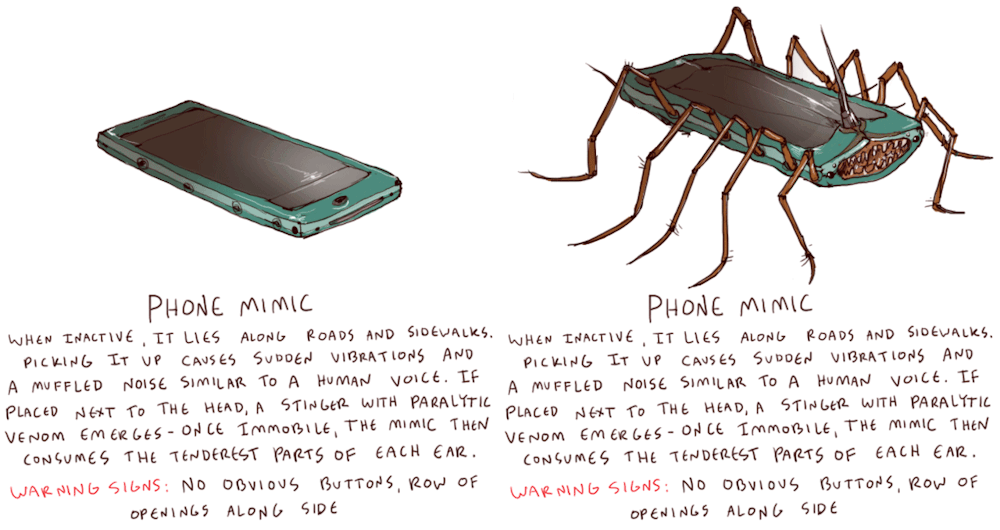
Modern Mimics

image
by iguanamouth (more rad art in the link!)

"Watch out! It's right behind you!"

"Where, in the dumpster?"

"No, it is the dumpster!"

Mimics are anxiety in monstrous form. It's not paranoia if everything you touch really could be out to get you. Keep a stack of post-its on hand for labeling things you know aren't mimics. Trust nothing. Trust no one.

Mimics only have near-perfect mimicry. Sometimes, they slip up; sometimes, they leave traces. Roll the tell before they discover the mimic. Bigger and older mimics may have no tells at all, but ensure that players have some sort of countermeasure against them - it's not just an instant kill when they open it, that's no fun.

Mimic Tells
1. breathing slowly
2. bulging at seams
3. droppings in surroundings
4. fetid stench
5. holes underneath for limbs
6. making the wrong sounds
7. mirrored/illegible writing
8. moving parts don't move
9. part of another form
10. ridges for eyes
11. warm air
12. wound leaking ichor


21st Century Mimics

Pizza box. In supernatural suburbia, pizza eats you! Sneaks into trunks of delivery cars, devours a pizza, then replaces it. The delivery driver doesn't know what doom they're bringing to your door (but it smells delicious).

1 HD. Armor as leather. d8 damage bite attack.

Email. The most dangerous chain letter. Open it up, and it'll try to eat your data, then your brain.

1 HD. Armor as leather (or more, if it's on a chunkier device). Animates the device it's on, giving it legs and teeth. If you can delete it (easier said than done when it's trying to chomp on your hands), you instantly kill it. Can bite for d6 piercing damage, or static discharge for d4 lightning damage to everything within 10'. Any electronic device that can receive/display email must save or receive a copy of the email mimic.

Trash can. Subsists on a diet of possums, raccoons, squirrels, and dumpster-divers. Leaves an acidic trail behind it that exudes a noxious stench of decaying flesh. The closest thing to a normal treasure-chest mimic you'll find in the city. Each has a designated hunting ground; fights heard in alleyways are occasionally a pair of trash can mimics fighting for dominance.

2 HD. Armor as leather. 2 attacks per round (any combination of tentacles (d6 bludgeoning, save or grabbed, 15' range), bites (d8 piercing), and lobbing a wad of sludge (60' range, d6 acid, 10' radius detonation, sticky - targets are slowed (save ends)). Gets a free bite attack against everyone it's got grabbed.

Corpse. Poor fucker, but looks rich enough to have something juicy on it. When you try to loot it, it splits open lengthwise into a toothy maw. Speaks in a genteel human voice. Will morph back into humanoid form and run once reduced to half HP - and the PCs are gonna look like they're attacking a hapless bystander. Likes hiding in dumpsters, car trunks, rivers.

2 HD. Armor as leather. 2 attacks per round (any combination of tentacles (d6 bludgeoning, save or grabbed, 15' range) and bites (d8 piercing). Gets a free bite attack against everyone it's got grabbed.

Sidewalk. Step on a crack, it'll break your back and then digest you. Attacks at night, when there's no one else around. Spans d4*10 sidewalk tiles. Looks like a centipede made of concrete and sinew when it fully reveals itself. Hunts in packs; often an entire street has been colonized by sidewalk mimics.

2 HD. Armor as chain. 2 attacks per round (any combination of smashes (d6 bludgeoning, save vs. knockdown) and bites (d8 piercing)). Runs at double speed, can climb walls and ceilings.

Grand piano. Attacks when played. The strings within whip into a frenzy; anyone within 15' takes 1 slashing damage on their turn (no save) and must save or take another 1 when they try to move within that radius. It snaps its lid to bite, and charges far faster than its bulk would suggest. Kept half-domesticated by the rich, powerful, and guilty.

3 HD. Armor as chain. 3 attacks per round (any combination of strings (d6 slashing, 15' range), bites (d8 piercing), and charges (d6 bludgeoning, target chooses to either be pushed 10' or be knocked down)).

Streetlamp. Like an anglerfish. Exudes a clinging supernatural darkness within 100'. Can't move from its rooted foundation without great effort. Grabs travelers walking along the highway, or victims of car accidents.

3 HD. Armor as chain. 2 attacks (bite (d6 piercing and save vs. grab), lash (d6 bludgeoning and save vs. knockdown to all in 180 degree arc; range 30') or blinding beam (target is blinded (save ends)) per round. Will retract into sky and drop grabbed targets from 30' up.

Taxi. Waits to pick you up on the corner. Tinted windows. Can perfectly mimic human voices. Interior looks like a worn taxicab with distressingly human leather interiors. The front seat is occupied by a lump of misshapen eyes, teeth, flesh, and tendrils. When someone enters, the mimic reveals itself (as the entire taxicab) and tries to eat them.

4 HD. Armor as plate. Will try to run over characters as it moves (d12 damage, DEX save to jump out of the way). Has 3 tentacle attacks per round (d6 bludgeoning damage and save vs. grab) OR 1 tentacle attack and a move. Anyone it grabs, it will pull inside the following round. Anyone inside takes d6 piercing damage and d4 acid damage per round as they are chewed and digested.

Structural Mimics

The two following mimics have grown fat and vast over decades; slowly becoming entire buildings. Do you know what every building in your city is? Have you ever really looked at the skyline? Could you truly tell if that one was where it was yesterday?

Kill a structural mimic through defacing its component rooms (hammers, spray paint, and fire are your friends here), or by destroying its vital organs.


Gas Station. Convenient. Local. Hungry. Does actually provide gas, occasionally. Full-service; go inside to pay. That's when it gets you.

2 vital rooms. When destroyed, it convulses, spewing gouts of flame through cracks in the parking lot. Everyone within takes d10 fire damage (save for half).
Heart is in basement (see ambnz's post), stairs down are behind the counter.
Brain is on the roof, encased in what looks like an AC unit.
3 attacks per round. Within parking lot, can spread gasoline in 10' square puddles, then set it on fire. Inside or adjacent to building, tentacle lash to grab (d6 bludgeoning and save vs. sticky grab) and bite anyone who's been grabbed for d8 piercing (save for half).

Skyscraper. Ostensibly an insurance company, but no one knows anyone who works there or has a plan from them. Who would, these days? It's just another cog of the unfeeling, uncaring corporate machine. Some people still venture inside - urban explorers, lost tourists, people walking around late at night who need to get in from the cold. They're never seen again.

4 vital rooms. Elevators still work, against all odds, though they'll still try to eat you.
Brain in penthouse.
Heart in sub-basement.
Lungs on ground floor. Blows characters out of room, or slams them against walls.
Stomach in building core, in middle of elevator shafts. Constantly sloshes with incredibly corrosive acid; need armor or a hazard suit to even think about entering (and it'll ablate quickly).
When it's down to 2 vital rooms, will stand up and sprint down city streets in mad dash to eat as much as it can before it dies.
Inside, riddled with parasites. Carrion crawlers, smaller mimics, ropers, rust monsters, etc.
Has 4 attacks per round. Tentacles and bites against grappled enemies (you know the drill at this point in the post), or room convulsion to knock everyone in the room over (save negates).

Monday, December 23, 2019

Secret Santicorn 2019: The Shellcraze

So every December, the OSR Discord runs a Secret Santa where we all throw in our names, a quick prompt, and get someone's prompt to fulfill. This was my first Secret Santicorn, and I hope I've delivered! ambnz's response to my prompt was fantastic, and can be found here: Skyscraper Mimics

semiurge requested the following: The latest fashion craze (refer to: tulip mania, ostrich feather boom) has made an unusual and inconvenient-to-get commodity into a valuable treasure (while it lasts). What is the commodity? What are the lengths people must go to get it? Who stands to lose the most when the market crashes? And so on and so on"

I'm setting this in the Meatropolis because it could always use more development! And it seems to be compelling enough that others won't mind.


The hatcheries of Ogoath's many wombs bear bitter, mutant fruit. Turtletomas, stillborn or soon-to-die, shatter their eggsacs and plummet into the benighted abyss of stars. Some are plain, pallid, twisted things. Others have shells that shine like gems: brilliant, cold, vibrant, twinkling. It is the latter that now possess the attentions of the idle nutrient-rich of the Meatropolis's fleshcrafter houses. This season's fashion trend is turtletoma gem-shell, and it adorns every eligible heir's clothes to a dazzling degree.

Gem-shell is worn in jewelry, or as charms, or bracers, or studded into flesh. Cloaks are woven out of thinly pounded castoff dust; the odd fully-intact shell forms a pauldron or even is worn alone. A minor heir may have teeth replaced with shell, or fake eyes, or horns. A fleshcraft liege these days goes nowhere without a full assortment of shell trinkets like stained glass, in their house's ancestral colors. They jingle as they walk. The louder the better, so as to alert the masses that their better approaches.

Living turtletomas grow scarce these days. The shellcraze has driven hundreds of enterprising adventurers to the hatcheries, and Ogoath's corpse can no longer bear young. While millions of eggs in every stage of development form great walls of eggsac, adventurers are tenacious and endlessly inventive. They crack the shells by the dozen, extracting the stillborn fetal turtletomas and checking their shells for rare patterns. Most are discarded; perhaps 1 in a hundred is worth bringing to market. The few that resist are made short work of, like clubbing seal pups in aeons past.

There were people in the hatcheries long before the shellcraze. Turtle-breeders and turtle-riders in villages of eggshell, caring for the few hatchlings they found and nursing them to health. Some have decided to capitalize on the new trend, flash-growing and mutating strains into ever-brighter patterns - even custom-growing them to nobles' specifications. Of course, this has led to a cottage industry of stealing and sabotaging each others' designer turtletomas, and adventurers are always looking for more work. This has started to destabilize the strains, however, and many have made this their entire business. When the shellcraze ends, they'll be ruined. And the rampant experimentation with mutations and new patterns is hard to control - new, dangerous mutations aren't uncommon with such quick work.

Patterns
1. Bladed; while plain it's sharp around the edges to the point where you could use it as a combat discus.
2. Bloodsoaked. The stains won't come out. It keeps leaking, as the marrow inside continues to pump even after death.
3. Fractal pattern (d4 for which: 1. mandelbrot, 2. julia, 3. sierpinski triangles, 4. koch snowflake)
4. Furred, the turtletoma's shell mutated to be covered in a layer of incredibly soft hair.
5. Gridded (flip a coin for whether it's hex or square)
6. Jagged and broken, a confusing dissonance of bright clashing colors
7. Map of the Old World
8. Metallic sheen (d6 for metal: 1. gold, 2. silver, 3. copper, 4. platinum, 5. mirrored, 6. cobalt); while it's not actually metal, it happens to be magnetic
9. Pareidolium; the features on the shell resolve into a snarling mortal face - it may look like someone important...
10. Piped, like an organ. When wind passes through, it produces dissonant tones.
11. Rocky and speckled like granite.
12. Single gem, to be cut and polished (d8 for which: 1. diamond, 2. ruby, 3. emerald, 4. sapphire, 5. topaz, 6. opal, 7. smoky quartz, 8. amethyst)
13. Snakeskin
14. Solid matte color
15. Spotted with polka-dots like a ladybug's carapace
16. Stained-glass mural depicting an event from the turtle's genetic memory
17. Starry, a void filled with a swirl of shining pinpricks that gleam with an inner light
18. Striped between d6 colors
19. Unadorned bone. Sometimes simplicity is elegance.
20. Words and letters cover the shell in a bizarre script. Translated, it may carry secrets, or hidden magics.

The shellcraze has given rise to other nascent trends. Shellomancy, divining someone's future from the shells they wear and how they catch the light of a burning turtlefat candle, casting undulating shadows on the wall. Counterfeit shells, fleshcrafted from whatever spare bone lies around, and a variety of "professionals" who purport to tell the different between the fakes and the real thing (often, they run a thriving counterfeit shop on the side). Defrauding the nutrient-rich has always been a favorite pastime of the Meatropolis, and every new fashion is merely a new coat of paint for every old scam.

Everything ends. The shellcraze is no exception, as greater terrors rise. The hatcheries are an ecosystem, even in death. The half-formed spirits of the millions dead animate swarms of corpses into hurricanes of cheap shell and turtleflesh. Hydratomas break free of deeper eggs, seeking the newly-liberated food with their under-developed clusters of eyes and snapping beaks-within-beaks. Scores of adventurers plummet to their deaths before the day's harvest is done, and soon only the luckiest and most well-prepared survive. Shell spirals in rarity to the point where even the rich dare not bother with it - they've moved on to artisanal custom-grown masses of grey matter.

Monday, December 16, 2019

Wizards Die Messily


Wizards aren't stable. I think this post speaks for itself pretty well; magical catastrophes are a staple of the arcane arts and there's so many different ways for things to go wrong that are more interesting than "rocks fall, everyone dies". Not all the explosion effects kill - but all of them will do something nasty.

Reasons a Wizard (or Warlock, or Sorcerer, or Witch, etc) Might Explode
1. Angered the gods
2. Ascended to the astral plane
3. Ate something funny
4. Bred two spells together that hate each other
5. Captured a spell that overwhelmed their brain
6. Cast a Wish spell and fucked up
7. Died with too many spells in their brain
8. Failed a save (pick a save, any save)
9. Lost a wizard duel
10. Orgasmed
11. Patron wants to punish them
12. Purposely triggered it just to see what happens
13. Read the spellbook backwards
14. Research gone horribly wrong
15. Ritual components were wrong
16. Rolled quadruples on casting a spell
17. Someone walked up behind them and shouted "Boo!"
18. Spell mutated too many times
19. Tried to channel too much power
20. Tried to finagle the laws of magic

d66 Ways a Wizard Explodes
11. Angelic Ascension. The wizard shines with inner divine light and ascends to become a terrifying angelic figure, growing more eyes and wings out of every pore. Save or fall to your knees singing hymns; everyone who witnesses the event is now part of a religion whether they like it or not. They'll be held to the same demands and standards as everyone else who follows that deity.
12. Birdsplosion. Everything that isn't animate for d10*10' around the wizard turns into a bird and flocks to attack people in the area (thanks, Hitchcock!). The swarm as a whole has like 5 HD, takes up a [radius] area, and gets to attack everyone in the radius once each turn. It can fly around at the speed of birds.
13. Bismuth. The wizard crystallizes and metastasizes. Oily rectangular rainbows of sharpened bismuth cut through the air itself, rooting themselves into the ground and everyone within d10*10'. 2d6 piercing damage (save for half) and pinned to the spot. Removing the bismuth that's pierced through you is going to be a challenge.
14. Bloodsplosion. Everyone within d10*10' is soaked in scalding blood (d6 fire damage, no save) as the wizard is violently exsanguinated. Anything bloodborne is contracted (no save). The wizard instantly drops to as near-death as the system you're using allows. Everything's soaked through in blood, destroying all papers and writing. You can't get the blood out of any items affected, no matter how hard you try.
15. Bone Rebellion. The skeleton war has come and you're ground zero. d20 of each bone-haver within d10*100's bones squirm their way out of their body and assemble into a great bone golem with 1 HD for each person exboneguinated. It wants the rest of your bones, and gains another hit die for every human-sized person it kills and exboneguinates. Can cast Debone once per round.
16. Cancer. The wizard's flesh boils and ruptures, reduplicating explosively to encompass a d10*100' sphere. Save to run. If you fail, you are engulfed in pulsing flesh that crushes inwards for d6 bludgeoning damage each round until someone can free you. The wizard takes 1 Stress every time their new horrible flesh is cut at, though they lose no hit points. They can try to control it by making Charisma tests, though if they fail it will act against their wishes.

21. Chain Detonation. Everything within d10*10' explodes in shrapnel, taking 3d6 damage. Everything destroyed this way deals 2d6 damage to everything within the same radius of it. Continue, decreasing the number of d6 each time until you run out of d6s.
22. Clonesplosion. Everyone within d10*10' is cloned d3 times. Each clone is d6. (1. evil, 2. more good than the PC, 3. different race, 4. different class, 5. different appearance, 6. roll twice).
23. Compulsive Murder. For everyone within d10*100' for d20 days, to gain the benefits of a rest you must murder someone.
24. Dataclysm. All information within d10*100' is wiped. Lose all backstory, name, XP, and return to level 1. You no longer know why you are here or what you are doing or who your allies are. All books and other methods of information storage are wiped as well.
25. Dinosaur. Summon a tyrannosaurus rex from 65 million years ago. You have saved it from certain death; it responds with the only thing it knows - hunger. It's basically a walking, feathery, dragon, so stat it up as such. It will eat, cronch, and swallow you whole. Armor is no match for a mouthful of six-inch enamel knives. The unfortunate wizard begins in its jaws.
26. Ennui. Everyone within d10*100' feels an inescapable wave of existential "why bother"? Charisma save to take additional actions past the first one - this applies to rounds, exploration turns, hexcrawling, etc. Wears off when you succeed your third Charisma save this way.

31. Escher Explosion. Each opening within a d10*1000' radius now leads to a different, random opening within the space (can be outside the radius). This includes pouches, but not orifices. If two openings have a size difference, anything passing through is rescaled accordingly.
32. Everyone Reincarnates. Make new level 1 characters. Randomly roll for everything; don't get equipment. They wake up in the bloody shreds of each previous character.
33. Everyone's a Wizard Now. The wizard collapses into a pile of robes and teeth. Everyone in the vicinity now has a chunk of the wizard's magical power and a corresponding little copy of the wizard's mind in their head. It'll chime in with bad advice, but you have 1 MD and can cast one spell the wizard used to know.
34. Flesh-Eating Bacteria. Everyone within d10*10' contracts a bad case of incredibly contagious and virulent flesh-eating bacteria on a random area of their body. Save each round or take d6 necrotic damage. It ends once the bacteria are removed or you succeed three times. Anyone you touch contracts it too (no save).
35. Fountain of Youth. The wizard transmutes into a well of antitemporal thaumatic energy, reversing the age of everything within d10*10' by d20 years. Things reduced to 0 or fewer years of age undisintegrate, never having existed. Touching the well after the initial burst of energy ages you by d20-10 years the first time (so +/- 10 years); each additional time roll an additional d20 and subtract an additional 10. The well lasts for years equal to the wizard's age at time of explosion.
36. Fusion. Everything within d10*10' must save or be fused into a horrifying monstrosity. The wizard doesn't get a save. Each round, everyone in the monstrosity gets to collectively vote either democracy or anarchy.  If democracy wins, a plurality of minds get to choose what they do, and if there is no plurality then nothing happens. If anarchy wins, everyone must come to a unanimous consensus within 1 minute or the turn is allocated randomly to one mind of the monstrosity.

41. God Says No. The effect that caused the explosion stops. The wizard stops. Everyone within d10*100' stops. A voice informs you, loudly and politely, that what you've done is not allowed. Time is rewound to before you considered doing such a thing, and that effect is no longer possible.
42. Gun. The wizard is transmuted into a random legendary gun (see Vault Hunter rules here) and becomes its onboard machine-spirit. It must kill something every day to remain intelligent.
43. Lightning! A massive lightning strike obliterates the wizard (4d6 lightning damage, no save) and scars everyone nearby (2d6 lightning damage within d10*10', save for half). Metal objects are charged with static electricity and remain so for the next 24 hours, attracting or repelling other metal objects (50% chance of each) as well as discharging when touched with bare skin (1 lightning damage).
44. Magic Dead Zone. d10*100' radius sphere becomes an anti-magic zone. Magical creatures, items, and effects persist for 10 minutes in the zone before disintegrating.
45. Mindbomb. Everyone randomly passes their character sheet to another character (including NPCs, hirelings, monsters, etc).
46. Miniature Sun. For 10 minutes, the wizard shines with the light of a sun. This magically leaves the wizard unharmed, but melts everything on their body. This also blinds permanently and deals 4d6 radiation damage to everyone within 10', blinds save ends and deals 3d6 damage within 100', and save vs. blinding (save ends) and deals 2d6 damage within 1000'.

51. Mutations! Everyone within d10*100' rolls d100s on the mutation table until they roll a positive mutation (they get all the mutations they roll).
52. Paintbomb. Roll 8 times on the Esoteric Colors table. Each cardinal direction is soaked in one of those colors for a d10*10' long cone. The wizard is coated in all 8.
53. Seeking Spores. The wizard's body sprouts with fungus that reaches for everyone within d10*100'. The spores are paralytic (save negates) and will grow rapidly once they encounter biomass. This weighs you down by 1 inventory slot, doubling every round until you're immobilized. Then you start taking damage as they crush you (d6 bludgeoning per round). The spores can be neutralized with fire, water, acid, etc - but there's lots of them, and growing fungi will release more spores.
54. Spellified. As a 4-die Spellify, applied to everyone within d10*100' of the wizard (they end up in the wizard's brain). They can interact in the wizard's mindscape (see Cavegirl's Astral Projection rules for how this might look).
55. Tear Open a Portal in Time. A d10*10' radius circle below the wizard becomes a portal in time to a random prehistoric era and everyone in the circle falls through. It lasts for 1 hour.
56. Teleport. Find the nearest thing that passes for a map in your campaign; whether it's the dungeon map, city map, region hex-map, world map... or sketch something quick. Then, throw a dart at it (drop a pencil if you don't have darts on hand). Everyone in the party teleports there.

61. There's a Crater Here Now! It's d10*1000' in radius. Good job. Everyone gets shunted to the outside and saves vs. being pulped by the air friction.
62. Transmuted into X. The wizard and everyone within d10*10' must save or become a random substance. Roll on the periodic table of elements, or a substance table of choice (see Mimics and Miscreants' spells section for mine). Dispel magic effects can return transmuted characters to their flesh-and-blood state.
63. Tunguska Event. Everything in a d10*1000' radius falls inwards. Save to remain standing. Stuff will fall on the characters; more saves as appropriate. The wizard, at the nexus of this shockwave, implodes for 6d6 bludgeoning damage (save for half).
64. Turn To Moon. Save vs. blindness as the wizard turns into a great orb of marble and ascends to the heavens. This absolutely obliterates anything in its path. You may save to jump off the new moon; if you succeed, roll a d10 to figure out how many d6s of falling damage you take. If you fail, you have about a minute of oxygen in your lungs. Make it count.
65. Uncontrollable Cackling. Everyone within d10*100' starts laughing uncontrollably. Save vs. suffocation, then unconsciousness, then 1d6 bludgeoning damage per round as your skeleton starts to shake apart with the force of your mirth. Passing a save ceases the cackling.
66. Vacuum. A d10*100' radius sphere around the wizard becomes airless for 10 minutes. Even the air in your lungs disappears. Every action in the bubble, without air, also requires a save vs. unconsciousness. You can survive 3 minutes without air in your lungs before irreversible brain damage. Good luck.

Most Recent Post

Mothership: Alternative Trauma Responses

My current weekly drop-in game of Mothership: Gradient Descent is now twelve sessions and thirteen characters deep. The extant four (or six,...